Perimenopause Symptoms: What Fits and What Else to Check
Changing periods, hot flashes, sleep problems, and mood shifts can occur in perimenopause, but the pattern and severity of each change matter.
Periods that come sooner or later, become lighter or heavier, or occasionally don’t arrive can be part of perimenopause. Hot flashes, night sweats, sleep disruption, mood changes, vaginal dryness, and urinary symptoms can occur too.8 None of these changes proves the cause on its own. Bleeding that disrupts your life, bleeding between periods or after sex, and new bleeding after menopause deserve particular attention.12
Period changes: expected variation or a reason to look closer?
One of the first noticeable changes in perimenopause is often your period pattern. Periods may arrive more or less often, and the bleeding may become lighter or heavier. Symptoms don’t follow one fixed order: hot flashes may come and go, while vaginal dryness or other symptoms may continue after periods stop.8
An irregular cycle isn’t automatically a problem, but it isn’t automatically perimenopause either. Changing contraception can disturb your usual cycle pattern. Heavy bleeding can also have other causes, including fibroids, adenomyosis, endometriosis, and some medicines.23 If a period is heavier than your usual, the useful question is how much it has changed and what else is happening with it.
For example, changing a pad or tampon every one to two hours or bleeding for more than seven days are signs that a period may be heavy. They aren’t, by themselves, the full rule for when to seek care. Arrange an assessment if heavy periods are affecting your life, you have severe period pain, or you bleed between periods or after sex. Feeling tired or short of breath alongside heavy bleeding matters too, because an assessment may include checking for iron-deficiency anemia.2
There’s an important distinction once periods have ended. For women over 45, menopause is usually identified after more than a year without a period. If you’re in that situation, any new vaginal bleeding, even a little spotting or pink or brown discharge, needs assessment. It’s often not serious, but occasionally signals a condition that needs treatment.1
Heat, sleep, and mood can feed into one another
Hot flashes and night sweats can occur during perimenopause. A night sweat may wake you; poor sleep can then leave you feeling irritable, anxious, or less able to concentrate the next day. Low mood, depression, memory complaints, and what many people call brain fog can also occur during the transition.8 That connection is useful, but it doesn’t mean every mood or concentration change is caused by hormones.
Sleep is a good example of why the details matter. Hot flashes and reproductive-hormone changes are associated with sleep problems, but they don’t explain every case. Insomnia, obstructive sleep apnea, and restless legs syndrome are among the sleep disorders considered in women during the menopause transition.56 If sleep problems keep affecting your days, especially when night sweats don’t seem to explain the awakenings, it’s worth discussing sleep itself rather than treating it only as a menopause symptom.56 Low mood can also occur during the transition without establishing perimenopause as its cause.8
Physical symptoms need their own context
Vaginal dryness and changes in urination can occur around menopause. You may notice more frequent urination or symptoms that feel like a urinary tract infection, including burning when you pee.8 Burning when you pee can resemble a UTI; the symptom alone cannot identify a hormone change as its cause.8 If burning is new or keeps happening, ask about checking for a UTI rather than assuming it’s hormonal. If dryness is the main concern, options discussed in menopause guidance include nonhormonal moisturizers or lubricants and vaginal estrogen.7
Headaches also deserve a closer look at their pattern. Migraine can occur around a period, and changing hormone levels are linked with menstrual migraine. Many women who have menstrual migraine also have attacks at other times.3 If you get menstrual migraines, a period-related pattern is useful information to discuss with a GP; treatment may help.3 Research reviews also describe migraine and sleep disturbance as overlapping concerns during perimenopause.4
The most helpful way to sort these changes is to ask what’s new for you. A cycle change alongside newly frequent hot flashes fits a different picture from isolated heavy bleeding, persistent low mood, or burning when you pee. Heavy periods that affect your life, severe period pain, or bleeding between periods or after sex are reasons to seek assessment. So is any new vaginal bleeding if you’re over 45 and have gone more than a year without a period, even when other symptoms seem to fit perimenopause.12
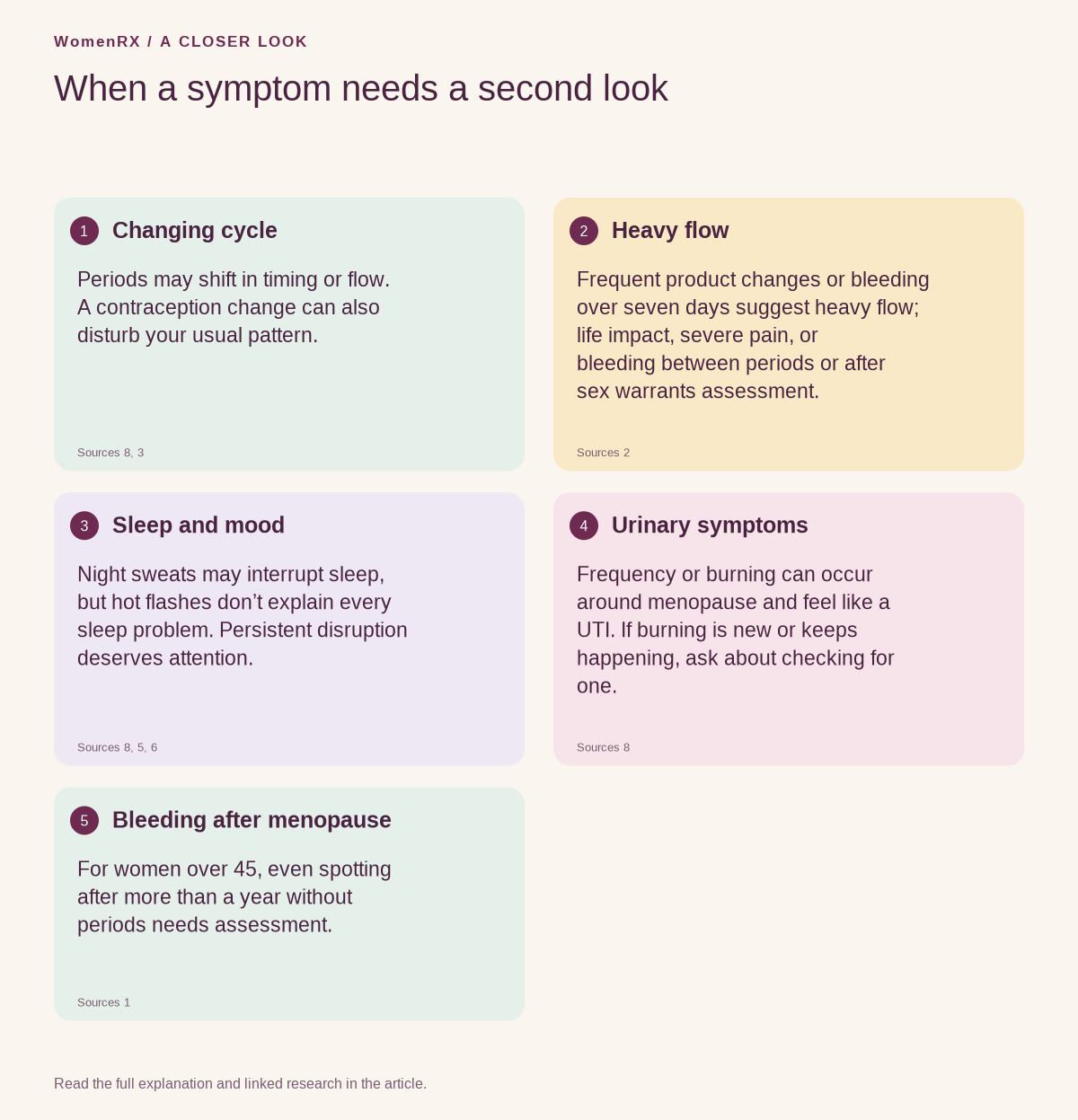
When a symptom needs a second look
Changing cycle: Periods may shift in timing or flow. A contraception change can also disturb your usual pattern.83
Heavy flow: Frequent product changes or bleeding over seven days suggest heavy flow; life impact, severe pain, or bleeding between periods or after sex warrants assessment.2
Sleep and mood: Night sweats may interrupt sleep, but hot flashes don’t explain every sleep problem. Persistent disruption deserves attention.856
Urinary symptoms: Frequency or burning can occur around menopause and feel like a UTI. If burning is new or keeps happening, ask about checking for one.8
Bleeding after menopause: For women over 45, even spotting after more than a year without periods needs assessment.1
Read the figure as text
These distinctions show which changes may fit perimenopause, which have other possible causes, and which bleeding patterns call for assessment.- Changing cycle: Periods may shift in timing or flow. A contraception change can also disturb your usual pattern.83
- Heavy flow: Frequent product changes or bleeding over seven days suggest heavy flow; life impact, severe pain, or bleeding between periods or after sex warrants assessment.2
- Sleep and mood: Night sweats may interrupt sleep, but hot flashes don’t explain every sleep problem. Persistent disruption deserves attention.856
- Urinary symptoms: Frequency or burning can occur around menopause and feel like a UTI. If burning is new or keeps happening, ask about checking for one.8
- Bleeding after menopause: For women over 45, even spotting after more than a year without periods needs assessment.1
More questions, answered
Can hormonal contraception make my period pattern harder to interpret?
Yes. A change in contraception can disturb your cycle, and menopause guidance does not use the usual 12-month period rule in the same way for someone using hormonal contraception. Tell your clinician what method you use when discussing new bleeding or missed periods.37
Sources you can check
- Postmenopausal bleeding - NHSAccessed 2026-09-25Return to first citation
- Heavy periods - NHSAccessed 2026-09-25Return to first citation
- Period problems - NHSAccessed 2026-09-25Return to first citation
- The integration of migraine and sleep disturbance in perimenopause: a narrative review.Heale R, Tait C. · Menopause (New York, N.Y.) · 2026Return to first citation
- Sleep Disruption in the Menopausal Transition and Postmenopause: A Narrative Review.Lyu AC, Kravitz HM. · Obstetrics and gynecology · 2026Return to first citation
- Sleep disturbance and menopause.Carmona NE, Solomon NL, Adams KE. · Current opinion in obstetrics & gynecology · 2025Return to first citation
- Recommendations | Menopause: identification and management | Guidance | NICEAccessed 2026-09-25Return to first citation
- Symptoms of menopause and perimenopause - NHSAccessed 2026-09-25Return to first citation