Perimenopause Symptoms: What Fits and What Needs a Closer Look
Changing periods, hot flashes, sleep disruption, and mood shifts can occur during perimenopause, but the pattern matters more than any symptom count.
Periods that come more or less often, with lighter or heavier bleeding, are a common early sign of perimenopause. Hot flashes, night sweats, sleep problems, and mood changes may also occur. Symptoms vary, and a new symptom isn’t automatically hormonal. Bleeding between periods or after sex, heavy bleeding that affects your life, and any bleeding after 12 months without a period deserve medical review. 81
There’s no useful master list of 100 perimenopause symptoms. The better question is whether your changes form a recognizable pattern, and whether anything in that pattern needs attention for another reason. Some women have symptoms that disrupt work, sleep, or relationships; others have hardly any. 8
Start with what’s happening to your periods
A change in periods is often one of the first signs of perimenopause. They may come more often or less often, and the bleeding may be lighter or heavier than you’re used to. Eventually, periods stop. Menopause is defined after 12 months without a period; bleeding after that point is postmenopausal bleeding and needs to be checked. 8
That range doesn’t mean every bleeding change is simply perimenopause. For example, a period that arrives less predictably is different from bleeding between periods or after sex. Arrange a medical review for either of those, for severe period pain, or for heavy periods that affect daily life. If you’re changing a pad or tampon every one to two hours, that’s a concrete sign of heavy flow worth raising, especially if you also feel tired or short of breath. 1
Heavy bleeding near menopause can reflect changing ovarian function, but fibroids, polyps, and other conditions can also contribute. A clinician may consider pregnancy, thyroid problems, or iron deficiency in selected cases, alongside an assessment of the bleeding itself. Heavy menstrual bleeding that causes anemia needs prompt treatment. If heavy periods affect your daily life or you often feel short of breath, discuss these symptoms with a clinician. 71
Notice the heat-and-sleep connection
Hot flashes and night sweats are recognizable menopause-transition symptoms, but you don’t have to have them to be in perimenopause. Sleep trouble can also show up as difficulty falling asleep or staying asleep. Night sweats may make it worse, and poor sleep can leave you feeling irritable, stressed, or anxious the next day. 38
That connection is useful when you’re trying to make sense of several changes at once. If you wake sweaty and then struggle to get back to sleep, the daytime exhaustion may have a partly different explanation than exhaustion without disrupted sleep. Neither pattern, on its own, identifies the cause. In an international app survey, fatigue and exhaustion were frequently reported by women aged 35 and older, but a symptom survey cannot establish that perimenopause caused each report. 4
Take mood and thinking changes seriously, without assuming one cause
Irritability, anxiety, low mood, and a sense of mental exhaustion may occur during the transition. In one app-based comparison of women aged 35 and older, participants who identified as perimenopausal reported more of these psychological symptoms than those who identified as premenopausal. The groups also differed in average age, so the finding helps describe an association, not diagnose the cause of an individual woman’s symptoms. 5
Some women also describe forgetfulness or “brain fog.” Research on cognition during the transition is still developing: one study found a difference in a measure of learning efficiency when perimenopausal participants were compared with reproductive and postmenopausal participants, but it did not find a difference between early and late perimenopause in self-reported memory complaints or objective test performance. A new memory concern is real even when its cause isn’t obvious. 86
Don’t write off persistent low mood as hormones. Depression can involve depressed mood or loss of interest that affects daily life for at least two weeks, and it can make sleeping, eating, or working difficult. Seek help for those changes. If you’re thinking about hurting yourself, get help right away; call 911 if you’re in immediate danger. 2
Consider vaginal, urinary, and other changes in context
Vaginal dryness, a lower sex drive, urinary symptoms, joint pain, and dry or itchy skin can occur around menopause; some symptoms, including vaginal dryness and joint pain, may continue afterward. These are worth bringing up when they affect comfort or daily life, even if your periods are still changing. 8
A burning feeling when you pee or needing to pee more often can also feel like a urinary tract infection. Because similar sensations can have different causes, don’t assume a new or bothersome urinary symptom is just perimenopause. Likewise, weight gain, digestive trouble, or fatigue alone won’t tell you where you are in the transition. These symptoms appear in menopause guidance or symptom surveys, but they’re not a reliable way to label every new health change as hormonal. 84
The most useful distinction is practical: changing cycles and familiar symptom clusters can give you a reason to consider perimenopause, while unusual bleeding, symptoms affecting daily life, or symptoms that persist without a clear explanation give you a reason to look further. You don’t need to settle the label before asking for help. 817
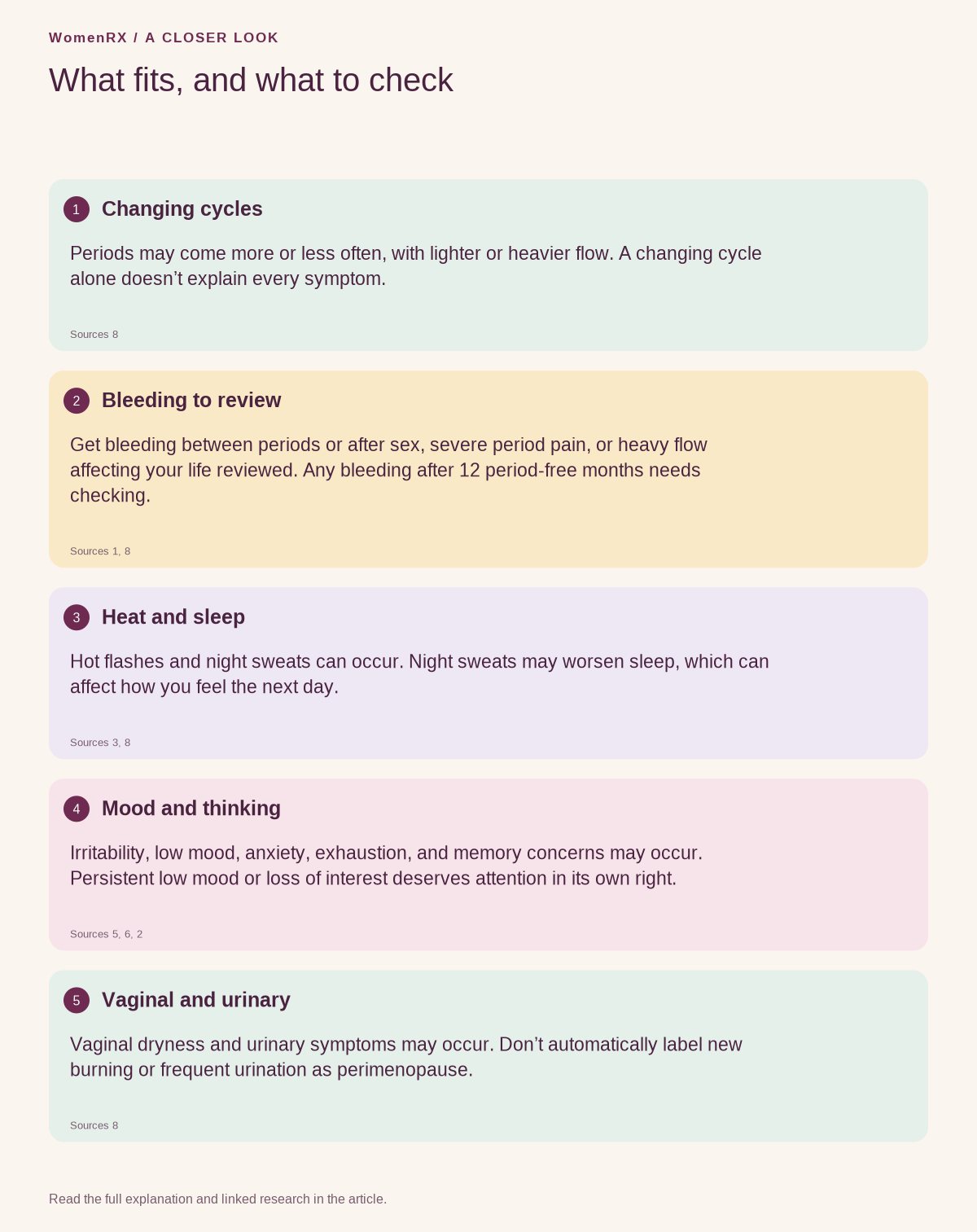
What fits, and what to check
Changing cycles: Periods may come more or less often, with lighter or heavier flow. A changing cycle alone doesn’t explain every symptom.8
Bleeding to review: Get bleeding between periods or after sex, severe period pain, or heavy flow affecting your life reviewed. Any bleeding after 12 period-free months needs checking.18
Heat and sleep: Hot flashes and night sweats can occur. Night sweats may worsen sleep, which can affect how you feel the next day.38
Mood and thinking: Irritability, low mood, anxiety, exhaustion, and memory concerns may occur. Persistent low mood or loss of interest deserves attention in its own right.562
Vaginal and urinary: Vaginal dryness and urinary symptoms may occur. Don’t automatically label new burning or frequent urination as perimenopause.8
Read the figure as text
Use these symptom groups to distinguish changes that can occur around perimenopause from bleeding that needs medical review. This is not a diagnostic score.- Changing cycles: Periods may come more or less often, with lighter or heavier flow. A changing cycle alone doesn’t explain every symptom.8
- Bleeding to review: Get bleeding between periods or after sex, severe period pain, or heavy flow affecting your life reviewed. Any bleeding after 12 period-free months needs checking.18
- Heat and sleep: Hot flashes and night sweats can occur. Night sweats may worsen sleep, which can affect how you feel the next day.38
- Mood and thinking: Irritability, low mood, anxiety, exhaustion, and memory concerns may occur. Persistent low mood or loss of interest deserves attention in its own right.562
- Vaginal and urinary: Vaginal dryness and urinary symptoms may occur. Don’t automatically label new burning or frequent urination as perimenopause.8
More questions, answered
Can I be in perimenopause without hot flashes?
Yes. Some women have few symptoms, and a change in periods is often an early sign. Hot flashes aren’t required to recognize that your cycle may be changing. 8
Can birth control make perimenopause harder to recognize?
Yes. Hormonal contraception can change bleeding patterns or stop periods, making periods a less useful clue. Pregnancy is still possible during perimenopause. 8
Sources you can check
- Heavy periods - NHSAccessed 2026-09-25Return to first citation
- Depression: MedlinePlusAccessed 2026-09-25Return to first citation
- Other medicines for menopause symptoms - NHSAccessed 2026-09-25Return to first citation
- Global perspectives on perimenopause: a digital survey of knowledge and symptoms using the Flo application.Hedges MS, Hewings-Martin Y, Karam J, Castaneda R, Cunningham AC, Xu Y, Zhaunova L, Faubion SS, Shufelt CL. · Menopause (New York, N.Y.) · 2026Return to first citation
- Psychological symptoms during perimenopause: a global perspective.Cunningham AC, Hedges MS, Hewings-Martin Y, Castaneda R, Karam J, Zhaunova L, Faubion SS, Shufelt CL. · Menopause (New York, N.Y.) · 2026Return to first citation
- Subjective cognition and objective cognitive performance in early versus late perimenopause.Furey RT, Zhu C, Li Q, Gurvich C. · Journal of clinical and experimental neuropsychology · 2026Return to first citation
- Perimenopausal abnormal uterine bleeding.Dreisler E, Frandsen CS, Ulrich L. · Maturitas · 2024Return to first citation
- Symptoms of menopause and perimenopause - NHSAccessed 2026-09-25Return to first citation