Menopause Symptoms: What Fits, and What Needs a Closer Look
Some changes are closely linked with menopause, while symptoms like fatigue can have several explanations.
Hot flashes and night sweats are recognized menopause-related vasomotor symptoms, and menopause can also involve genitourinary changes, sleep difficulties, mood symptoms, and aches. But a symptom list can’t tell you what’s causing a change in your own body. Fatigue is a good example: it can accompany menopause-related sleep disruption, but it can also have other causes. Regular soaking night sweats or very heavy bleeding deserve assessment.
A symptom list is a starting point, not an explanation
Menopause symptom lists often combine changes that are closely associated with the transition and symptoms that can arise for many reasons. Research reviews describe hot flashes and night sweats, genitourinary changes, sleep difficulties, mood symptoms, fatigue, and musculoskeletal complaints among symptoms reported around menopause. That breadth can be useful for recognizing patterns, but seeing a symptom on a list doesn’t establish its cause. 4 6 7
A more useful question than “How many symptoms do I have?” is “What kind of change is this, when does it happen, and what else could explain it?” Perimenopause and postmenopause can both be times when changes occur, but more than one cause may be in play.
Changes with a clearer menopause link
Hot flashes and night sweats are vasomotor symptoms associated with the menopause transition. A review of population-based studies found that vasomotor symptoms were common among perimenopausal and postmenopausal women, though estimates varied substantially across studies and regions. That makes them a recognizable pattern, not a test that can confirm the cause of every episode of sweating. 4
Genitourinary symptoms are another recognized menopause-related group. The North American Menopause Society describes genitourinary syndrome of menopause as a treatment-relevant condition, distinct from vasomotor symptoms. If you have persistent genitourinary concerns, it’s reasonable to discuss them as their own symptom group rather than assuming they’re simply part of a long general list. 8
Periods can also become irregular just before menopause. A change in cycle pattern can fit the transition, but that doesn’t mean every change in bleeding should automatically be attributed to it. 3
Symptoms that need more context
Sleep problems, mood symptoms, fatigue, and aches are also reported during menopause. They matter, but they are less useful as stand-alone clues because the symptom itself doesn’t identify its cause. 6 7
Fatigue shows why the distinction matters. Menopause-related night sweats may disrupt sleep, and hot flashes and night sweats are associated with poorer sleep. But fatigue can also be related to insufficient sleep, sleep disorders, anemia, thyroid disease, depression, anxiety, medication effects, and other health conditions. If tiredness lasts for weeks or is interfering with daily life, don’t assume menopause is the whole explanation. 2 5
The same principle applies to a symptom that feels new, keeps worsening, or doesn’t follow the pattern you recognize. Menopause may be part of the picture; the symptom list alone can’t rule other explanations in or out.
When not to write a change off
Regular night sweats that soak your clothes or bedding are worth getting checked, especially if they come with fever or chills, cough, diarrhea, or unexplained weight loss. Night sweats can have causes besides menopause, including anxiety, alcohol or drug use, hyperhidrosis, and some medicines. 1
Heavy bleeding also deserves attention rather than an automatic “it’s just perimenopause” explanation. One practical sign of heavy periods is needing to change a pad or tampon every one to two hours. 3
For other symptoms, consider the pattern and impact: Is it persistent? Is it getting worse? Is it affecting everyday activities? Those details can help frame a useful conversation about whether menopause fits, whether another cause needs attention, or whether both may be contributing.
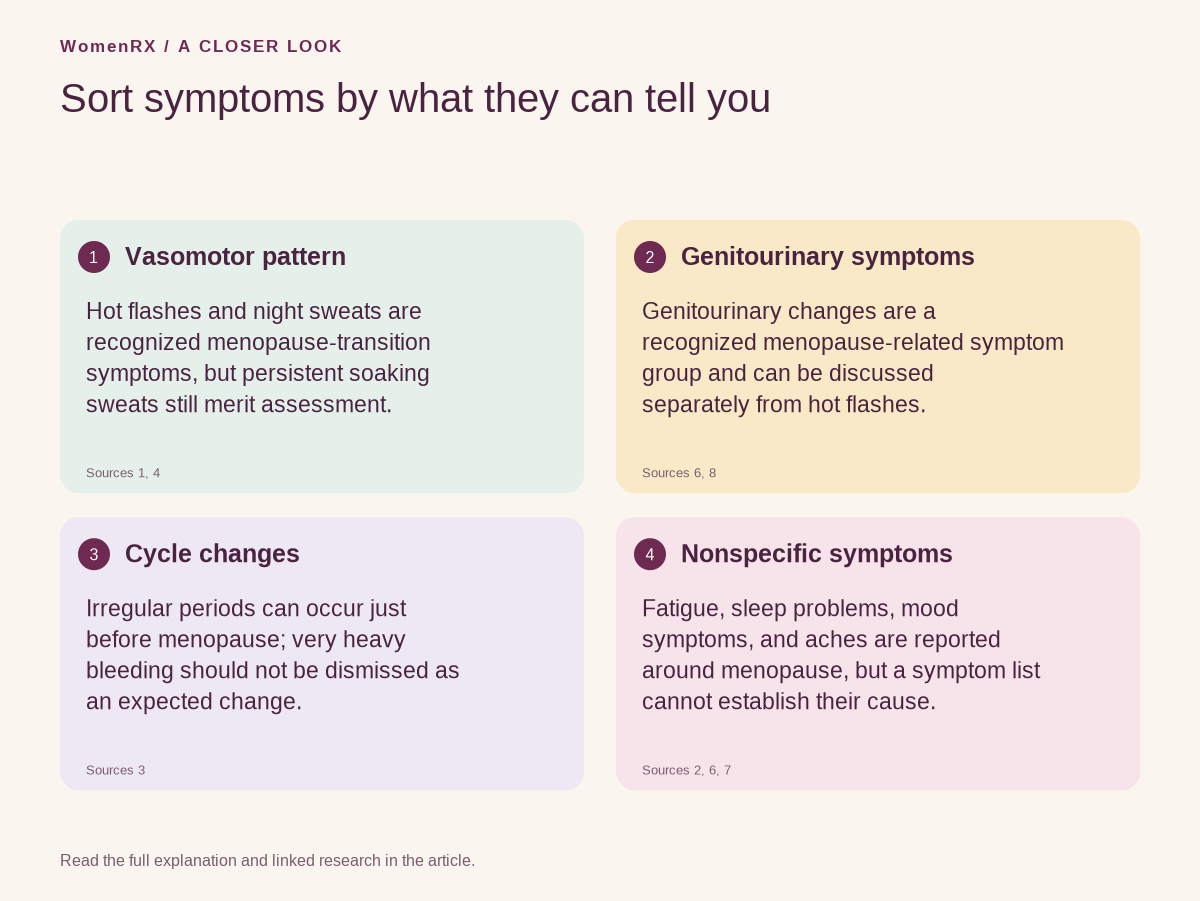
Sort symptoms by what they can tell you
Vasomotor pattern: Hot flashes and night sweats are recognized menopause-transition symptoms, but persistent soaking sweats still merit assessment.14
Genitourinary symptoms: Genitourinary changes are a recognized menopause-related symptom group and can be discussed separately from hot flashes.68
Cycle changes: Irregular periods can occur just before menopause; very heavy bleeding should not be dismissed as an expected change.3
Nonspecific symptoms: Fatigue, sleep problems, mood symptoms, and aches are reported around menopause, but a symptom list cannot establish their cause.267
Read the figure as text
These categories distinguish recognizable menopause-associated patterns from symptoms that need more context. None can diagnose the cause on its own.- Vasomotor pattern: Hot flashes and night sweats are recognized menopause-transition symptoms, but persistent soaking sweats still merit assessment.14
- Genitourinary symptoms: Genitourinary changes are a recognized menopause-related symptom group and can be discussed separately from hot flashes.68
- Cycle changes: Irregular periods can occur just before menopause; very heavy bleeding should not be dismissed as an expected change.3
- Nonspecific symptoms: Fatigue, sleep problems, mood symptoms, and aches are reported around menopause, but a symptom list cannot establish their cause.267
More questions, answered
Can menopause cause fatigue?
Fatigue is reported among menopause-related symptoms, and vasomotor symptoms are associated with poorer sleep. But fatigue also has many other possible causes, including anemia, thyroid disease, sleep disorders, depression, and medication effects. Persistent fatigue is worth assessing rather than attributing to menopause by default. 2 5 6
Are irregular periods always a sign of perimenopause?
Irregular periods can be common just before menopause, but a cycle change by itself doesn’t establish its cause. Heavy bleeding, such as needing to change a pad or tampon every one to two hours, should not simply be written off as a transition symptom. 3
Sources you can check
- Night sweats - NHSAccessed 2026-09-25Return to first citation
- Fatigue: MedlinePlusAccessed 2026-09-25Return to first citation
- Period problems - NHSAccessed 2026-09-25Return to first citation
- Global prevalence of vasomotor symptoms in the menopause transition: systematic review and meta-analysis.Ellahi SA, Spector A, Talaulikar V, Faulkner A, Desai R. · Climacteric : the journal of the International Menopause Society · 2026Return to first citation
- Effect of physical activity on sleep in women experiencing vasomotor symptoms during menopause: a systematic review and meta-analysis.Corrêa AB, Bardella MDC, da Silva AP, Moreira MM, Leite LFPA, de Moraes C. · Maturitas · 2025Return to first citation
- The effectiveness of psychosocial interventions on physiological symptoms of menopause: a systematic review and meta-analysis.Robinson K, Hardy R, Melville M, Saidel S, Desai R, Spector A. · BMC women's health · 2026Return to first citation
- Estradiol transdermal spray for menopausal symptom management: From RCT to real-world evidence.Hirschberg AL, Stute P, Águas F, Fait T, Polo-Kantola P, Amorim FG, Rézette I, Hadji P. · Maturitas · 2026Return to first citation
- The 2022 hormone therapy position statement of The North American Menopause Society.“The 2022 Hormone Therapy Position Statement of The North American Menopause Society” Advisory Panel. · Menopause (New York, N.Y.) · 2022Return to first citation