Perimenopause and Autoimmune Disease: What Needs a Closer Look?
Hot flashes, poor sleep, pain, and fatigue can overlap with other health changes, so the most useful question is what’s new for you and your condition.
Perimenopause can bring changing periods, hot flashes, sleep difficulties, and muscle or joint pain. Autoimmune symptoms can also come and go, and their pattern depends on the condition. Descriptions of these symptoms do not establish a rule for telling perimenopause and autoimmune activity apart. Bring new or worsening symptoms, especially changes in an area your autoimmune condition affects, to a clinical review rather than assuming hormones or a flare are responsible. 631
Why the overlap feels confusing
Perimenopause is the transition leading up to menopause. Changes in estrogen and progesterone can accompany changes in your menstrual cycle and symptoms such as hot flashes, mood changes, and vaginal dryness. Sleep difficulties and muscle or joint pain can also be part of the menopause picture. 763
An autoimmune condition follows its own course. Symptoms depend on which organs or tissues it affects, and they may worsen for a time and then improve. Redness, swelling, warmth, and pain can occur with inflammation, but other illnesses can cause those symptoms too. Perimenopause does not give every autoimmune symptom a hormonal explanation, and a new symptom does not, by itself, establish a flare. 1
The useful distinction is between recognizing an overlap and deciding what caused it. You can often describe the first yourself. The second may require an assessment tailored to your particular condition.
Put the change in context, not in a category
If you wake sweaty after a sudden wave of heat, that’s worth describing as a possible hot flash, particularly if your periods are changing. Hot flashes and night sweats are recognized menopause symptoms. But that pattern alone cannot tell you whether another problem is also present. 63
Pain needs similar care. Muscle and joint pain can accompany perimenopause. If you have rheumatoid arthritis, for example, joints are also among the areas your condition can affect. Tell your care team about new joint symptoms, including any swelling or warmth you can observe. Those details matter to a review; they are not a home test for a flare. 61
Fatigue is especially hard to sort by feel. Interrupted sleep may leave you tired, but fatigue can also have causes such as anemia, thyroid disease, infection, pain, medication effects, or another sleep disorder. If it lasts for weeks or is interfering with your usual activities, make time for a review rather than treating it as an inevitable part of perimenopause. 2
A change in periods adds context, not a verdict. Perimenopause commonly involves menstrual changes, but bleeding dates cannot determine whether pain, fatigue, or other symptoms reflect autoimmune activity. If you note when symptoms and bleeding occur, use those notes to describe what has changed, not to label the cause yourself. 67
What makes a review more useful
Start with the change that prompted your concern: what you feel, what you can observe, when it began, and how it affects your day. Say whether it resembles a symptom you’ve had before, without assuming that a familiar symptom has the same cause this time. Because autoimmune diseases can affect very different parts of the body, your diagnosis and usual pattern are more useful to the clinician assessing you than a generic list of “flare symptoms.” 1
Include sleep changes, menstrual changes, and any recent changes in medicines or supplements. This is particularly relevant if you’re considering something marketed for menopause: evidence for many supplements is mixed, long-term safety information is limited, and some can interact with medicines. The right interaction check depends on the actual products and treatments you take. 7
You can also ask for help with a menopause symptom without settling the autoimmune question first. Menopause-specific cognitive behavioral therapy is an evidence-supported nonhormone option for bothersome hot flashes and night sweats, with research also finding improvements in sleep outcomes. Hormone therapy is the most effective treatment for vasomotor symptoms, but its benefits and risks are individualized. Neither approach should be mistaken for an assessment or treatment of autoimmune disease activity. 354
The bottom line is practical: describe the pattern, take persistent or worsening changes seriously, and let the review address both possibilities. The symptoms described here overlap, but these clinical descriptions do not provide a tested rule for separating perimenopause from autoimmune disease activity. 163
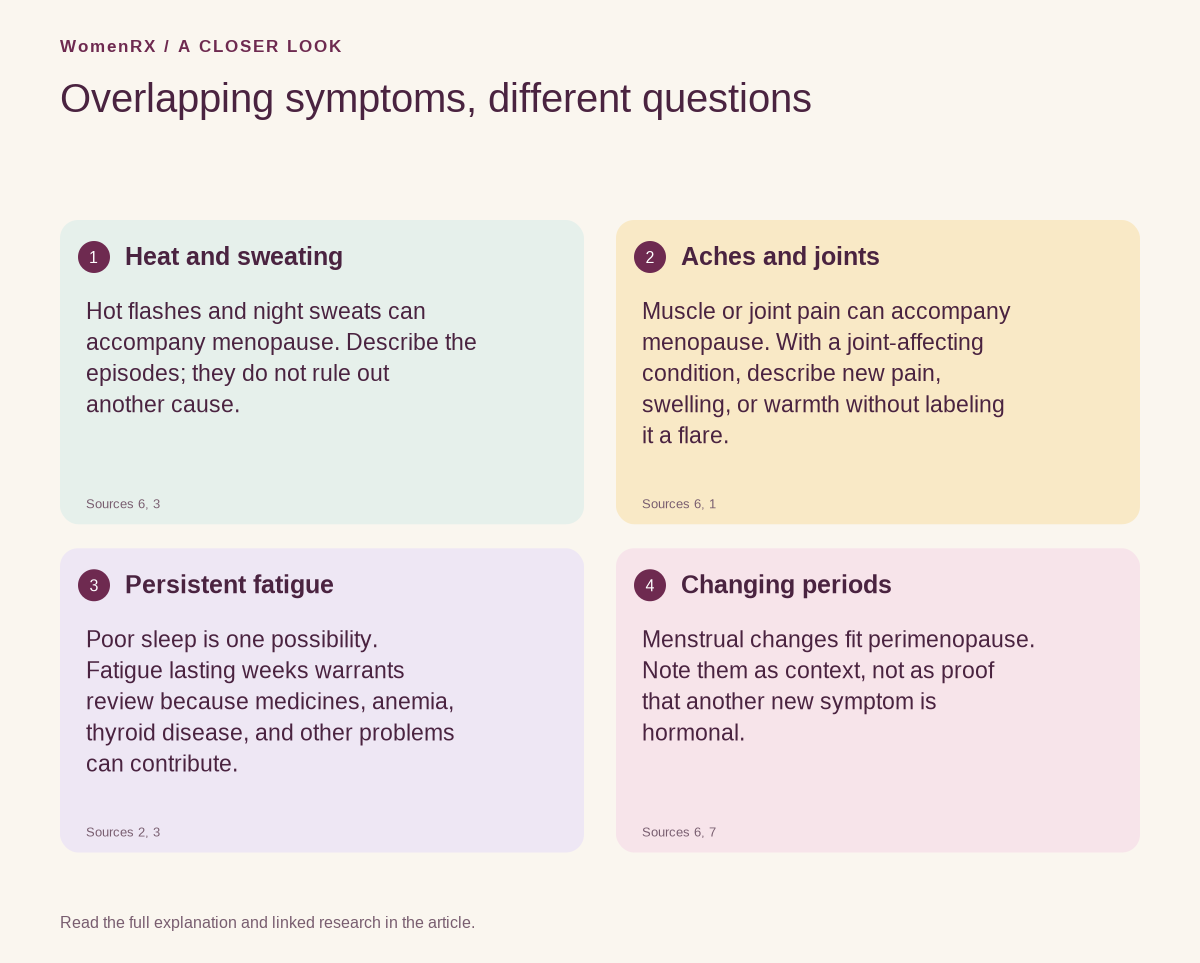
Overlapping symptoms, different questions
Heat and sweating: Hot flashes and night sweats can accompany menopause. Describe the episodes; they do not rule out another cause.63
Aches and joints: Muscle or joint pain can accompany menopause. With a joint-affecting condition, describe new pain, swelling, or warmth without labeling it a flare.61
Persistent fatigue: Poor sleep is one possibility. Fatigue lasting weeks warrants review because medicines, anemia, thyroid disease, and other problems can contribute.23
Changing periods: Menstrual changes fit perimenopause. Note them as context, not as proof that another new symptom is hormonal.67
Read the figure as text
These comparisons help you describe a change without treating the symptom as a diagnosis.- Heat and sweating: Hot flashes and night sweats can accompany menopause. Describe the episodes; they do not rule out another cause.63
- Aches and joints: Muscle or joint pain can accompany menopause. With a joint-affecting condition, describe new pain, swelling, or warmth without labeling it a flare.61
- Persistent fatigue: Poor sleep is one possibility. Fatigue lasting weeks warrants review because medicines, anemia, thyroid disease, and other problems can contribute.23
- Changing periods: Menstrual changes fit perimenopause. Note them as context, not as proof that another new symptom is hormonal.67
More questions, answered
How should I interpret worsening symptoms during perimenopause?
Autoimmune symptoms depend on the tissues affected and can come and go. Perimenopause can bring symptoms and menstrual changes of its own. If something changes, have it assessed in the context of your condition rather than assuming hormones caused a flare. 16
Sources you can check
- Autoimmune Diseases | Autoimmune Disease Symptoms | MedlinePlusAccessed 2026-09-25Return to first citation
- Fatigue: MedlinePlusAccessed 2026-09-25Return to first citation
- The effectiveness of psychosocial interventions on physiological symptoms of menopause: a systematic review and meta-analysis.Robinson K, Hardy R, Melville M, Saidel S, Desai R, Spector A. · BMC women's health · 2026Return to first citation
- The 2022 hormone therapy position statement of The North American Menopause Society.“The 2022 Hormone Therapy Position Statement of The North American Menopause Society” Advisory Panel. · Menopause (New York, N.Y.) · 2022Return to first citation
- The 2023 nonhormone therapy position statement of The North American Menopause Society.Menopause (New York, N.Y.) · 2023Return to first citation
- Recommendations | Menopause: identification and management | Guidance | NICEAccessed 2026-09-25Return to first citation
- Menopause | Menopause Symptoms | MedlinePlusAccessed 2026-09-25Return to first citation