Autoimmune Disease Sex Differences Are Real, but Varied
Women make up a larger share of people with several autoimmune diseases, but the size and meaning of that difference depend on the condition and the study.
Several autoimmune diseases, including lupus, autoimmune thyroid disease, and Sjögren’s disease, are diagnosed more often in women. The pattern varies by condition: in one German primary-care study, men were the larger share of diagnosed patients with type 1 diabetes and ankylosing spondylitis. A group statistic can’t tell you your personal risk, likely severity, age at onset, or treatment response. 1 3
The pattern changes from one condition to another
Autoimmune diseases are a broad group, not one illness with one sex pattern. In a study of people diagnosed with one or more of 11 autoimmune diseases in German primary care, women accounted for 86.0% of patients with lupus, 85.1% with autoimmune thyroiditis, 79.7% with Graves’ disease, and 77.2% with Sjögren’s syndrome. In the same dataset, men made up 59.1% of patients with type 1 diabetes and 55.6% with ankylosing spondylitis. These figures describe who was in that diagnosed patient group, not the chance that any woman or man in the general population will develop each disease. 3
A separate meta-analysis looked at causes of uveitis, an inflammation inside the eye, in specialist cohorts. Among those studies, uveitis linked to lupus and multiple sclerosis was more frequent in female patients, while uveitis associated with Behçet’s disease and ankylosing spondylitis was more frequent in male patients. That’s a comparison among people with uveitis, not a measure of how common those underlying diseases are across the population. 2
So the useful takeaway isn’t that autoimmune illness is simply “a women’s problem.” Many types are more common in women, but the direction and size of the difference depend on the diagnosis and on how researchers counted cases. 1 2 3
A share of patients isn’t your personal risk
A statistic such as “86% of patients were women” is a description of a group already diagnosed. It doesn’t mean an individual woman has an 86% chance of getting the disease. To estimate personal risk, researchers need population-level rates, with a defined population and time period, not just the sex mix in a clinic or patient registry.
The setting matters, too. The German study drew on primary-care records, while the uveitis analysis combined studies from specialist settings in several regions. A population survey in northwest China reported celiac disease prevalence of 1.39% among female participants and 0.44% among male participants. Those figures apply to that survey’s location and population, not automatically to the United States. 2 3 5
These different kinds of numbers answer different questions: who appears in a diagnosed group, whether a condition is more common in a particular surveyed population, or which causes are more frequent within a specialist group. They shouldn’t be treated as interchangeable.
Prevalence doesn’t settle questions about severity or treatment
Being more likely to be diagnosed with a condition doesn’t necessarily mean having a more severe course or responding differently to treatment. Those are separate research questions. A review reports higher prevalence of autoimmune thyroid disease in women. It also describes more advanced and aggressive thyroid disease in men, but doesn’t make clear whether that finding applies specifically to autoimmune thyroid disease. It therefore doesn’t establish a sex difference in severity for autoimmune thyroid disease. 4
These findings don’t provide a consistent comparison of age at onset or treatment response across the selected conditions. One 2025 primary-care study did examine a different outcome: among people with lupus, 30.2% of women and 25.4% of men had at least one additional autoimmune disease; among people with Sjögren’s syndrome, the figures were 31.6% and 20.7%. That is a difference in co-occurring diagnoses in this dataset, not a measure of disease severity or treatment success. 3
Biology may contribute, but it isn’t one settled explanation
Researchers are studying several possible contributors to sex differences, including sex hormones, immune-system activity, genes on the X chromosome, and environmental factors. A review describes these as interacting areas of investigation, rather than establishing one explanation that accounts for every disease. 6
There’s also a limit to what the cited findings say about sex and gender. Their female-versus-male comparisons don’t establish differences by gender identity or hormonal status. Nor do they establish how risk compares across menstrual cycles, pregnancy, postpartum, perimenopause, and postmenopause. A group-level difference shouldn’t be read as proof that a particular hormone or life stage caused someone’s condition. 2 3 6
For an individual, the diagnosis and its own evidence matter more than a broad sex pattern. The differences are useful for understanding population research, but they can’t predict on their own who will develop an autoimmune disease or how it will affect them.
What the sex differences measure
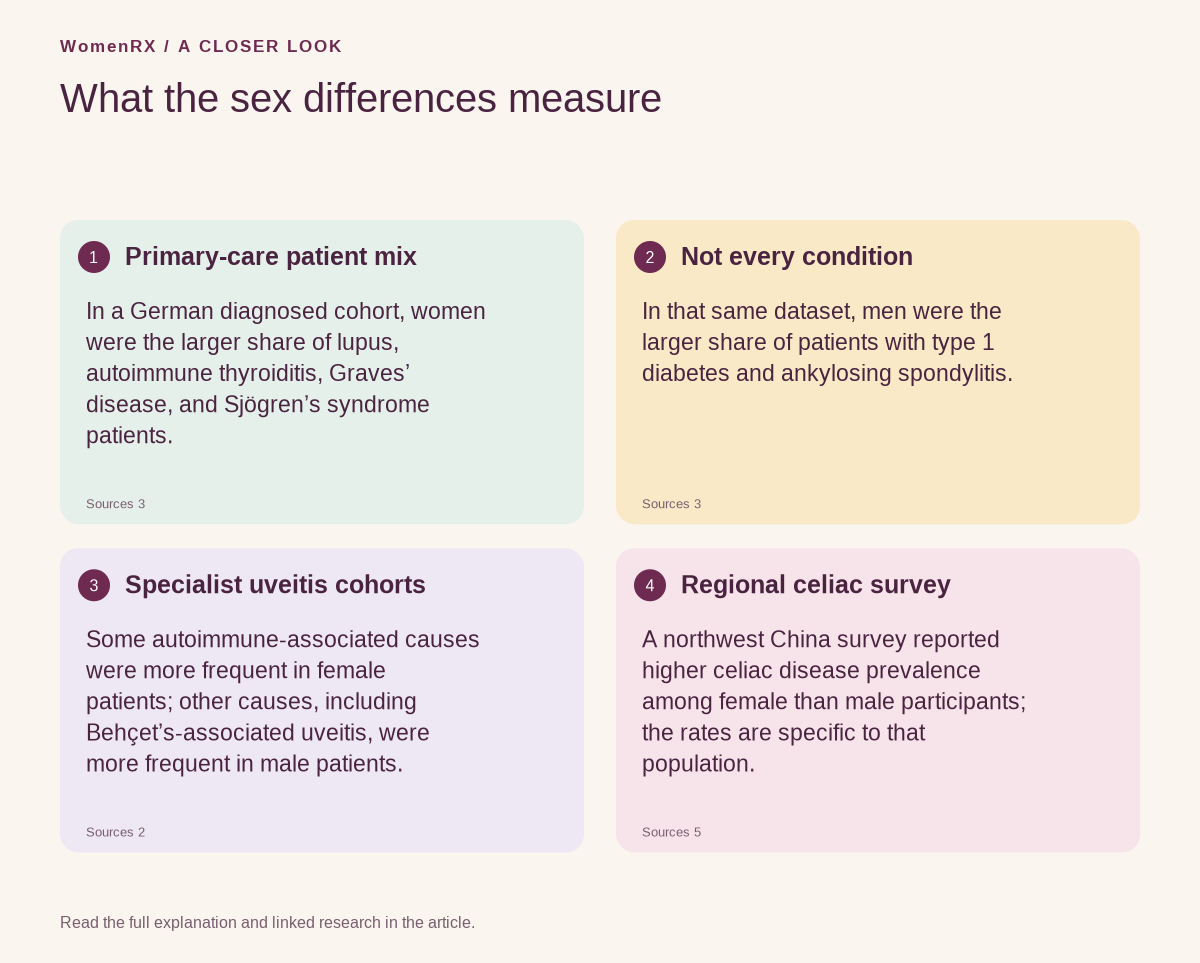
Primary-care patient mix: In a German diagnosed cohort, women were the larger share of lupus, autoimmune thyroiditis, Graves’ disease, and Sjögren’s syndrome patients.3
Not every condition: In that same dataset, men were the larger share of patients with type 1 diabetes and ankylosing spondylitis.3
Specialist uveitis cohorts: Some autoimmune-associated causes were more frequent in female patients; other causes, including Behçet’s-associated uveitis, were more frequent in male patients.2
Regional celiac survey: A northwest China survey reported higher celiac disease prevalence among female than male participants; the rates are specific to that population.5
Read the figure as text
These findings come from different populations and answer different questions. The comparison keeps diagnosed-group proportions separate from prevalence and specialist-cohort patterns.- Primary-care patient mix: In a German diagnosed cohort, women were the larger share of lupus, autoimmune thyroiditis, Graves’ disease, and Sjögren’s syndrome patients.3
- Not every condition: In that same dataset, men were the larger share of patients with type 1 diabetes and ankylosing spondylitis.3
- Specialist uveitis cohorts: Some autoimmune-associated causes were more frequent in female patients; other causes, including Behçet’s-associated uveitis, were more frequent in male patients.2
- Regional celiac survey: A northwest China survey reported higher celiac disease prevalence among female than male participants; the rates are specific to that population.5
More questions, answered
Does being a woman mean I’m more likely to have more than one autoimmune disease?
Some studies find that women with certain autoimmune conditions are more likely than men in the same condition group to have another autoimmune diagnosis. In one German primary-care study, this difference appeared for lupus and Sjögren’s syndrome. It’s a group-level association, not a prediction that any one person will develop another condition. 3
Do these findings show that menopause changes autoimmune disease risk?
No. The cited findings don’t establish a comparison of risk by menopausal stage or hormonal status. Researchers are investigating hormones as one possible contributor to sex differences, but that doesn’t show how menopause affects an individual’s risk. 3 6
Sources you can check
- Autoimmune Diseases | Autoimmune Disease Symptoms | MedlinePlusAccessed 2026-09-25Return to first citation
- Sex Differences in Uveitis Etiology: A Systematic Review and Meta-Analysis.Liba T, Bibi E, Lior Gorodetsky M, Sommer A, Gorenshtein A, Mekiten O, Megreli J, Machlis Y, Segal O. · Ocular immunology and inflammation · 2026Return to first citation
- Sex Differences in Autoimmune Multimorbidity Across Eleven Disorders: A Real-World Primary Care Study in Germany.Kostev K, Kaur N, Höfle J, Konrad M, Hammed A, Tanislav C, Rodemer I. · Medicina (Kaunas, Lithuania) · 2025Return to first citation
- Sex differences in thyroid function: from central regulation to hormone metabolism and disease susceptibility.Faria CC, Correa da Costa VM, Ferreira ACF, Fortunato RS, Carvalho DP. · The Journal of endocrinology · 2026Return to first citation
- Prevalence of celiac disease among permanent residents in Northwest China: A cross-sectional survey.Shi T, Xue S, Feng Y, Liu W, Li T, Li N, Aihemaijiang K, Huang X, Yao S, Hui W, Jiang Q, Gao F. · Scientific reports · 2026Return to first citation
- Sex matters: mechanistic insights into sex-driven patterns of autoimmunity and implications for pharmacotherapy.Guedes MS, Yildiz D. · Naunyn-Schmiedeberg's archives of pharmacology · 2026Return to first citation