PCOS Phenotypes Describe Differences, but These Comparisons Do Not Establish Future Risk
Two people can meet PCOS diagnostic criteria through different combinations of features. The cited group comparisons do not show whether a phenotype label predicts either person's future health.
PCOS phenotypes are names for the different ways someone can have at least two of three diagnostic features: disrupted ovulation, excess androgen activity, and polycystic ovarian morphology. You don't need all three, or even an ovarian finding, to meet the adult criteria. The label describes which features are present. The cited metabolic studies do not establish whether it predicts your future health, and reported treatment differences by phenotype remain exploratory.347
Why your PCOS might look different
If someone else's PCOS involves irregular periods and unwanted facial hair while yours was first noticed on an ovarian scan, neither experience has to be the template for yours. PCOS symptoms vary, and some people have few symptoms until they seek help with getting pregnant.1 The difference may also reflect which diagnostic features each person has. A phenotype is a shorthand for that combination, not a measure of how seriously to take your concerns.
Three features, four qualifying combinations
The adult Rotterdam approach uses three features: disrupted ovulation, which may show up as irregular or absent periods; clinical or biochemical signs of excess androgen activity; and polycystic ovarian morphology, an ovarian finding assessed by ultrasound or, in adults, sometimes by an anti-Müllerian hormone (AMH) result. At least two features are needed. There is no single specific test for PCOS, and an ovarian finding isn't required if the other two features are present.16 An ordinary fluid-filled ovarian cyst and the ovarian morphology used in PCOS classification should not be treated as interchangeable findings.26
The two-of-three criteria allow four qualifying feature combinations: all three; disrupted ovulation with androgen excess; androgen excess with ovarian morphology; or disrupted ovulation with ovarian morphology. These combinations are listed without assigning a phenotype letter to each. Researchers describe four Rotterdam phenotypes, labeled A through D. A, B and C are identified as hyperandrogenic, while D is non-hyperandrogenic.46 For example, someone with irregular periods and signs of androgen excess may meet the adult criteria even if an ovarian scan doesn't show polycystic morphology. Someone with androgen excess and polycystic morphology may meet them without having irregular periods. The combinations clarify what was found, rather than ranking one person's symptoms against another's.16
Not every diagnostic framework draws the boundary in the same place. The Rotterdam approach includes phenotype D, while frameworks that require androgen excess do not. A review of diagnostic approaches also notes that criteria requiring both androgen excess and ovulatory disruption exclude C and D.6 So if you see different descriptions of who “has PCOS,” first check which criteria they use.
What phenotype studies can and cannot tell you about health
A feature combination can organize a diagnosis, but the cited studies do not establish whether it sorts people by future health risk. In an Italian multicenter registry of 1,314 reproductive-age women with PCOS, the four Rotterdam phenotypes did not differ significantly in the prevalence of the metabolic complications studied, including glucose intolerance and abnormal blood lipids. BMI categories distinguished those measured complications more clearly in that cohort.7 That doesn't make BMI a complete assessment of health, or mean everyone with the same BMI has the same risk. In this cohort, phenotype letters did not distinguish the measured metabolic complications.
Other findings add nuance rather than overturning that point. A cross-sectional study of 343 people with PCOS found that the relationship between measured body-fat percentage and certain blood lipids differed by phenotype.3 Both studies describe measurements at a point in time; neither tells you what will happen to an individual years later.37 The useful distinction is between features that describe you now and measurements that assess a particular concern now. Your periods, androgen-related symptoms, glucose results and lipid results answer different questions. A phenotype letter cannot replace them.17
Nor does the letter settle a treatment choice. In a prospective study of 207 women receiving fertility treatment, differences between letrozole and clomiphene varied across groups, but clinicians chose the treatment rather than randomly assigning it. The authors called the phenotype subgroup findings exploratory and said randomized trials are needed to confirm them.4 If pregnancy is your concern, the combination of findings is useful context, not a treatment rule.4
Age and testing can change the picture
PCOS can become apparent around the first period or later.1 But the four-category research described above concerns adults or reproductive-age women; it does not establish how well those labels apply to an adolescent's early period pattern or ovarian findings.457
Interpretation can also change during later reproductive life. AMH, which may be used to assess the ovarian-morphology feature in adults, naturally declines with age, and its results vary across laboratory assays.6 The meaning of an AMH result therefore depends in part on age and assay; a phenotype letter alone does not capture either.6 Even within an adult study, changing the ultrasound follicle-count threshold moved some participants into a different phenotype or out of a PCOS diagnosis; the study involved 342 Asian-Indian women aged 21 to 38 at a referral center, so its figures shouldn't be assumed to apply to everyone.5
If your results seem inconsistent with someone else's, the most useful question is not “Which type is worse?” It's “Which two or three features support my diagnosis, how were they assessed, and which of my current concerns needs its own assessment?” That keeps the label in its proper role: a description of a pattern, not a verdict on your health or fertility.147
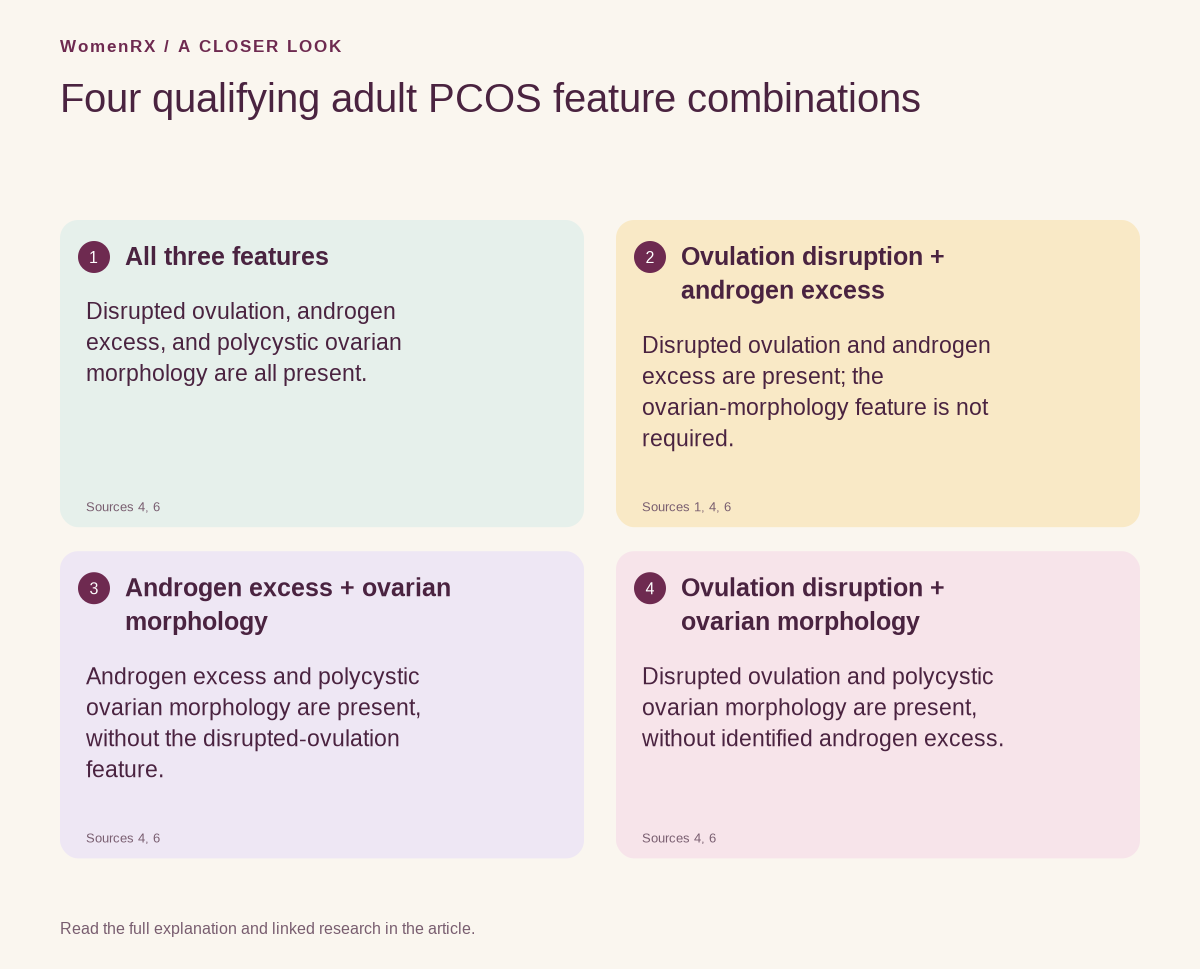
Four qualifying adult PCOS feature combinations
All three features: Disrupted ovulation, androgen excess, and polycystic ovarian morphology are all present.46
Ovulation disruption + androgen excess: Disrupted ovulation and androgen excess are present; the ovarian-morphology feature is not required.146
Androgen excess + ovarian morphology: Androgen excess and polycystic ovarian morphology are present, without the disrupted-ovulation feature.46
Ovulation disruption + ovarian morphology: Disrupted ovulation and polycystic ovarian morphology are present, without identified androgen excess.46
Read the figure as text
At least two of three features can meet the adult Rotterdam criteria. These combinations are shown without A to D phenotype labels. They describe features, not future health.- All three features: Disrupted ovulation, androgen excess, and polycystic ovarian morphology are all present.46
- Ovulation disruption + androgen excess: Disrupted ovulation and androgen excess are present; the ovarian-morphology feature is not required.146
- Androgen excess + ovarian morphology: Androgen excess and polycystic ovarian morphology are present, without the disrupted-ovulation feature.46
- Ovulation disruption + ovarian morphology: Disrupted ovulation and polycystic ovarian morphology are present, without identified androgen excess.46
More questions, answered
Can I have PCOS without polycystic ovarian morphology?
Yes. Under the two-of-three adult approach, disrupted ovulation plus androgen excess can meet the feature combination without polycystic ovarian morphology. The ovarian-morphology feature is not needed for that combination.16
Does phenotype D mean I have no metabolic concerns?
No. D means androgen excess was not identified as one of the diagnostic features; it doesn't describe all aspects of your health. In a reproductive-age PCOS registry, the four phenotype groups did not differ significantly in the prevalence of the metabolic complications studied.7
Sources you can check
- PCOS | Polycystic Ovary Syndrome | MedlinePlusAccessed 2026-09-25Return to first citation
- Ovarian Cysts | Polycystic Ovary Syndrome | MedlinePlusAccessed 2026-09-25Return to first citation
- The association between percentage body fat and lipid profiles in different phenotypes of PCOS.Pluta D, Daniluk J, Rhaiem TB, Biskup R, Szota Z, Prus P, Migacz M. · Ginekologia polska · 2026Return to first citation
- Phenotype-specific efficacy of letrozole versus clomiphene citrate in polycystic ovary syndrome: a prospective cohort study.Aytemiz EA, Aslan B, Kaplan NB, Aytaç R, Atabekoğlu C, Berker B, Sönmezer M, Özmen B, Şükür YE. · BMC women's health · 2026Return to first citation
- Impact of updated international diagnostic criteria for diagnosis of polycystic ovary syndrome (PCOS) among Asian-Indian women-a cross-sectional study.Mahey R, Cheluvaraju R, Jayraj AK, Rajput M, Upadhyay A, Negi A, Kumari A. · International journal of gynaecology and obstetrics: the official organ of the International Federation of Gynaecology and Obstetrics · 2025Return to first citation
- Updated Overview of the Geographical Prevalence of Polycystic Ovary Syndrome by Diagnostic Criteria, Phenotypes, Race, and Ethnicity.Noland MJO, Olfert MD. · International journal of environmental research and public health · 2026Return to first citation
- Body mass index outperforms the Rotterdam criteria in defining phenotypic heterogeneity in polycystic ovary syndrome: a multicenter study from the Italian PCOS registry (PCOSOUTCOME.net).Gambineri A, Federici S, Maseroli E, Guccione L, Bonomi M, Fulghesu AM, Giordano R, Mioni R, Pivonello R, Rotolo L, Sabbadin C, Scaroni C, Tonacchera M, Valensise H, Verde N, Vigno... · Journal of endocrinological investigation · 2026Return to first citation