Can You Have PCOS With Regular Periods?
Yes. Regular bleeding doesn’t rule out PCOS, and it doesn’t confirm that you’re ovulating.
Yes. PCOS can be present even when periods seem regular: one recognized PCOS pattern includes androgen excess and polycystic ovarian morphology without ovulatory dysfunction. Regular bleeding alone can’t settle the question. A clinician may consider your symptoms, exam, hormone blood tests and, when relevant, ultrasound findings; an AMH result by itself isn’t enough to establish PCOS. 125
Why regular bleeding doesn’t settle the question
A period is a sign of bleeding, not a direct measurement of whether an egg was released. In PCOS, ovulation may be infrequent or absent, but the condition can also occur without that feature. MedlinePlus describes PCOS as usually involving at least two of three features: problems with ovulation, higher androgen levels, or ovarian changes. 1
A recent study of 2,492 women with PCOS described a phenotype with hyperandrogenism and polycystic ovarian morphology but no ovulatory dysfunction. That pattern shows why regular cycles or ovulation do not automatically exclude PCOS: the other features may still be present. The study examined ultrasound markers in women already diagnosed with PCOS, so it supports the distinction between features rather than offering a stand-alone diagnostic test. 2
The ovarian finding is called polycystic ovarian morphology. Despite the name, it refers to a pattern of follicles seen on ultrasound, not proof that you have troublesome ovarian cysts. It is one possible part of the assessment, not a diagnosis by itself. 12
A regular cycle is not an ovulation test
Bleeding can occur without ovulation. In a small clinical trial involving 18 adolescents with anovulatory hyperandrogenism, regular menses returned during treatment, while progesterone-based testing documented ovulation in 14 of the 18 participants by six months. This was a specific group of adolescents receiving treatment, not an estimate of how often people with regular periods generally don’t ovulate. It does illustrate that bleeding pattern and ovulation evidence are different measures. 3
If knowing whether you ovulate matters to you, for example because you’re trying to conceive, tell your clinician that this is part of your question. They can decide whether an assessment beyond your cycle history is appropriate. The trial used progesterone measurements to assess ovulation, but its approach should not be read as a universal testing schedule. 3
What a clinician may look at next
An evaluation may bring together your cycle history, signs such as unwanted facial or body hair, a physical exam, and hormone blood tests. Ultrasound may help assess ovarian morphology when it is relevant. No single finding, including an ultrasound appearance, answers the whole question. 12
AMH can be tempting to treat as a shortcut, but it shouldn’t be used alone to diagnose PCOS. A study of 68 healthy women with regular cycles also illustrates that higher AMH can occur in women who don’t meet PCOS diagnostic criteria. 5
Hormonal birth control can make periods more regular. If you use it, tell your clinician what you use and what your cycles were like before starting it. 1
Age changes how the pattern is interpreted
If you’re a teenager, your cycle pattern still needs to be considered alongside other PCOS features. A longitudinal study of girls diagnosed with PCOS at age 14 used the 2023 adolescent guideline criteria requiring both hyperandrogenism and ovulatory dysfunction. For that adolescent cohort, both features mattered; bleeding pattern alone was not the reported basis for diagnosis. 4
The useful takeaway is simple: regular bleeding is one clue, not a verdict. If you have another possible PCOS feature, such as excess facial or body hair, ask about the full set of findings rather than relying on cycle regularity or one lab result alone. 125
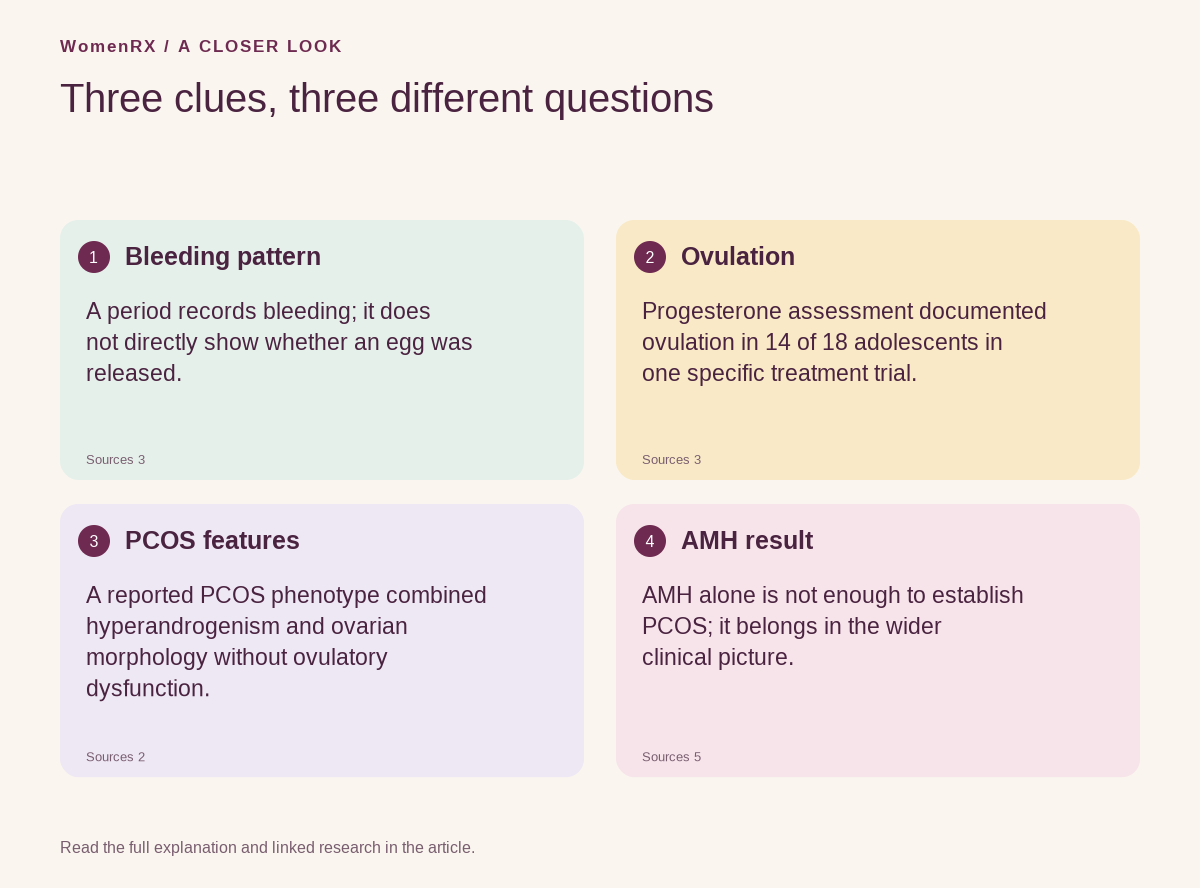
Three clues, three different questions
Bleeding pattern: A period records bleeding; it does not directly show whether an egg was released.3
Ovulation: Progesterone assessment documented ovulation in 14 of 18 adolescents in one specific treatment trial.3
PCOS features: A reported PCOS phenotype combined hyperandrogenism and ovarian morphology without ovulatory dysfunction.2
AMH result: AMH alone is not enough to establish PCOS; it belongs in the wider clinical picture.5
Read the figure as text
Regular bleeding, ovulation evidence, and PCOS features overlap, but none should be treated as a substitute for the others.- Bleeding pattern: A period records bleeding; it does not directly show whether an egg was released.3
- Ovulation: Progesterone assessment documented ovulation in 14 of 18 adolescents in one specific treatment trial.3
- PCOS features: A reported PCOS phenotype combined hyperandrogenism and ovarian morphology without ovulatory dysfunction.2
- AMH result: AMH alone is not enough to establish PCOS; it belongs in the wider clinical picture.5
More questions, answered
Does a high AMH result mean I have PCOS?
No. AMH alone shouldn’t establish a PCOS diagnosis. It needs to be interpreted alongside the rest of your symptoms and findings. 5
Can birth control make PCOS periods look regular?
Yes. Hormonal birth control can make periods more regular. If you’re discussing a possible PCOS diagnosis, mention what birth control you use and what your cycles were like before you started it. 1
Sources you can check
- PCOS | Polycystic Ovary Syndrome | MedlinePlusAccessed 2026-09-25Return to first citation
- The additional value of ultrasound markers in the diagnosis of polycystic ovary syndrome.van der Ham K, Barbagallo F, van Schilfgaarde E, Lujan ME, Laven JSE, Louwers YV. · Fertility and sterility · 2025Return to first citation
- Sensitization to insulin induces ovulation in nonobese adolescents with anovulatory hyperandrogenism.Ibáñez L, Ibáñez L, Valls C, Ferrer A, Marcos MV, Rodriguez-Hierro F, de Zegher F. · The Journal of clinical endocrinology and metabolism · 2001Return to first citation
- Childhood sleep behaviors and polycystic ovary syndrome risk in adolescence: the Raine study cohort longitudinal study.Abdul Jafar NK, McVeigh JA, Eastwood PR, Hart RJ, Sethi P, Joham AE, Tay CT, Teede HJ, Bennett CJ, Mansfield DR, Moran LJ. · The Journal of clinical endocrinology and metabolism · 2026Return to first citation
- The Correlation between Sex Hormone-Binding Globulin and Clinical Characteristics According to Anti-Müllerian Hormone in Women with Regular Menstrual Cycles: A Prospective Study.Keum J, Kim YJ, Choi SK, Lee WM, Bae J. · Journal of personalized medicine · 2024Return to first citation