Hot Flashes While You Still Have Periods
Hot flashes can begin before your periods become noticeably irregular, so having cycles doesn’t rule out perimenopause.
Yes, hot flashes can happen while you’re still having periods, sometimes before your cycle changes noticeably. In a study of women ages 35-47 who had regular cycles at enrollment, hot flashes were reported during follow-up. Perimenopause is one possibility, not a diagnosis based on a hot flash: your age, cycle pattern, sleep, and any changes in medicines add context. 41
Your period can continue while symptoms begin
Hot flashes don’t necessarily wait for your periods to become irregular. In a prospective study, researchers followed women ages 35-47 who had regular menstrual cycles when they entered the study. During follow-up, 31% of the 375 participants reported hot flashes. The researchers concluded that hot flashes can occur before observable menstrual irregularities. 4
A period tells you that bleeding is continuing; it doesn’t tell you that nothing else is changing. In that same study, higher levels of follicle-stimulating hormone, or FSH, were associated with hot flashes. That finding links the symptom with a hormonal measure used in research on ovarian aging, even though the women had regular cycles at enrollment. It doesn’t mean a hot flash reveals your hormone level or establishes its cause. 4
What your cycle pattern adds
Consider the order in which things changed. If your periods still arrive as they usually do, the hot flashes are still worth describing. If your cycle timing has also begun to change, describe whether that happened before or after the hot flashes started. The two together give a fuller picture than either alone. 4
Age belongs in that picture, but it isn’t a cutoff that settles the question. The study enrolled women ages 35-47 with regular cycles, so it shows that hot flashes can arise in the late reproductive years before periods become observably irregular. It doesn’t establish what a hot flash means at any particular age. 4
Notice what’s happening outside your cycle, too. For example, are the episodes waking you or making it harder to sleep? A cross-sectional study of women at different reproductive stages found that hot flashes and insomnia symptoms were associated, though it couldn’t show that one caused the other. Sleep disruption is useful to mention because it tells a clinician how the episodes are affecting you, not because it confirms perimenopause. 3
When another explanation deserves a look
A hot, flushed feeling can have more than one explanation. Medical reviews describe episodic flushing related to medicines or other bodily processes, as well as less common endocrine disorders. That doesn’t make a rare condition the likely explanation for a typical hot flash. It does mean the overall pattern matters more than the symptom’s name alone. 12
Describe whether the feeling comes in episodes or whether facial redness stays between them. One review distinguishes episodic from persistent facial flushing, which can have different causes. If the episodes began after a medicine change, mention the medicine and when you started it; medicines can be among the causes of episodic flushing. 1
A useful way to frame the conversation
You might say: “I’m still getting periods, but I’ve started having hot flashes. Could this fit with perimenopause, or does the pattern suggest another cause?” Bring the details that help answer that question: your age, what has changed or stayed the same about your cycles, when the episodes started, whether they interrupt sleep, and any recent medicine changes.
Continuing periods don’t exclude perimenopause. Looking at cycle history alongside the episodes and possible medication or health-related explanations gives a fuller basis for assessment. 14
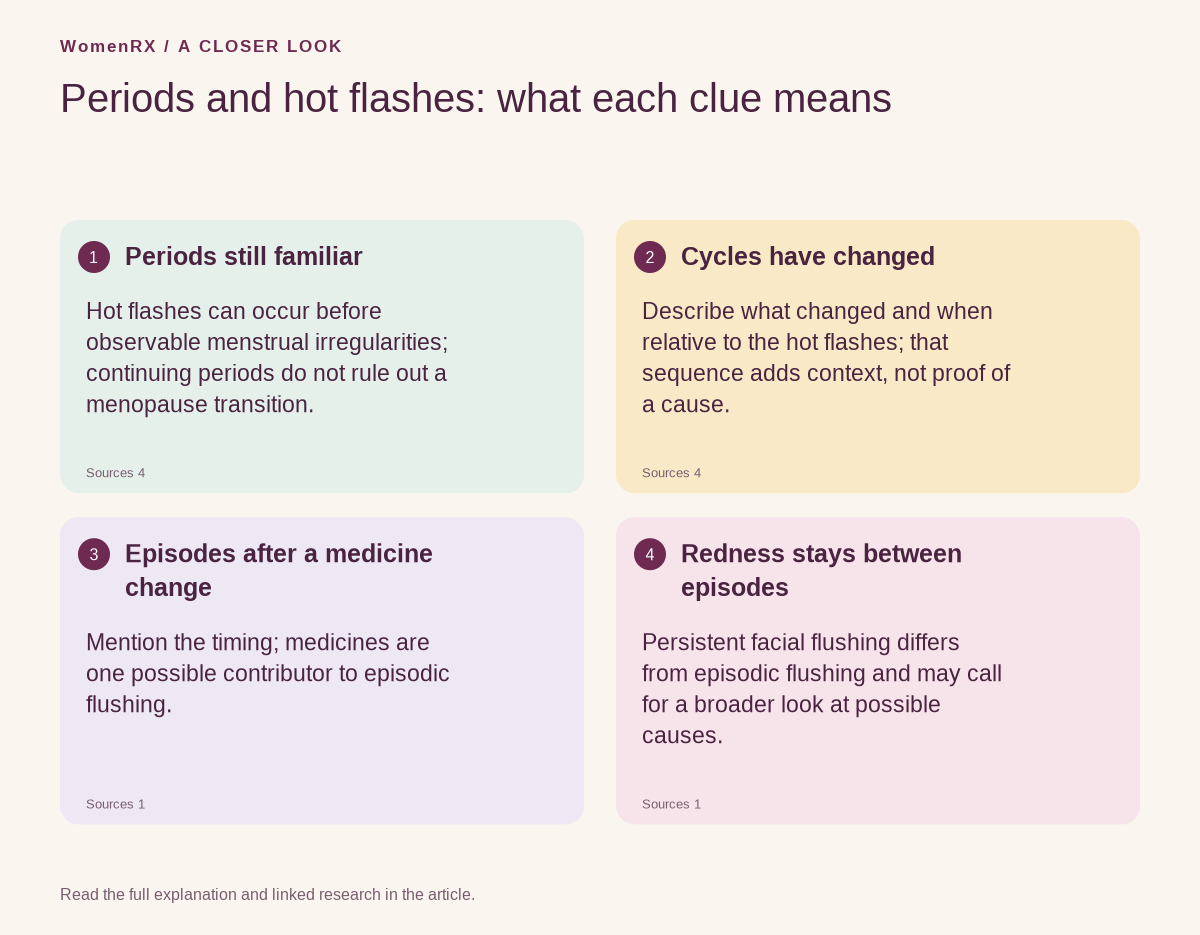
Periods and hot flashes: what each clue means
Periods still familiar: Hot flashes can occur before observable menstrual irregularities; continuing periods do not rule out a menopause transition.4
Cycles have changed: Describe what changed and when relative to the hot flashes; that sequence adds context, not proof of a cause.4
Episodes after a medicine change: Mention the timing; medicines are one possible contributor to episodic flushing.1
Redness stays between episodes: Persistent facial flushing differs from episodic flushing and may call for a broader look at possible causes.1
Read the figure as text
These patterns show why cycle history and the character of a flushed feeling add different kinds of context.- Periods still familiar: Hot flashes can occur before observable menstrual irregularities; continuing periods do not rule out a menopause transition.4
- Cycles have changed: Describe what changed and when relative to the hot flashes; that sequence adds context, not proof of a cause.4
- Episodes after a medicine change: Mention the timing; medicines are one possible contributor to episodic flushing.1
- Redness stays between episodes: Persistent facial flushing differs from episodic flushing and may call for a broader look at possible causes.1
More questions, answered
Do regular periods rule out perimenopause?
No. In a prospective study, hot flashes occurred among women who had regular cycles at enrollment, and the researchers reported that hot flashes can precede observable menstrual irregularities. Regular periods don’t rule it out, but hot flashes alone can’t confirm it. 4
Can a medicine be related to flushing?
Yes. A review of flushing describes medicines as one possible contributor to episodic flushing. If your symptoms began around a medicine change, mention the timing when discussing possible causes. 1
Sources you can check
- Flushing in (neuro)endocrinology.Hannah-Shmouni F, Stratakis CA, Koch CA. · Reviews in endocrine & metabolic disorders · 2016Return to first citation
- MANAGEMENT OF ENDOCRINE DISEASE: Flushing: current concepts.Huguet I, Grossman A. · European journal of endocrinology · 2017Return to first citation
- Hot flashes, insomnia, and the reproductive stages: a cross-sectional observation of women from the EPISONO study.Hachul H, Castro LS, Bezerra AG, Pires GN, Poyares D, Andersen ML, Bittencourt LR, Tufik S. · Journal of clinical sleep medicine : JCSM : official publication of the American Academy of Sleep Medicine · 2021Return to first citation
- Hot flashes in the late reproductive years: risk factors for Africa American and Caucasian women.Freeman EW, Sammel MD, Grisso JA, Battistini M, Garcia-Espagna B, Hollander L. · Journal of women's health & gender-based medicine · 2001Return to first citation