Hot Flashes and Diarrhea: What the Timing Tells You
Noticing when flushing and loose stools happen can help you describe the pattern, but diarrhea needs attention on its own.
If diarrhea happens around a hot flash, record when each starts, how many loose stools you have, how long they continue, and whether you’re replacing lost fluids. Note other symptoms and recent medicine or supplement changes too. The timing may reveal a pattern, but it won’t prove the hot flash caused the diarrhea. 123
A flush followed by an urgent trip to the bathroom can feel like one event. It’s worth noticing whether that sequence repeats. But a hot flash happening first doesn’t establish why the diarrhea started. Menopausal symptoms may explain the flushing, while diarrhea can have a separate cause. 14
Compare the two timelines
For a few episodes, make a short note of:
- The flush: When did it start and end?
- The bowel symptoms: Did a loose stool happen during the flush, soon afterward, or at another time? How many loose stools did you have that day? Three or more loose stools in one day meets the usual definition of diarrhea. 1
- The duration: Did the bowel symptoms settle, continue into the next day, or keep returning? Diarrhea that lasts at least four weeks is considered chronic, even if it comes and goes. 1
- Fluids and other symptoms: Note what you’ve been able to drink and whether you’re concerned about dehydration. Record fever, chills, abdominal pain, or blood in the stool as well. Fever, chills, and bloody stools can accompany diarrhea caused by a virus or bacteria. 1
- Recent changes: Write down when you started or changed a medicine or supplement. This is especially useful if the diarrhea began around the same time.
You don’t need a perfect diary. You’re looking for a distinction: does diarrhea repeatedly occur near a flush, or does it also happen when you aren’t flushing? Does it stop when the flush ends, or carry on for days? Those observations can make the symptoms easier to explain without treating the timing as a diagnosis.
Don’t let the flush explain away diarrhea
Diarrhea has several possible causes, including infections and problems with how the colon functions, such as irritable bowel syndrome. It can also occur after some types of stomach surgery. 1 A familiar hot-flash pattern doesn’t rule out a new bowel problem.
What you’re taking may matter too. In a placebo-controlled trial of postmenopausal women with a history of breast cancer, diarrhea was reported more often by women assigned magnesium oxide than by those assigned placebo. The trial did not find that magnesium oxide helped their hot flashes. 2 Diarrhea is also among the adverse effects reported in clinical trials of desvenlafaxine, a medicine studied for hot flashes. 3 Neither finding can tell you what caused your own symptoms, but a recent change is worth discussing with a health care provider.
Let duration and hydration guide your next move
Diarrhea can cause dehydration, so replacing lost fluids matters. MedlinePlus lists water, fruit juice, sports drinks, noncaffeinated soda, and salty broth as fluid options for adults with diarrhea. 1
If you’re an adult, contact a health care provider if diarrhea lasts more than two days, you have signs of dehydration, or you have severe abdominal or rectal pain. 1 You don’t need to establish whether the flushing and diarrhea are connected before getting help for the bowel symptoms.
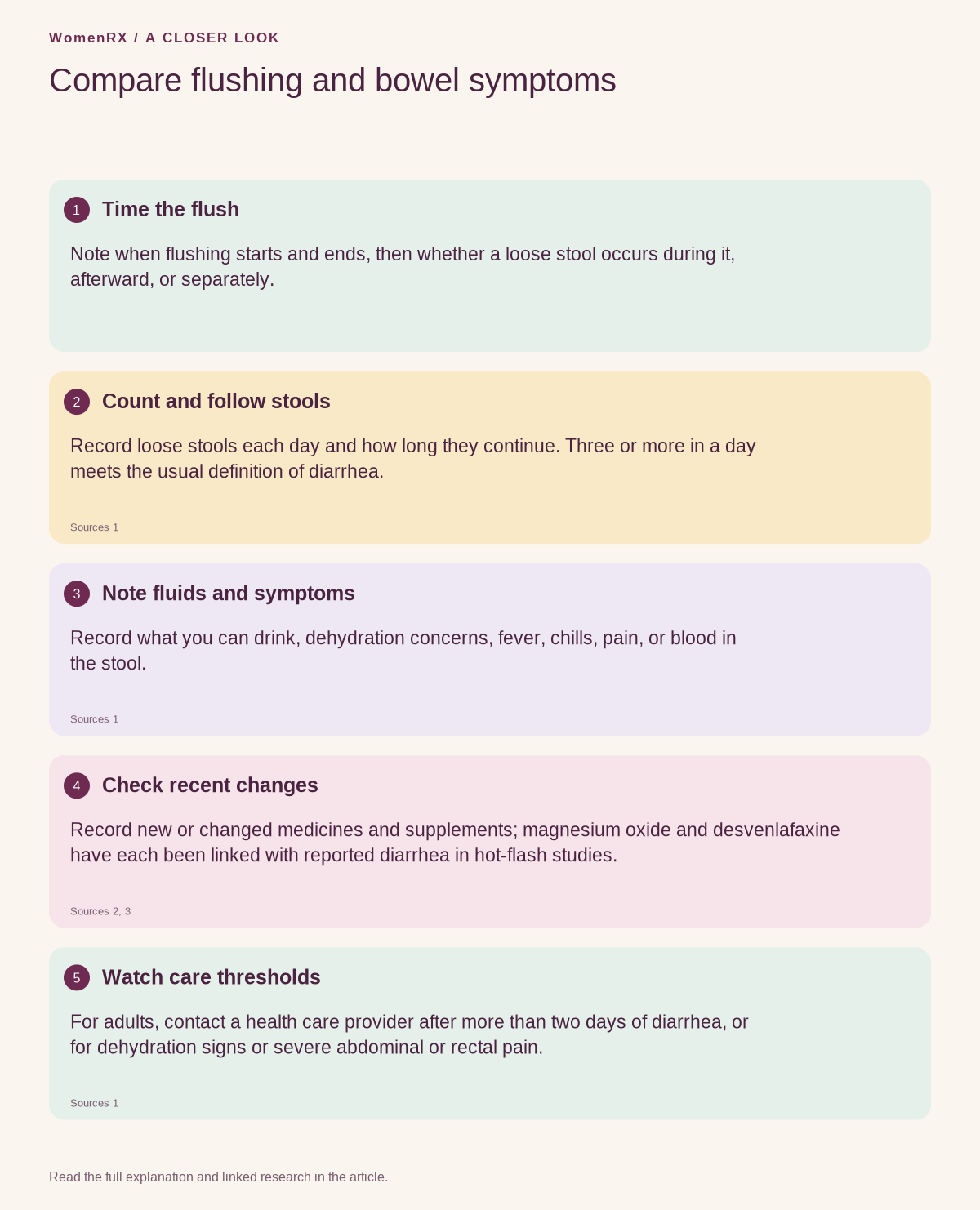
Compare flushing and bowel symptoms
Time the flush: Note when flushing starts and ends, then whether a loose stool occurs during it, afterward, or separately.
Count and follow stools: Record loose stools each day and how long they continue. Three or more in a day meets the usual definition of diarrhea.1
Note fluids and symptoms: Record what you can drink, dehydration concerns, fever, chills, pain, or blood in the stool.1
Check recent changes: Record new or changed medicines and supplements; magnesium oxide and desvenlafaxine have each been linked with reported diarrhea in hot-flash studies.23
Watch care thresholds: For adults, contact a health care provider after more than two days of diarrhea, or for dehydration signs or severe abdominal or rectal pain.1
Read the figure as text
A brief record can show whether the symptoms overlap, occur separately, or continue on different timelines.- Time the flush: Note when flushing starts and ends, then whether a loose stool occurs during it, afterward, or separately.
- Count and follow stools: Record loose stools each day and how long they continue. Three or more in a day meets the usual definition of diarrhea.1
- Note fluids and symptoms: Record what you can drink, dehydration concerns, fever, chills, pain, or blood in the stool.1
- Check recent changes: Record new or changed medicines and supplements; magnesium oxide and desvenlafaxine have each been linked with reported diarrhea in hot-flash studies.23
- Watch care thresholds: For adults, contact a health care provider after more than two days of diarrhea, or for dehydration signs or severe abdominal or rectal pain.1
More questions, answered
Could magnesium taken for hot flashes be causing diarrhea?
It’s possible. In a placebo-controlled trial involving postmenopausal women with a history of breast cancer, diarrhea was reported more often in the magnesium oxide groups than in the placebo groups, and magnesium oxide did not improve hot flashes. 2 If your symptoms began after starting a supplement, note the timing and discuss the suspected effect with a health care provider.
Sources you can check
- Diarrhea | MedlinePlusAccessed 2026-09-25Return to first citation
- North Central Cancer Treatment Group N10C2 (Alliance): a double-blind placebo-controlled study of magnesium supplements to reduce menopausal hot flashes.Park H, Qin R, Smith TJ, Atherton PJ, Barton DL, Sturtz K, Dakhil SR, Anderson DM, Flynn K, Puttabasavaiah S, Le-Lindqwister NA, Padula GD, Loprinzi CL. · Menopause (New York, N.Y.) · 2015Return to first citation
- Efficacy of desvenlafaxine succinate for menopausal hot flashes.Tella SH, Gallagher JC. · Expert opinion on pharmacotherapy · 2014Return to first citation
- Is desvenlafaxine effective and safe in the treatment of menopausal vasomotor symptoms? A meta-analysis and meta-regression of randomized double-blind controlled studies.Berhan Y, Berhan A. · Ethiopian journal of health sciences · 2014Return to first citation