Can You Get Gabapentin for Hot Flashes Online?
A remote visit can be a place to discuss gabapentin, but whether it’s appropriate depends on your symptoms, health history, and the clinician’s assessment.
A clinician may consider gabapentin for menopause-related hot flashes during a telehealth visit, but a prescription isn’t guaranteed. Gabapentin is used off-label for hot flashes, and it can cause sleepiness or dizziness. 34 Be ready to explain how symptoms affect you, share your medical and medication history, and ask what schedule and follow-up plan the clinician would propose if you try it. 1
What a remote visit can and can’t do
A video or phone visit can give a clinician a chance to hear about your hot flashes, sleep disruption, health history, and treatment preferences. But telehealth isn’t automatically enough for every assessment: a clinician may need more information, an in-person examination, or testing before making a decision. If the clinician doesn’t have your full history, plan to fill in the gaps. 1
Gabapentin is one nonhormonal medicine used off-label for menopause-related vasomotor symptoms. A discussion or online appointment does not mean you’ll receive a prescription. 3
What the online price may leave out
For one concrete medication-price example, a pharmacy listed 30 generic gabapentin 100 mg capsules for $5 on September 25, 2026. It required an existing prescription and listed the product as unavailable through that pharmacy in Kentucky, North Dakota, New Jersey, Tennessee, and Washington, DC. The $5 package did not qualify for its free-shipping threshold, and the shipping charge was not captured. This is a package price, not a recommended hot-flash dose or a monthly treatment cost. 6
Before paying for a remote visit, ask separately what the consultation costs, whether a membership is required, and whether any testing or follow-up would have its own charge. A medication listing cannot tell you those costs or whether a clinician will prescribe gabapentin.
Make the conversation specific
Before the visit, think about what your hot flashes look like in an ordinary week. For example, you might describe whether they happen mostly during the day or wake you at night, how often they interrupt sleep, and what you’ve already tried. This helps keep the conversation focused on the problem you want help with, rather than on a medication name alone.
Have your medical history and a current list of medicines and supplements available. Mention relevant health conditions and any previous experience with hormone therapy or other treatments. If you take tamoxifen after breast cancer treatment, say so: in a small prospective study, adding gabapentin was not associated with a statistically significant change in plasma Z-endoxifen concentrations among 14 participants. That finding is limited to the study’s participants and does not settle every medication question. 5
Useful questions include: “What makes gabapentin a reasonable option for me?” “What side effects should I watch for?” and “When would we review whether it’s helping?” You can also ask what would prompt a different treatment or an in-person assessment.
Weigh symptom relief against side effects
A systematic review and meta-analysis of randomized trials found that gabapentin reduced hot-flash frequency compared with placebo at four and 12 weeks. The findings are group averages across trials, not a prediction of what one person will experience; the review included both menopausal participants and people with breast cancer. Dizziness and sleepiness were more common with gabapentin than with control treatment. 4
That tradeoff matters if feeling drowsy or dizzy could affect your daily routine. Ask how the clinician would evaluate those effects and what to do if they interfere with your activities. Ask what dosing schedule the clinician would propose for you, how it might be adjusted, and when you would review benefit and side effects. Don’t choose a dose or schedule from someone else’s experience: the evidence summary doesn’t establish a personal regimen for you.
Compare options without assuming one is best
Treatment choice depends on your symptoms, health history, and preferences, not simply on being a woman or being in menopause. Menopause guidance reviewed in a 2024 systematic review included gabapentin, certain antidepressants, and a neurokinin-3 receptor antagonist among nonhormonal medication options for vasomotor symptoms. The same review found that guidance consistently supported menopausal hormone therapy for vasomotor symptoms, while individual suitability varies. 2
The options don’t have identical tradeoffs. Gabapentin may help with hot flashes, but dizziness or sleepiness may matter if you need to stay alert during the day. Hormone therapy is another option for vasomotor symptoms, while certain antidepressants and a neurokinin-3 receptor antagonist are other nonhormonal medicines to discuss. Ask which fits your history and priorities rather than assuming one works best for everyone. 24
If you and the clinician decide to try gabapentin, agree on what improvement would matter to you, what side effects to report, and when to check in. The purpose is not to secure a prescription online; it’s to leave the visit with a treatment decision and a clear plan for assessing whether it fits your life.
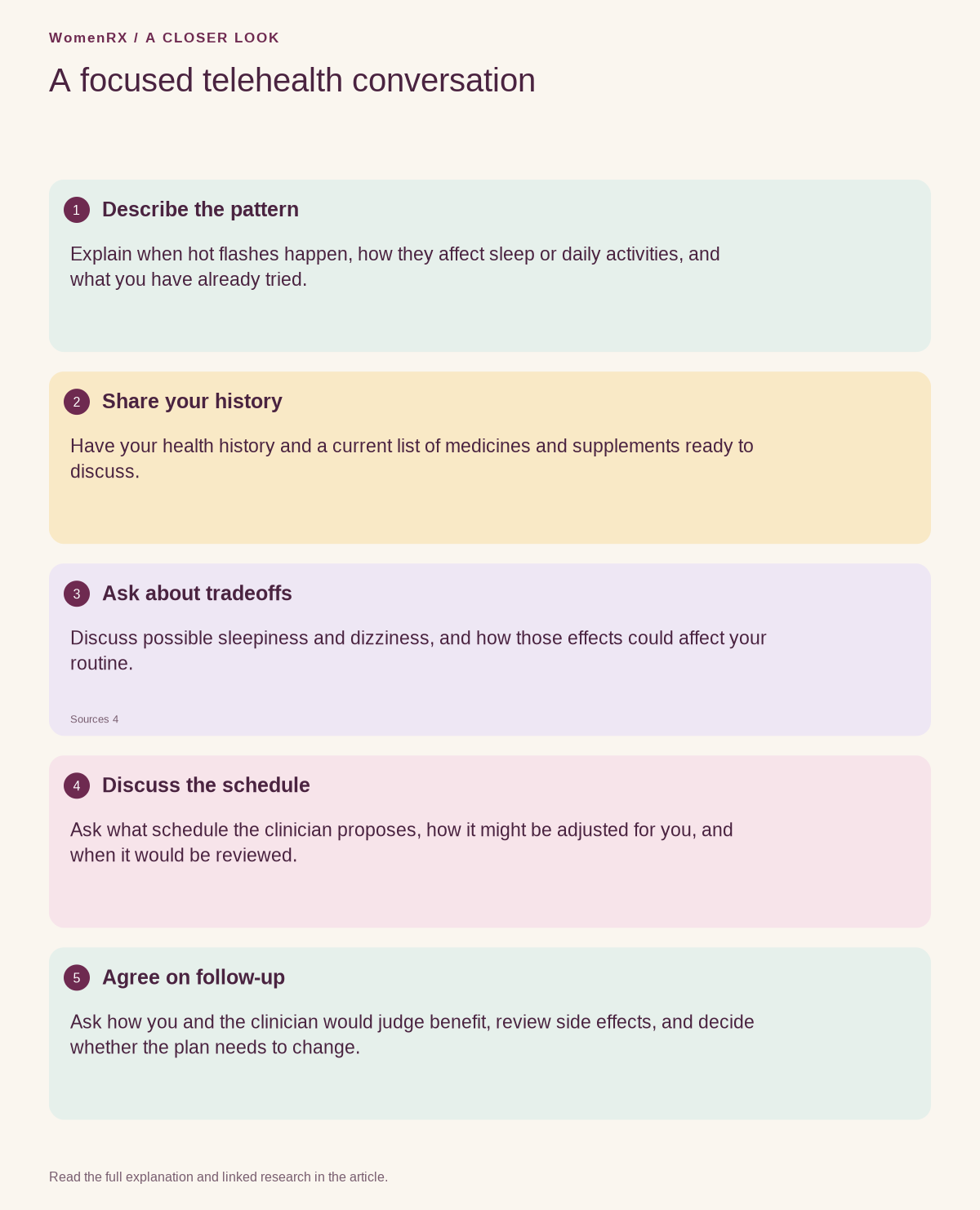
A focused telehealth conversation
Describe the pattern: Explain when hot flashes happen, how they affect sleep or daily activities, and what you have already tried.
Share your history: Have your health history and a current list of medicines and supplements ready to discuss.
Ask about tradeoffs: Discuss possible sleepiness and dizziness, and how those effects could affect your routine.4
Discuss the schedule: Ask what schedule the clinician proposes, how it might be adjusted for you, and when it would be reviewed.
Agree on follow-up: Ask how you and the clinician would judge benefit, review side effects, and decide whether the plan needs to change.
Read the figure as text
Use these prompts to describe the problem and ask how a treatment decision would be assessed. They are conversation aids, not a diagnostic checklist.- Describe the pattern: Explain when hot flashes happen, how they affect sleep or daily activities, and what you have already tried.
- Share your history: Have your health history and a current list of medicines and supplements ready to discuss.
- Ask about tradeoffs: Discuss possible sleepiness and dizziness, and how those effects could affect your routine.4
- Discuss the schedule: Ask what schedule the clinician proposes, how it might be adjusted for you, and when it would be reviewed.
- Agree on follow-up: Ask how you and the clinician would judge benefit, review side effects, and decide whether the plan needs to change.
More questions, answered
Is gabapentin specifically approved to treat hot flashes?
Gabapentin is used off-label for hot flashes. A review discussing US treatment options identifies paroxetine as an approved medication for menopause-related vasomotor symptoms and describes gabapentin as an off-label option. 3
What side effects are worth discussing?
Sleepiness and dizziness are relevant to discuss: a meta-analysis found both were more common with gabapentin than with control treatment in trials for vasomotor symptoms. Ask how these effects could affect your routine and how you should follow up if they occur. 4
Sources you can check
- Telehealth: MedlinePlusAccessed 2026-09-25Return to first citation
- A systematic review and critical appraisal of menopause guidelines.Hemachandra C, Taylor S, Islam RM, Fooladi E, Davis SR. · BMJ sexual & reproductive health · 2024Return to first citation
- Systematic review and network meta-analysis comparing the efficacy of fezolinetant with hormone and nonhormone therapies for treatment of vasomotor symptoms due to menopause.Morga A, Ajmera M, Gao E, Patterson-Lomba O, Zhao A, Mancuso S, Siddiqui E, Kagan R. · Menopause (New York, N.Y.) · 2024Return to first citation
- Efficacy and safety of gabapentin and pregabalin in patients with vasomotor symptoms: a systematic review and meta-analysis.Shan D, Zou L, Liu X, Shen Y, Cai Y, Zhang J. · American journal of obstetrics and gynecology · 2020Return to first citation
- The impact of coadministration of venlafaxine, citalopram or gabapentin on the metabolic activation of tamoxifen.Safgren SL, Suman VJ, Leon Ferre RA, Kosel ML, Stearns V, Henry NL, Denduluri N, Irvin W, Ingle JN, Sideras K, Ames MM, Reid JM, Loprinzi CL, Black JL, Weinshilboum RM, Goetz MP. · Breast cancer research and treatment · 2025Return to first citation
- Honeybee gabapentin package price and dispensing availabilityAccessed 2026-09-25Return to first citation