If Paroxetine Isn’t Right, What Can Help Hot Flashes?
Other prescription options may help, but the best fit depends on why you take paroxetine, your health history, and which tradeoffs matter to you.
If paroxetine doesn’t help enough or causes troublesome effects, options to discuss include another SSRI or SNRI, fezolinetant, gabapentin, or menopausal hormone therapy if it fits your health history and preferences. They aren’t interchangeable, and indirect comparisons don’t predict your individual response. If paroxetine also treats depression or another condition, that need belongs in the conversation too. 1 6 8
First, separate hot-flash relief from other treatment goals
Paroxetine may be used for menopausal hot flashes or, in a different formulation and treatment context, for depression. Brisdelle’s prescribing information describes its use for hot flashes and says it isn’t for psychiatric problems such as depression; paroxetine is also an antidepressant used to treat major depressive disorder. If you take it for mood as well as hot flashes, any alternative needs to account for both goals. 1 8
It helps to name what you want to change: hot flashes that continue, a side effect, or both. Paroxetine can affect sexual function, including libido and orgasm, and may interact with medicines that affect clotting, such as warfarin. The timing of a symptom and your other medicines can help shape which options are worth discussing. 1
How the main alternatives differ
Another SSRI or an SNRI
Other antidepressants, including escitalopram, citalopram, venlafaxine, and desvenlafaxine, have shown reductions in hot-flash frequency or severity in clinical trials. When prescribed for hot flashes, these options are used off-label. That doesn’t mean they lack evidence, but it does mean the hot-flash use isn’t the specific approved indication. Side effects and interactions vary by medicine, so the exact option matters. 6 8
A different SSRI or SNRI may be worth discussing if you want to consider another medicine in this broad class. It won’t necessarily avoid effects associated with SSRIs, such as sexual side effects, and the right choice also depends on whether you need treatment for depression or another condition. 1 6 8
Fezolinetant
Fezolinetant is a prescription, nonhormonal treatment for moderate-to-severe menopause-related hot flashes. It works differently from antidepressants. In two 12-week, placebo-controlled trials involving postmenopausal women who had at least seven moderate-to-severe symptoms a day, fezolinetant reduced symptom frequency and severity more than placebo. The prescribing information also makes liver-related lab follow-up a consideration to discuss. 2
A network meta-analysis comparing results across separate trials found that fezolinetant reduced hot-flash frequency more than paroxetine, desvenlafaxine, and extended-release gabapentin at the studied regimens. These weren’t direct, head-to-head trials, so the result is a comparison of evidence across studies, not a promise about which treatment will work best for you. 6
Gabapentin
Gabapentin is a prescription medicine used for other conditions and sometimes used off-label for hot flashes. Sleepiness, tiredness, and dizziness are possible side effects; those may matter if you need to stay alert for driving, work, or caregiving. The indirect comparison described above found greater average symptom-frequency reductions with fezolinetant than with extended-release gabapentin at the regimens studied, but that doesn’t mean gabapentin cannot help an individual. 3 4 6
Menopausal hormone therapy
If you’re open to hormones, menopausal hormone therapy may also be part of the discussion. A clinical review describes it as the most effective treatment for vasomotor symptoms, but it isn’t suitable for everyone. A history of estrogen-dependent cancer, coronary heart disease, stroke, or blood clots can affect whether it’s appropriate, so personal health risks and preferences matter. 7 8
Compare the tradeoffs, not just the drug names
The evidence doesn’t put every option on equal footing. In the network meta-analysis, fezolinetant reduced hot-flash frequency more than several nonhormonal medicines, including paroxetine and gabapentin, at the regimens studied. Because those results came from indirect comparisons, they can help frame a discussion but can’t reliably rank treatments for one person. 6
A meta-analysis of six randomized paroxetine trials involving 1,486 women estimated that placebo response accounted for 79% of the mean treatment response for hot-flash frequency and 68% for severity. Those are pooled trial-level estimates, not predictions about an individual. They’re one reason to consider whether a treatment is making a meaningful difference for you, rather than assuming a particular option will be a clear winner. 5
A focused conversation can start with three points: whether paroxetine is also treating depression, which effects you most want to avoid, and whether hormone therapy fits your health history and preferences. You can also ask how the evidence for a proposed alternative compares with the reason you’re considering a change.
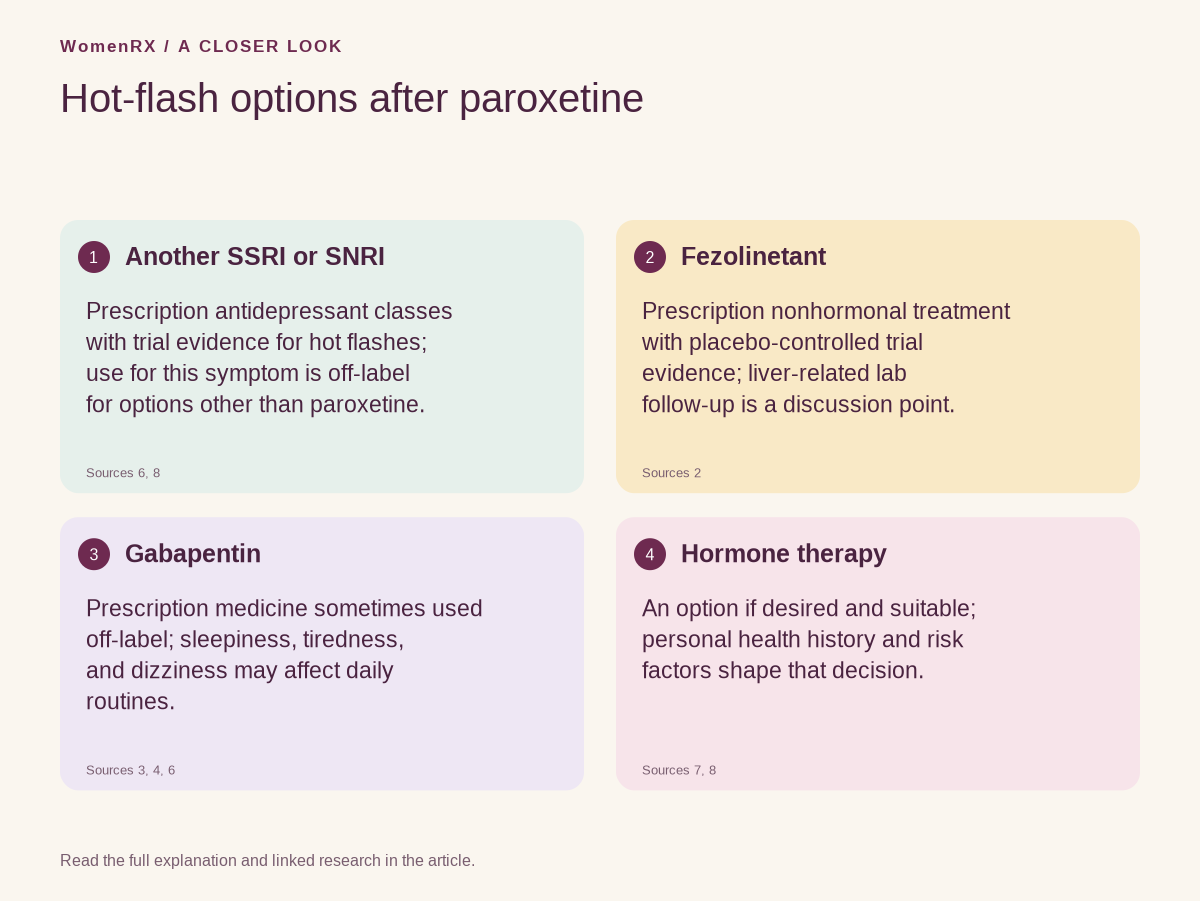
Hot-flash options after paroxetine
Another SSRI or SNRI: Prescription antidepressant classes with trial evidence for hot flashes; use for this symptom is off-label for options other than paroxetine.68
Fezolinetant: Prescription nonhormonal treatment with placebo-controlled trial evidence; liver-related lab follow-up is a discussion point.2
Gabapentin: Prescription medicine sometimes used off-label; sleepiness, tiredness, and dizziness may affect daily routines.346
Hormone therapy: An option if desired and suitable; personal health history and risk factors shape that decision.78
Read the figure as text
These pathways differ in class, evidence, and tradeoffs. The comparison can guide a discussion, but it does not mean switching is automatically the right move.- Another SSRI or SNRI: Prescription antidepressant classes with trial evidence for hot flashes; use for this symptom is off-label for options other than paroxetine.68
- Fezolinetant: Prescription nonhormonal treatment with placebo-controlled trial evidence; liver-related lab follow-up is a discussion point.2
- Gabapentin: Prescription medicine sometimes used off-label; sleepiness, tiredness, and dizziness may affect daily routines.346
- Hormone therapy: An option if desired and suitable; personal health history and risk factors shape that decision.78
More questions, answered
If paroxetine helps my mood too, what should I consider?
Make sure the discussion covers both hot flashes and mood. Brisdelle is indicated for menopausal hot flashes, not depression, and other paroxetine formulations may be used for depression. 1 8
Are the nonhormonal alternatives equally effective?
No. An indirect comparison found different average effects across treatments, with fezolinetant reducing hot-flash frequency more than several nonhormonal options at the regimens studied. Since the treatments weren’t compared in direct head-to-head trials, the findings don’t tell you which will work best for you. 6
Sources you can check
- BRISDELLE (PAROXETINE) CAPSULE [LEGACY PHARMA USA, INC.] | US prescribing information and patient instructionsAccessed 2026-09-25Return to first citation
- VEOZAH (FEZOLINETANT) TABLET, FILM COATED [ASTELLAS PHARMA US, INC.] | US prescribing information and patient instructionsAccessed 2026-09-25Return to first citation
- Side effects of gabapentin - NHSAccessed 2026-09-25Return to first citation
- About gabapentin - NHSAccessed 2026-09-25Return to first citation
- Magnitude of placebo response in clinical trials of paroxetine for vasomotor symptoms: a meta-analysis.Rhodes JR, Alldredge CT, Elkins GR. · Frontiers in psychiatry · 2023Return to first citation
- Systematic review and network meta-analysis comparing the efficacy of fezolinetant with hormone and nonhormone therapies for treatment of vasomotor symptoms due to menopause.Morga A, Ajmera M, Gao E, Patterson-Lomba O, Zhao A, Mancuso S, Siddiqui E, Kagan R. · Menopause (New York, N.Y.) · 2024Return to first citation
- Efficacy of Low-Dose Paroxetine for the Treatment of Hot Flushes in Surgical and Physiological Postmenopausal Women: Systematic Review and Meta-Analysis of Randomized Trials.Riemma G, Schiattarella A, La Verde M, Zarobbi G, Garzon S, Cucinella G, Calagna G, Labriola D, De Franciscis P. · Medicina (Kaunas, Lithuania) · 2019Return to first citation
- A Clinical Review on Paroxetine and Emerging Therapies for the Treatment of Vasomotor Symptoms.David PS, Smith TL, Nordhues HC, Kling JM. · International journal of women's health · 2022Return to first citation