Tripeptide on a Label: What It Actually Tells You
“Tripeptide” describes a peptide’s length, not one specific ingredient or a guaranteed skin benefit.
A tripeptide is a short chain of three amino acids, but many different chains fit that description. To judge a product, look for the named peptide or sequence, whether it’s topical or oral, and evidence on that exact formula and use. Results from one tripeptide product don’t establish that all tripeptides work alike. 3 4
One word, many possible ingredients
“Tripeptide” tells you something about a molecule’s size, not its identity. Different combinations of three amino acids make different peptides. For example, research describes Gly-Pro-Hyp as a collagen-related tripeptide and GHK as glycyl-L-histidyl-L-lysine; GHK can also be paired with copper as GHK-Cu. Those names aren’t interchangeable. 3 4
That distinction matters because a label’s broad term doesn’t tell you what the product is meant to do, how it’s used, or whether that specific formula has been studied. A cream applied to skin and a supplement taken by mouth are different products with different evidence questions.
A practical label check
1. Find the more specific name. Look beyond “tripeptide” for a named peptide, sequence, or ingredient term, such as GHK-Cu or collagen tripeptide. If the label only gives a broad peptide term, you may not be able to match it confidently to a particular study.
2. Identify the product’s route and format. Is it a leave-on cream or serum, or something to swallow? Research on a topical product doesn’t establish the effect of an oral product, or vice versa. For instance, a small study of a topical collagen tripeptide ampoule and a separate oral collagen-peptide trial investigated distinct formulations and uses. 1 3
3. Check whether the study tested the peptide or a finished blend. A study of a cream containing retinol, a tripeptide concentrate, and glaucine can’t show which ingredient caused the observed changes. Likewise, a study of GHK-Cu combined with a ferment extract is evidence about that combination, not GHK-Cu alone. 2 4
4. Match the claim to the study’s actual outcome. “Skin benefits” is broad. A study might measure wrinkles, elasticity, hydration, or another specific outcome. Ask whether the study examined the claim you care about, in people, using the same type of product and application route.
5. Look at who was studied and how strong the comparison was. A study of 22 Asian women using a topical collagen tripeptide product for four weeks reported improvements, but it was a small, single-arm pilot without a comparison group. That finding is a reason to study the product further, not proof that any tripeptide cream will have the same effect. 3
What product studies can, and can’t, tell you
The evidence varies by formula. In one randomized, placebo-controlled trial, 114 women aged 20 to 50 with thigh cellulite and self-reported hair thinning took a specific low-molecular-weight collagen peptide product for 24 weeks. The product was enriched in Gly-Pro-Hyp sequences. That study offers evidence about that oral collagen-peptide formulation in that group; it does not establish a general effect for every ingredient labeled “tripeptide,” or for topical skincare. 1
Other studies make the product-specific point clear. One open-label trial studied a combined cream containing retinol, a tripeptide concentrate, and glaucine in 20 men and women. Another study tested a cream combining GHK-Cu with a ferment extract; most of its 32 participants were women. Neither design establishes that the peptide alone produced the reported changes. 2 4
So when a brand cites a study, check the full product description, route, comparison group, study length, and participant group. If the product or formula differs, the study may be relevant background, but it isn’t direct proof for the item in your hand.
Pregnancy and breastfeeding need product-specific answers
These studies don’t establish whether these products are safe to use during pregnancy or breastfeeding. And the word “tripeptide” alone can’t answer that question: the named ingredient, other formula components, and whether it’s topical or oral all matter. Don’t treat a peptide label as a safety assurance; look for information on the specific product and intended use.
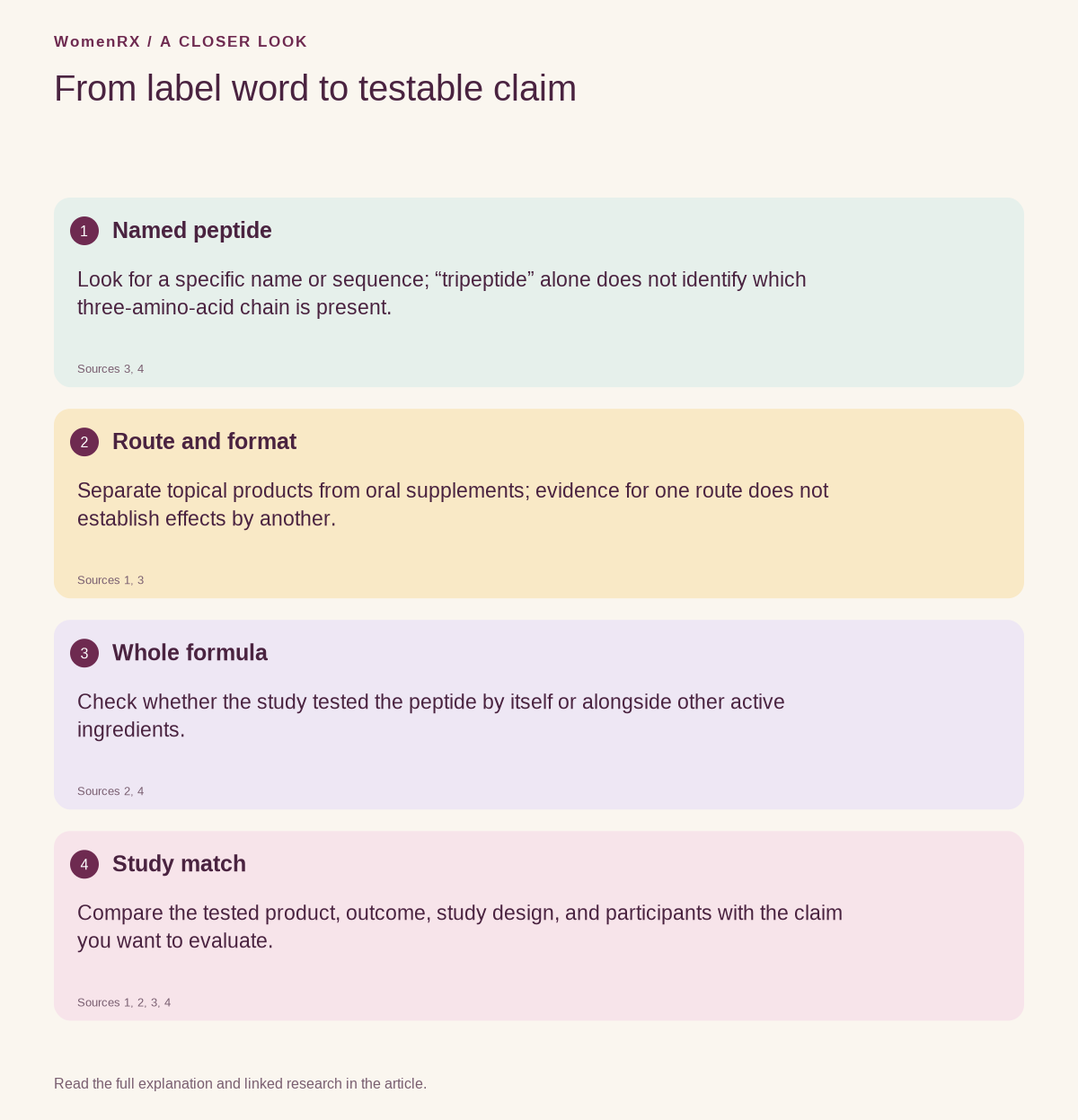
From label word to testable claim
Named peptide: Look for a specific name or sequence; “tripeptide” alone does not identify which three-amino-acid chain is present.34
Route and format: Separate topical products from oral supplements; evidence for one route does not establish effects by another.13
Whole formula: Check whether the study tested the peptide by itself or alongside other active ingredients.24
Study match: Compare the tested product, outcome, study design, and participants with the claim you want to evaluate.1234
Read the figure as text
Use these label details to tell whether a product can be matched to specific evidence.- Named peptide: Look for a specific name or sequence; “tripeptide” alone does not identify which three-amino-acid chain is present.34
- Route and format: Separate topical products from oral supplements; evidence for one route does not establish effects by another.13
- Whole formula: Check whether the study tested the peptide by itself or alongside other active ingredients.24
- Study match: Compare the tested product, outcome, study design, and participants with the claim you want to evaluate.1234
More questions, answered
Does “tripeptide” mean the product contains collagen?
No. It describes peptide length, not the source or exact sequence. Collagen-related examples include Gly-Pro-Hyp and hydrolyzed collagen tripeptide, but the generic word alone doesn’t identify either one. 3
Can a study of one tripeptide product support a different one?
Only indirectly. If the sequence, route, or formula differs, the study isn’t direct evidence for the other product. Combination studies also can’t isolate the peptide’s effect from the other ingredients. 2 4
Sources you can check
- Low-Molecular-Weight Collagen Peptide Supplementation Improves Cellulite Severity, Skin Elasticity, and Hair Shaft Diameter: A Clinical Study with Pharmacokinetic Evaluation.Hwang S, Won J, Kim S, Kang W, Park M. · Journal of medicinal food · 2026Return to first citation
- Clinical and histologic findings after use of a novel combined retinol, tripeptide, and glaucine containing cream in the treatment of photo-aged skin.Rao S, Goldberg D. · Journal of cosmetic dermatology · 2023Return to first citation
- Effect of a Topical Collagen Tripeptide on Antiaging and Inhibition of Glycation of the Skin: A Pilot Study.Lee YI, Lee SG, Jung I, Suk J, Lee MH, Kim DU, Lee JH. · International journal of molecular sciences · 2022Return to first citation
- Augmented Skin Beneficial Effects of Thermus Thermophilus and Bacillus Subtilis Mixed-Culture Ferment Extract by Tripeptide GHK-Cu.Wang J, Tao K, Huang H, Chang H. · Skin research and technology : official journal of International Society for Bioengineering and the Skin (ISBS) [and] International Society for Digital Imaging of Skin (ISDIS) [and] International Society for Skin Imaging (ISSI) · 2026Return to first citation