How to Read a Tripeptide Product Before Buying
A tripeptide name, a skin claim, and a research-use label tell you different things. Check all three before you decide.
Start with the full ingredient name, then ask what the product is meant to do and whether it’s intended for skin, another form of personal use, or laboratory research. Look for evidence on that ingredient in a comparable formulation and used for the advertised purpose. Cell and tissue findings alone can’t tell you what a finished product will do for you. 1 2 3
First, identify the ingredient
“Tripeptide” isn’t a complete ingredient name. Research papers, for example, describe Ser-Pro-Cys (SPC), glycyl-l-histidyl-l-lysine (GHK), and Copper Tripeptide-1 by name. They study different materials in different settings. A product page that says only “tripeptide complex” gives you too little information to match it to any of that research. Look for the full name in the ingredient list or product details. 1 2 3
The form matters as much as the name. In one study, SPC was attached to a PEGylated polymer. Another examined GHK in an engineered peptide-gold nanoparticle material. Neither is evidence that an ordinary serum containing a similarly named ingredient will produce the same effect. 1 2
Read the promise and the product description together
The front of a package may emphasize “peptide technology,” while the details tell a more useful story. These are cues for reading a listing, not proof that a seller has classified or assessed a product correctly:
- A skin-appearance product may be presented as a cream or serum for moisturizing, smoothing, or improving the look of skin. Ask whether its evidence measures the appearance claim being made in people using a comparable finished product.
- A product making a treatment claim may promise to heal a wound or treat a disease. That is a different question from whether a cream changes how skin looks. Don’t treat a laboratory finding as evidence for a treatment promise.
- A research-use material may say “for research use only” and describe a peptide as a powder or laboratory reagent. That label is a reason to stop considering it as a personal-use product. A seller’s mixing or administration directions do not establish that it’s appropriate to use on or in your body.
Check the intended route as a way to understand what’s being offered, not as an instruction to use it. A topical product, a substance advertised for injection, and a laboratory material raise different questions. A study using cells or an engineered material does not validate a seller’s proposed route for a retail product. 1 2
See whether the evidence reaches the advertised result
A useful comparison has four parts: the exact ingredient, the formulation, who or what was studied, and the outcome measured. For example, research on Copper Tripeptide-1 found changes in elastin-related measures in dermal fibroblasts. The researchers also tested a combination of ingredients in UV-damaged human skin biopsy samples. That is promising laboratory and tissue work, but it does not show that a finished Copper Tripeptide-1 cosmetic improves skin appearance in people. The combination’s result cannot be assigned to Copper Tripeptide-1 alone. 3
The distinction matters for more dramatic claims, too. The SPC-polymer study reported effects on human tumor cells in vitro. It did not test a tripeptide product as a cancer treatment in people. If a listing uses a result like that to sell a personal-use product, the study is not evidence for the advertised benefit. 1
Check what you can actually verify about the product
Before comparing prices or promises, see whether the listing provides a complete ingredient list, identifies who makes or sells the product, and clearly states what the finished product is and is not intended for. Check for a lot number and any stated storage information on the package. If the seller claims purity or independent testing, look for documentation tied to the specific product and lot rather than an unsupported badge or a study about the ingredient in general. These details help you assess the listing; none, by itself, proves a benefit or establishes that a product is suitable for personal use.
If you can’t identify the ingredient, intended use, or finished formulation, you can’t make a meaningful comparison with a study. You don’t need to fill those gaps with the seller’s most confident claim.
Five checks for a tripeptide listing
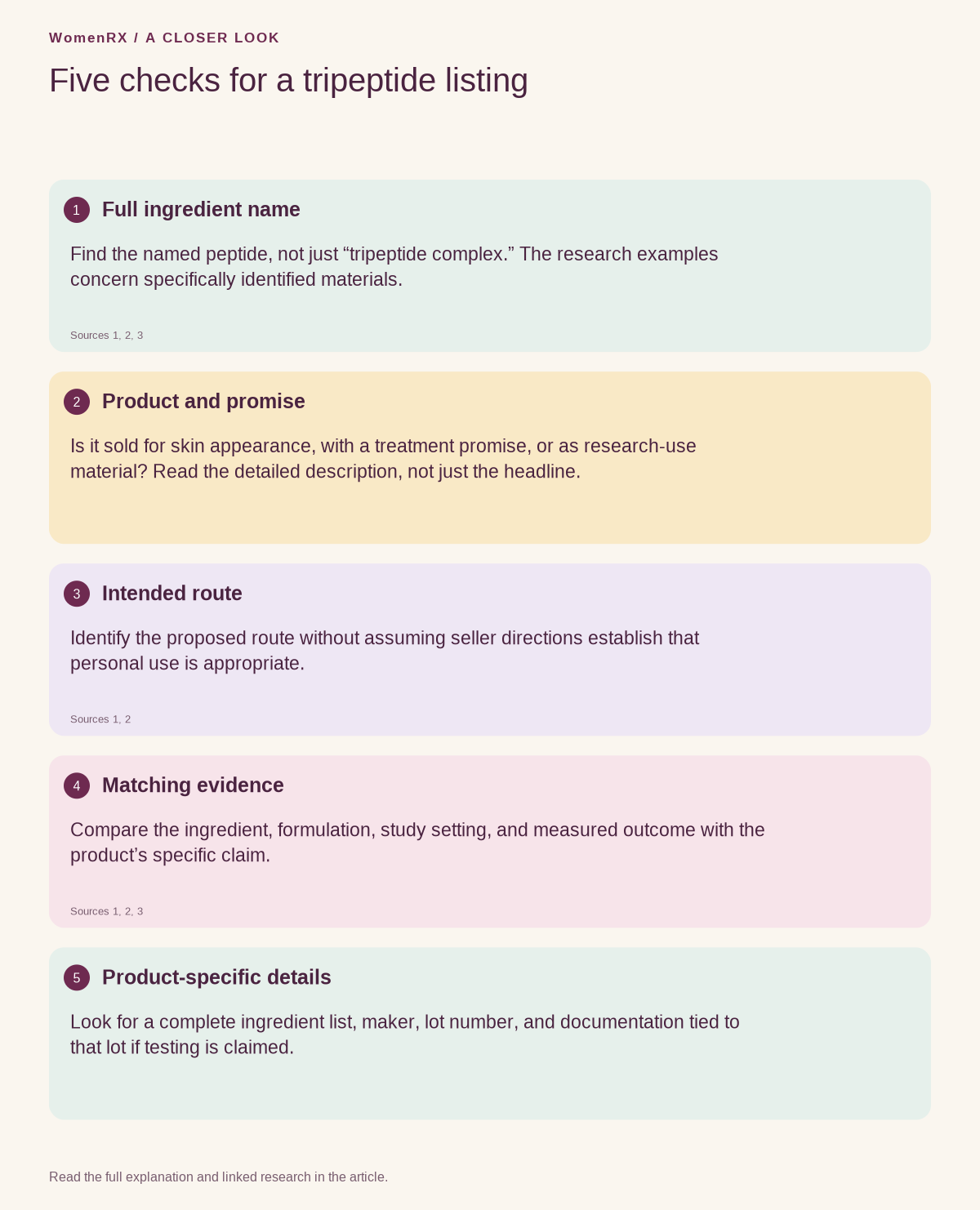
Full ingredient name: Find the named peptide, not just “tripeptide complex.” The research examples concern specifically identified materials.123
Product and promise: Is it sold for skin appearance, with a treatment promise, or as research-use material? Read the detailed description, not just the headline.
Intended route: Identify the proposed route without assuming seller directions establish that personal use is appropriate.12
Matching evidence: Compare the ingredient, formulation, study setting, and measured outcome with the product’s specific claim.123
Product-specific details: Look for a complete ingredient list, maker, lot number, and documentation tied to that lot if testing is claimed.
Read the figure as text
Use these checks to separate what the listing says from what research has tested.- Full ingredient name: Find the named peptide, not just “tripeptide complex.” The research examples concern specifically identified materials.123
- Product and promise: Is it sold for skin appearance, with a treatment promise, or as research-use material? Read the detailed description, not just the headline.
- Intended route: Identify the proposed route without assuming seller directions establish that personal use is appropriate.12
- Matching evidence: Compare the ingredient, formulation, study setting, and measured outcome with the product’s specific claim.123
- Product-specific details: Look for a complete ingredient list, maker, lot number, and documentation tied to that lot if testing is claimed.
More questions, answered
What would make a skin study more relevant to my product?
Look for people using a comparable finished product, by the same intended route, with an outcome that matches the advertised skin claim. Results from cells, biopsy samples, or engineered peptide materials answer different questions. 1 2 3
Sources you can check
- Covalent Conjugate of Ser-Pro-Cys Tripeptide with PEGylated Comb-Like Polymer as Novel Killer of Human Tumor Cells.Manko N, Starykovych M, Mitina N, Volianiuk K, Wang L, Jin M, Liu K, Panchuk R, Klyuchivska O, Zaichenko A, Kit Y, Stoika R. · ACS omega · 2022Return to first citation
- Self-Assembled Peptide-Gold Nanoparticle 1D Nanohybrids Functionalized with GHK Tripeptide for Enhanced Wound-Healing and Photothermal Therapy.Jeon N, Kim L, Choi SG, Lee H, Min JY, Kim HM, Han EH, Lee E. · ACS applied materials & interfaces · 2025Return to first citation
- Multi-Target Restoration of Dermal Elastic Fibers Through Elastin Upregulation, Elastase Suppression, and Scaffold Reinforcement.Ye S, Kang S, Jeong ET, Jun SH, Kang NG. · Current issues in molecular biology · 2026Return to first citation