GHK-Cu: What to Check Before You Use It
A skin serum labeled GHK-Cu and an injectable peptide raise different evidence and safety questions.
Start with the route: is the product meant for skin, or is it being sold for injection? Human studies have tested topical formulas listing copper tripeptide-1, but they do not establish the benefit of a different product labeled GHK-Cu. The FDA has identified specific concerns about compounded injectable GHK-Cu. In the US, check the finished product’s claims and category rather than treating its ingredient name as proof of approval or safety. 3457
First, find out what product you’re looking at
A product labeled GHK-Cu isn’t fully described by an ingredient name. The topical studies below list copper tripeptide-1 in their formulas; their reports do not verify that a different product labeled GHK-Cu has an identical ingredient or formulation. A serum intended for skin and a compounded injection also don’t come with the same evidence or the same intended use. Before weighing a benefit claim, read the label and product page for three things: how it’s meant to be used, what the seller says it will do, and whether it contains other active ingredients. 3457
That last detail matters. If a product promises to improve skin texture, you want to know whether the evidence tested its full formula or the ingredient by itself. If a seller points to research on a serum, that research does not automatically answer a question about an injection.
What the skin studies can tell you
There is some human research on topical products listing copper tripeptide-1. One open-label study followed women with acne scars using a gel that also contained L-carnitine L-tartrate, alpha-glucosyl hesperidin, and sodium hyaluronate. Scar appearance and skin-texture measures improved during use, and the researchers reported no adverse effects. But the report does not describe a comparator, and the formula had several ingredients. The study cannot tell us whether copper tripeptide-1 caused the changes or establish the safety of a separately marketed GHK-Cu product. Pregnant and breastfeeding women were excluded. 3
A separate, small open-label study examined a scalp regimen in adults with dandruff. Participants used both an exfoliating scrub and a serum listing copper tripeptide-1 plus other ingredients. The researchers reported improvements over 15 days, but the design cannot separate the serum’s contribution from the scrub’s, or the peptide’s contribution from the rest of the serum. Pregnant and breastfeeding people were excluded from this study too. 4
You may also see a skin-delivery experiment mentioned in support of a GHK-Cu product. It tested delivery of copper tripeptide-1 into excised pig skin using microscopic particles designed to increase skin permeability. That helps answer a laboratory delivery question. It does not show a visible skin benefit or establish safety in people. 2
So the practical reading of the evidence is narrow: a few combination products listing copper tripeptide-1 have been studied, but those findings aren’t a reliable forecast for a different serum, a product used on broken skin, or an injectable preparation sold as GHK-Cu. 234
Why the route changes the safety question
Applying a product to skin and injecting it are not interchangeable routes. For compounded injectable GHK-Cu, the FDA has identified potential immune reactions related to peptide aggregation and impurities, and says human data are limited for assessing safety. That warning is specifically about the injectable route; it does not describe the risk of an ordinary topical cosmetic. Equally, a topical study cannot settle injection safety. 5
Dietary copper guidance won’t settle either question. NIH guidance describes copper intake from food and supplements, including risks from excessive intake. Those intake figures are not safety limits for a GHK-Cu serum or injection. 1
If you’re pregnant or breastfeeding, make that a separate evidence check, not a footnote. The two topical studies above excluded these groups, so their results cannot establish safety for them. The cited studies also don’t answer whether an ingredient from a particular product reaches breast milk. If you’re considering a product during either period, bring its exact ingredients, route, and claims to the clinician involved in your pregnancy or postpartum care rather than relying on a general “copper is essential” claim. 134
How to read the US product category
In the US, an ingredient’s name does not determine whether a finished product is a cosmetic or a drug. Intended use does. A product marketed to moisturize or alter appearance may be a cosmetic. Claims to treat a disease or affect the body’s structure or function can make a product a drug, even if it looks like a skin-care serum. FDA gives hair-regrowth and cell-regeneration claims as examples that can establish drug intended use. A product can also meet both definitions. 7
That distinction has a consequence: cosmetics, apart from color additives, generally do not need FDA approval before sale; drugs generally need approval or must meet an applicable over-the-counter drug monograph. Seeing GHK-Cu on a cosmetic ingredient list therefore does not mean FDA approved that finished product or verified its claimed benefits. 7
Compounded preparations raise a different question. FDA’s rules for compounding from bulk substances under section 503A set conditions for state-licensed physicians and pharmacists; its bulk-substance safety information also addresses nominations under sections 503A and 503B. The FDA’s May 2026 interim 503A list places noninjectable GHK-Cu in category 1, meaning it remains under evaluation. GHK-Cu is not on the final 503A bulks list. Neither fact establishes that a particular finished preparation is FDA approved, appropriate for injection, or made under the rules that apply to its compounder. Ask the seller or prescriber what the finished product is and who prepares it. 5689
If a listing says “research use,” don’t assume that phrase tells you how the product is meant to be used. Check the seller’s description for the intended route and the claims made about the product. In the US, claims in advertising or other promotional materials can help establish a product’s intended use. 7
If you live outside the US, the US categories above are not a ruling on a product’s status where you live. Check the rules and the specific finished product in your own jurisdiction. Wherever you’re shopping, the most useful first question stays the same: What exactly is this product intended to do, and by what route?
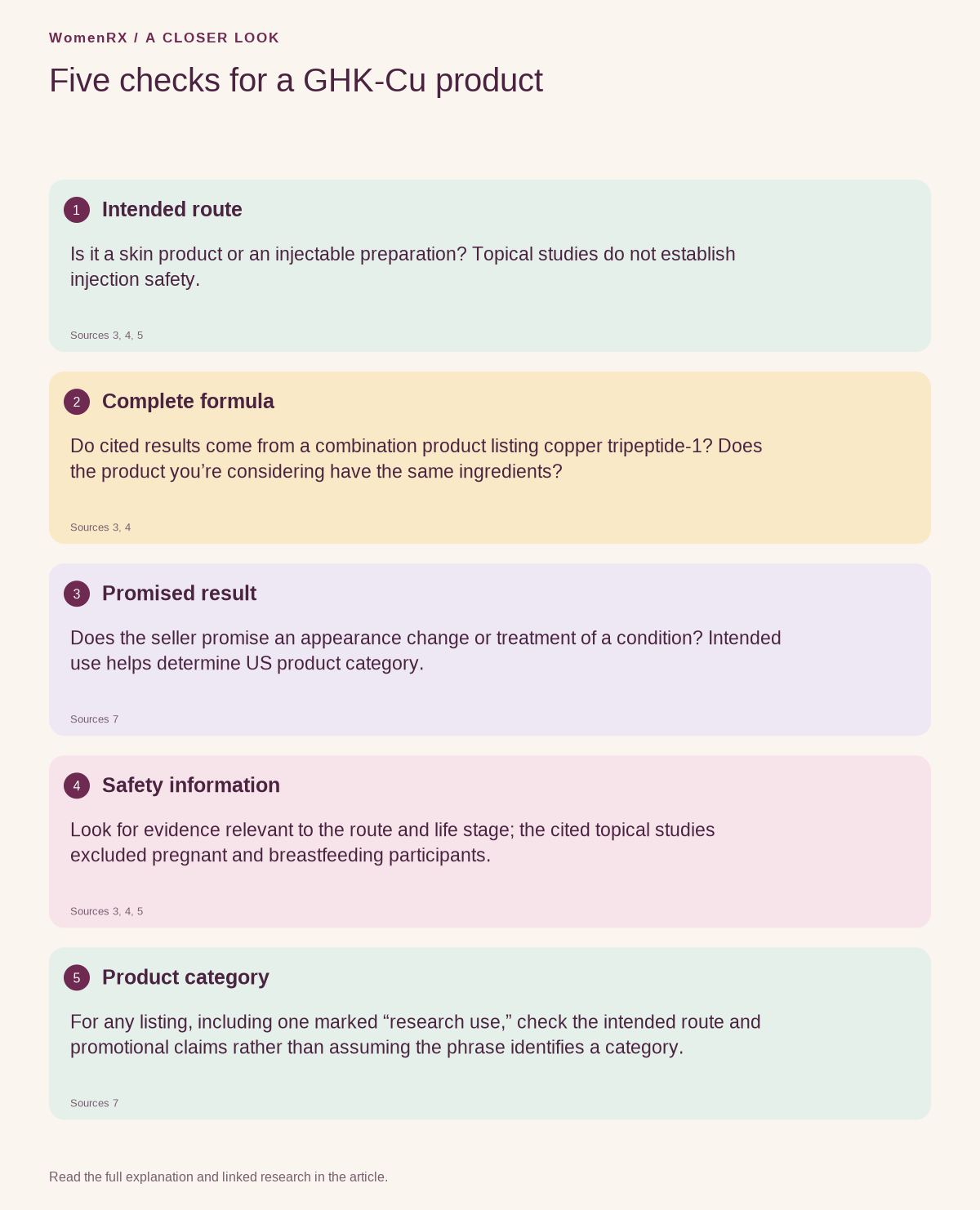
Five checks for a GHK-Cu product
Intended route: Is it a skin product or an injectable preparation? Topical studies do not establish injection safety.345
Complete formula: Do cited results come from a combination product listing copper tripeptide-1? Does the product you’re considering have the same ingredients?34
Promised result: Does the seller promise an appearance change or treatment of a condition? Intended use helps determine US product category.7
Safety information: Look for evidence relevant to the route and life stage; the cited topical studies excluded pregnant and breastfeeding participants.345
Product category: For any listing, including one marked “research use,” check the intended route and promotional claims rather than assuming the phrase identifies a category.7
Read the figure as text
Use these questions to keep product identity, evidence, and route-specific safety from getting mixed together.- Intended route: Is it a skin product or an injectable preparation? Topical studies do not establish injection safety.345
- Complete formula: Do cited results come from a combination product listing copper tripeptide-1? Does the product you’re considering have the same ingredients?34
- Promised result: Does the seller promise an appearance change or treatment of a condition? Intended use helps determine US product category.7
- Safety information: Look for evidence relevant to the route and life stage; the cited topical studies excluded pregnant and breastfeeding participants.345
- Product category: For any listing, including one marked “research use,” check the intended route and promotional claims rather than assuming the phrase identifies a category.7
More questions, answered
Does a study in women establish a women-specific GHK-Cu benefit?
No. The scar-gel study enrolled women, but it tested a multi-ingredient product listing copper tripeptide-1 in an open-label study. It cannot isolate that ingredient’s effect, establish a benefit for a different product labeled GHK-Cu, or show that women respond differently from men. The scalp-regimen study enrolled adults and did not report a women-specific result in the cited findings. 34
Sources you can check
- Copper - Health Professional Fact SheetAccessed 2026-09-25Return to first citation
- Water-Soluble, Enzyme-Degradable, and Hydrolyzable STAR Particles for Enhanced Drug Delivery to Skin.Sadeqi A, Arslan Azizoğlu G, Prausnitz MR. · Advanced healthcare materials · 2026Return to first citation
- Efficacy and Safety Assessment of ThriveCo Scar Fader Gel With Scarcede™ in the Treatment of Skin Scars.Patel MN, Patel N, Merja A, Patnaik S, Maulekhi S. · Cureus · 2025Return to first citation
- An Assessment of the Safety, Efficacy, and Tolerability of a Novel Scalp Treatment Regimen Combining a Hydroxy Acid-Based Scrub and Copper Tripeptide Serum in the Management of Seborrheic Dermatitis in Adults.Patel MN, Patel N, Merja A, Patnaik S. · Cureus · 2024Return to first citation
- Certain Bulk Drug Substances for Use in Compounding that May Present Significant Safety Risks | FDAAccessed 2026-09-26Return to first citation
- Bulk Drug Substances Used in Compounding Under Section 503A of the FD&C Act | FDAAccessed 2026-09-26Return to first citation
- Is It a Cosmetic, a Drug, or Both? (Or Is It Soap?) | FDAAccessed 2026-09-26Return to first citation
- 21CFR216.23, displayed current through September24,2026Accessed 2026-09-26Return to first citation
- FDA503A nominated substances: current linked May14,2026 listAccessed 2026-09-26Return to first citation