Copper Peptides After Menopause: What Skin Evidence Shows
Controlled studies in aged skin have reported improvements, but the published review summary doesn’t establish a benefit specifically for postmenopausal skin.
GHK-Cu, a peptide bound to copper, has some human skin evidence: a review reports improvements in firmness, elasticity, and wrinkles in controlled studies of aged skin. It doesn’t identify participants’ menopause status or show whether a product sold today would produce similar results. That makes menopause-specific promises stronger than the evidence described. 2

What has been measured in human skin
GHK-Cu forms when the peptide GHK binds copper. A review of GHK and tissue remodeling reports controlled studies in aged skin with improvements in tightness, elasticity, firmness, fine lines, wrinkles, photodamage, and hyperpigmentation. Those are reported skin outcomes, not just predictions from laboratory work. 2
There’s a limit to how much you can take from that report when choosing a serum. The review’s abstract doesn’t give participant counts, the size of the improvements, the study preparations, or enough methods to assess the results closely. It doesn’t establish that a finished cosmetic on a store shelf matches what was studied. 2
Why “aged skin” doesn’t answer the menopause question
If you’re considering copper peptides because a product is marketed for skin after menopause, the key question is whether researchers identified postmenopausal participants and measured their results. The aged-skin review summary doesn’t report that information. Its findings may be relevant to a concern you have, such as fine lines, but they don’t establish that GHK-Cu has a particular effect because someone is postmenopausal. They also don’t show that it works differently before and after menopause. 2
That distinction helps you read a claim precisely. “Studied for wrinkles in aged skin” reflects the outcomes the review reports. “Proven to restore menopausal skin” adds a population and a promise those reported details don’t support.
Why the mechanism sounds convincing
A separate review describes antioxidant, anti-inflammatory, and tissue-remodeling effects of GHK-Cu in in vitro and in vivo research. These findings offer a reason to investigate its skin effects. They aren’t a measure of how much a cream changes the appearance of someone’s face. 1
For a product you’re thinking of buying, the useful question is more specific than “Does copper support skin?” Ask what outcome was measured, in whom, and whether the evidence concerns GHK-Cu itself or the finished formula. A claim about collagen-related activity, for example, isn’t interchangeable with a measured change in visible wrinkles. 1 2
The fair takeaway: GHK-Cu isn’t supported solely by a proposed mechanism, because a review does report controlled aged-skin findings. But those findings aren’t a reliable forecast for a particular product or proof of a menopause-specific benefit. 2
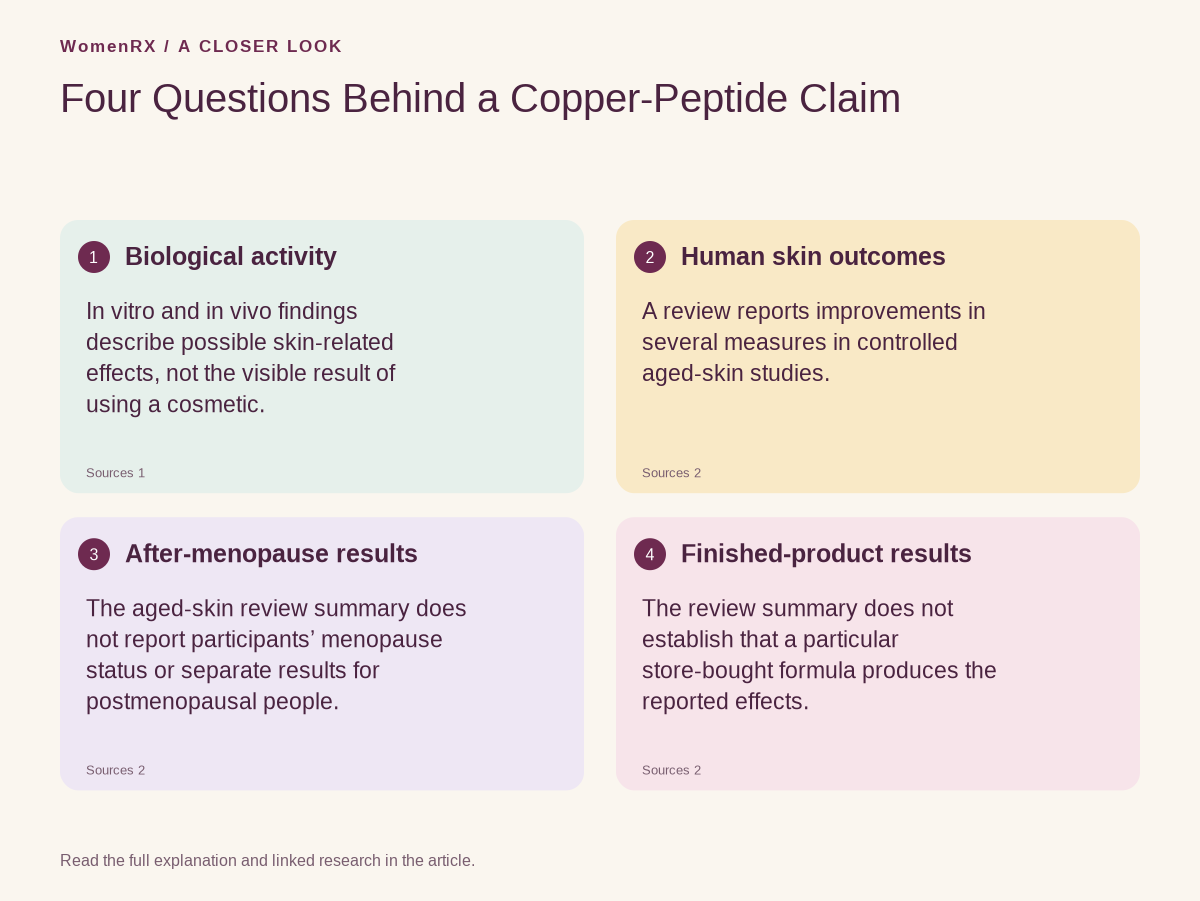
Four Questions Behind a Copper-Peptide Claim
Biological activity: In vitro and in vivo findings describe possible skin-related effects, not the visible result of using a cosmetic.1
Human skin outcomes: A review reports improvements in several measures in controlled aged-skin studies.2
After-menopause results: The aged-skin review summary does not report participants’ menopause status or separate results for postmenopausal people.2
Finished-product results: The review summary does not establish that a particular store-bought formula produces the reported effects.2
Read the figure as text
A claim about GHK-Cu can refer to biological activity, measured skin outcomes, a particular population, or a finished product. Each requires different evidence.- Biological activity: In vitro and in vivo findings describe possible skin-related effects, not the visible result of using a cosmetic.1
- Human skin outcomes: A review reports improvements in several measures in controlled aged-skin studies.2
- After-menopause results: The aged-skin review summary does not report participants’ menopause status or separate results for postmenopausal people.2
- Finished-product results: The review summary does not establish that a particular store-bought formula produces the reported effects.2
Sources you can check
- The potential of GHK as an anti-aging peptide.Dou Y, Lee A, Zhu L, Morton J, Ladiges W. · Aging pathobiology and therapeutics · 2020Return to first citation
- The human tri-peptide GHK and tissue remodeling.Pickart L. · Journal of biomaterials science. Polymer edition · 2008Return to first citation