Copper Peptides for Hair Loss: What Women Should Know
A promising result in mice doesn’t show that copper peptides regrow hair in women.
The hair-growth research described here tested GHK-Cu in a specially designed topical delivery system and a mouse model, not in women with hair thinning. It therefore can’t show that copper-peptide serums, oral copper, or treatment for female-pattern hair loss work. Because hair loss can have different causes, getting an assessment of what’s behind it is a more useful first move than relying on a growth claim. 12
What the study tested, and what it didn’t
GHK-Cu is a copper-bound peptide. In a recent study, researchers developed a particular topical microemulsion to improve how the peptide penetrates skin. They tested the delivery system in laboratory and skin-penetration experiments, then assessed hair growth in mice after hair removal. Minoxidil was included as a comparator in the mouse experiment. 2
The mouse findings are a reason to investigate the approach further, not evidence that it regrows hair on a woman’s scalp. The study details report no human hair-growth trial and no results in women or people with female-pattern hair loss. A result in a mouse hair-cycle model can’t establish a treatment effect in people. 2
The formulation matters, too. The experiment used a purpose-built carrier because getting GHK-Cu through the skin is a challenge. Its results don’t show that a different serum or cosmetic formula will deliver the peptide in the same way, or produce the same outcome. And because the experiment used a topical formulation, it doesn’t show that taking copper by mouth helps hair grow. 2
Hair thinning can have different causes
Hair loss isn’t one condition with one solution. Female-pattern hair loss can be persistent, while hair loss associated with an illness may be temporary. The NHS advises seeking an assessment of the cause, since treatment may help some types of hair loss. 1
That makes cause-finding more useful than starting with a product’s broad promise to “support growth.” If you’re noticing thinning, ask what pattern or cause might explain it and whether there are options that fit that type. An assessment can help connect the problem to a relevant next step before you spend money on a commercial hair treatment. 1
How to read a copper-peptide claim
Look for the actual hair outcome and the people studied, not just a claim about ingredients or skin delivery. A study showing that a specialized formula penetrates skin, or changes a laboratory measure, is not the same as a study showing that hair grows in women. 2
For now, this research doesn’t establish copper peptides as a treatment for women’s hair loss. It also doesn’t tell us whether results from this particular mouse-tested formulation would apply to other products. Keep the distinction in mind, and don’t let trying a serum take the place of finding out why your hair is thinning. 12
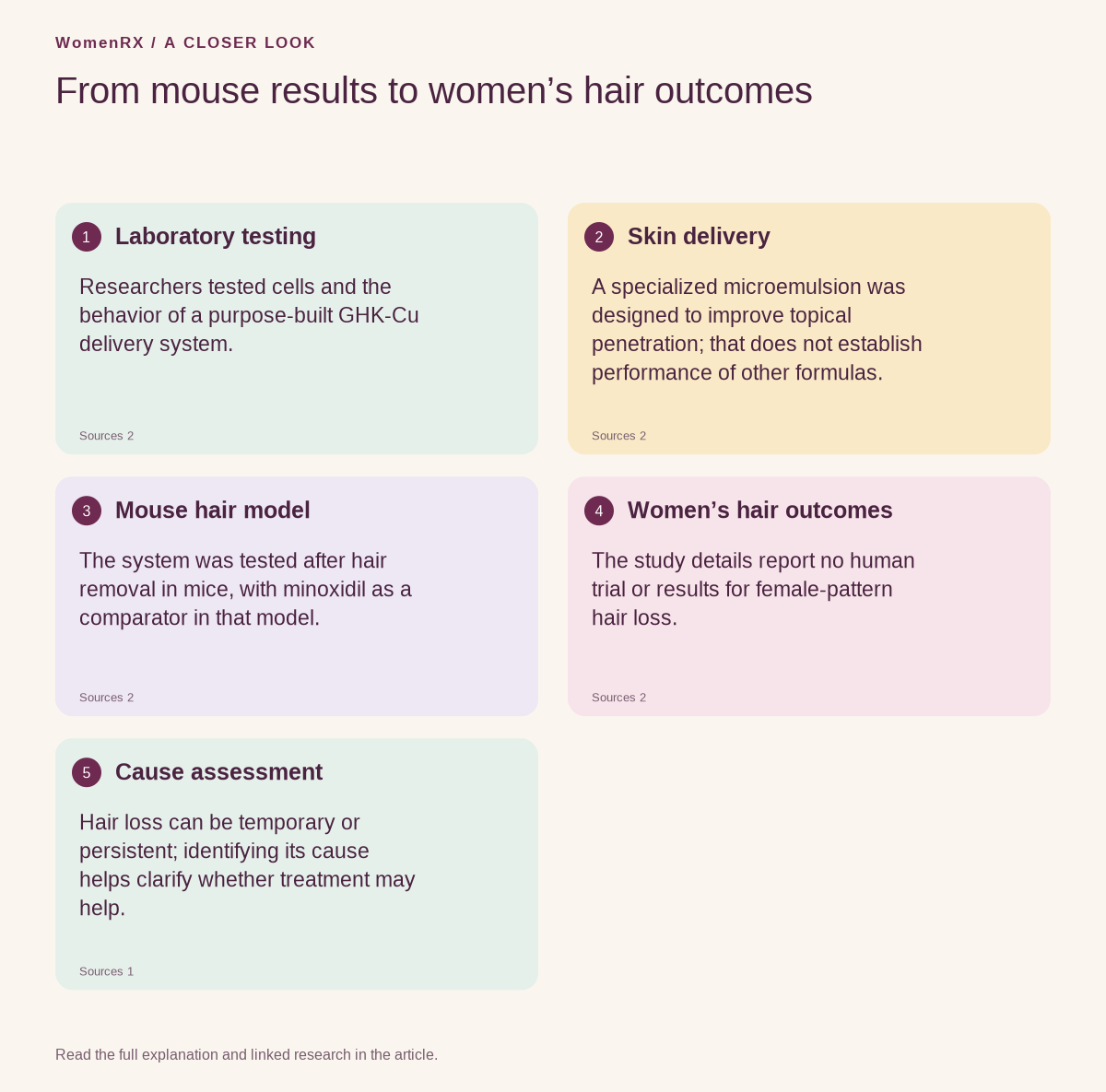
From mouse results to women’s hair outcomes
Laboratory testing: Researchers tested cells and the behavior of a purpose-built GHK-Cu delivery system.2
Skin delivery: A specialized microemulsion was designed to improve topical penetration; that does not establish performance of other formulas.2
Mouse hair model: The system was tested after hair removal in mice, with minoxidil as a comparator in that model.2
Women’s hair outcomes: The study details report no human trial or results for female-pattern hair loss.2
Cause assessment: Hair loss can be temporary or persistent; identifying its cause helps clarify whether treatment may help.1
Read the figure as text
The research tests a specialized delivery system and a mouse hair model; it does not report hair-growth results in women.- Laboratory testing: Researchers tested cells and the behavior of a purpose-built GHK-Cu delivery system.2
- Skin delivery: A specialized microemulsion was designed to improve topical penetration; that does not establish performance of other formulas.2
- Mouse hair model: The system was tested after hair removal in mice, with minoxidil as a comparator in that model.2
- Women’s hair outcomes: The study details report no human trial or results for female-pattern hair loss.2
- Cause assessment: Hair loss can be temporary or persistent; identifying its cause helps clarify whether treatment may help.1
More questions, answered
Does the study show that taking copper helps hair grow?
No. The hair-growth experiment tested a topical GHK-Cu delivery system in mice, not oral copper supplements. It can’t establish a benefit from taking copper for hair loss. 2
Did the study test copper peptides for female-pattern hair loss?
The study’s hair-growth experiment was in mice, and the reported results don’t include women or people with female-pattern hair loss. It can’t show that GHK-Cu treats that condition. 2
Sources you can check
- Hair loss - NHSAccessed 2026-09-25Return to first citation
- Thermodynamically stable ionic liquid microemulsions pioneer pathways for topical delivery and peptide application.Liu T, Liu Y, Zhao X, Zhang L, Wang W, Bai, Liao Y, Wang Z, Wang M, Zhang J. · Bioactive materials · 2024Return to first citation