GHK-Cu for Skin: What Human Studies Show
A few small reports describe skin changes with specific GHK-Cu creams, but they don’t show what a different product will do.
Human research on topical GHK-Cu is not limited to lab studies: a 2025 review describes three small studies reporting changes in collagen-related measures or photoaged skin. But the review’s abstract also says clinical studies are absent, contradicting its own study summaries. The findings are preliminary, tied to particular creams, and can’t predict results from a different retail formula. 3
GHK-Cu has a plausible skin-repair story. In cell studies, it has been associated with changes in collagen and other connective-tissue processes. That gives researchers a reason to study it, but a cell response is not the same as a visible, dependable benefit from a face cream. 2 3
What the reported human studies found
A 2025 review describes three small human studies of topical GHK-Cu. Its account needs some caution: the abstract says there is a “surprising absence of clinical studies” using GHK-Cu, while the body describes those three volunteer studies. That internal inconsistency makes it hard to treat the review as a clear inventory of the clinical evidence. The findings below are what its study summaries report, not a settled estimate of how well the ingredient works. 3
In a one-month study of 20 volunteers, 10 used GHK-Cu cream on one thigh and melatonin cream on the other. The other 10 used vitamin C cream on one thigh and retinoic acid cream on the other. Biopsies were reported to show increased procollagen synthesis in 70% of the volunteers treated with GHK-Cu, compared with 50% for vitamin C and 40% for retinoic acid. These percentages describe the share of participants reported to have a response, not how large the change was or whether it was noticeable in everyday appearance. The review doesn’t provide participants’ ages or enough detail to judge the study methods fully. 3
The review also describes two 12-week studies in women with photoaged skin. One included 41 women with skin changes around the eyes; the other included 71 women with facial photoaging. The review reports that the eye-area cream improved lines and wrinkles and increased skin thickness and density compared with placebo or a vitamin K cream. For the facial study, it reports improved skin density and thickness, laxity, fine lines, and wrinkle depth. The review doesn’t give participants’ ages or enough study-design detail to establish how confidently those results can be interpreted. 3
These reports are worth distinguishing from laboratory findings, but they don’t establish how substantial or lasting the changes were. Nor do findings in women with photoaged skin demonstrate a menopause-specific benefit. 3
Why one cream’s results don’t transfer automatically
A topical product is more than its headline ingredient. GHK-Cu, GHK without copper, and Pal-GHK, a modified form of GHK, are distinct preparations. The 2025 review discusses differences in skin permeability and formulation challenges, including the fact that lab permeability results and a product’s ability to improve skin in people are different questions. 3
That distinction matters when you’re weighing a retail claim. The reported human outcomes concern particular creams. They don’t show that another cream with GHK-Cu will deliver the same amount of ingredient to skin or produce the same result. Even a study showing that a peptide affects cells or passes through a model of skin can’t establish that a finished product reduces wrinkles in people. 2 3
A GHK-Cu-coated tissue scaffold, for example, was studied for cell attachment, cell growth, and antibacterial properties. That kind of research may inform work on materials and tissue repair, but it does not test whether a cosmetic cream changes the appearance of someone’s skin. 1
A more useful way to read the claim
When a product promises smoother or firmer-looking skin, look for evidence on the finished formula, not just on the ingredient family. Ask what was tested, who used it, which skin outcome was measured, and for how long. A study of a specific cream offers more direct evidence for that cream than a claim based on collagen mechanisms or peptide research in cells. It still doesn’t guarantee an identical result for every person.
The fairest summary is that topical GHK-Cu has some encouraging human reports, including studies in women with photoaged skin, but the evidence is small and inconsistently presented. The ingredient name alone isn’t enough to forecast what a product on a store shelf will do. 3
From lab finding to product claim
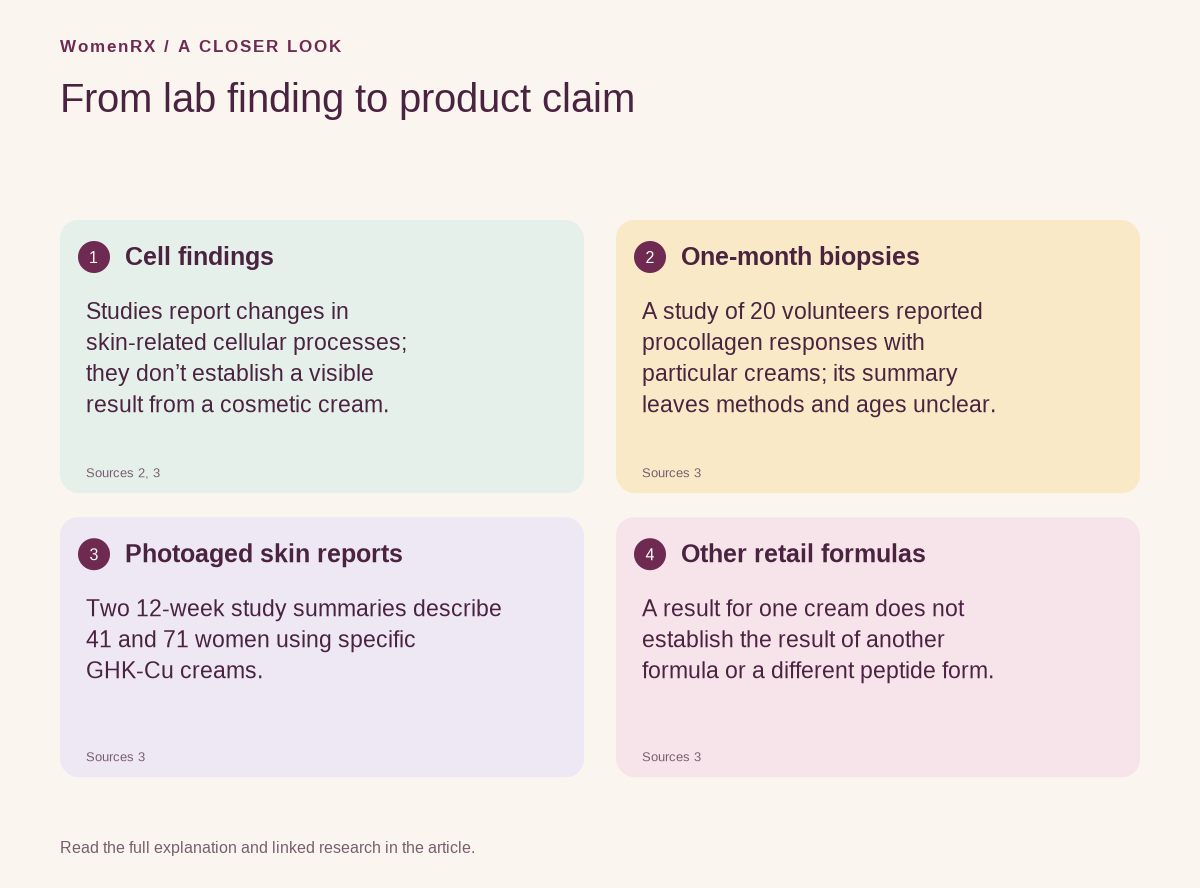
Cell findings: Studies report changes in skin-related cellular processes; they don’t establish a visible result from a cosmetic cream.23
One-month biopsies: A study of 20 volunteers reported procollagen responses with particular creams; its summary leaves methods and ages unclear.3
Photoaged skin reports: Two 12-week study summaries describe 41 and 71 women using specific GHK-Cu creams.3
Other retail formulas: A result for one cream does not establish the result of another formula or a different peptide form.3
Read the figure as text
These evidence types answer different questions. Human findings are more directly relevant to skin outcomes, but results for a tested cream still don’t prove another formula will work the same way.- Cell findings: Studies report changes in skin-related cellular processes; they don’t establish a visible result from a cosmetic cream.23
- One-month biopsies: A study of 20 volunteers reported procollagen responses with particular creams; its summary leaves methods and ages unclear.3
- Photoaged skin reports: Two 12-week study summaries describe 41 and 71 women using specific GHK-Cu creams.3
- Other retail formulas: A result for one cream does not establish the result of another formula or a different peptide form.3
More questions, answered
Were the people in the studies women?
The review identifies 41 women in the eye-area study and 71 women in the facial study. It doesn’t report their ages in the summary. The sex of the 20 volunteers in the one-month biopsy study isn’t specified there. 3
Does a lab permeability result prove a cream works?
No. A permeability experiment can examine whether a peptide passes through a skin model under test conditions. It doesn’t show that a finished cream improves wrinkles or other skin outcomes in people. 3
Sources you can check
- Enhanced biological properties of collagen/chitosan-coated poly(ε-caprolactone) scaffold by surface modification with GHK-Cu peptide and 58S bioglass.Molavi AM, Sadeghi-Avalshahr A, Nokhasteh S, Naderi-Meshkin H. · Progress in biomaterials · 2020Return to first citation
- The human tripeptide GHK-Cu in prevention of oxidative stress and degenerative conditions of aging: implications for cognitive health.Pickart L, Vasquez-Soltero JM, Margolina A. · Oxidative medicine and cellular longevity · 2012Return to first citation
- Topically applied GHK as an anti-wrinkle peptide: Advantages, problems and prospective.Mortazavi SM, Mohammadi Vadoud SA, Moghimi HR. · BioImpacts : BI · 2025Return to first citation