GHK-Cu Creams and Injections Aren’t Evidence-Equivalent
A cream may have limited skin findings behind it, but those findings can’t establish what an injected GHK-Cu product will do.
Small human studies offer limited information about creams containing GHK-Cu, but their findings don’t establish whether injected GHK-Cu improves skin or is safe.56 The product distinction matters too: a cream sold for cosmetic use and a compounded injection face different oversight, and FDA has identified potential safety risks specifically for compounded injectable GHK-Cu.79
What the cream studies actually show
GHK-Cu, also called copper tripeptide-1, is a peptide bound to copper. It appears in products marketed for skin appearance. That gives you a starting point for evaluating a cream, not a reason to expect the same result from an injection.5
One small human study described in a 2025 review applied GHK-Cu cream to the thighs of 10 volunteers for one month and examined skin biopsies. It reported a change in procollagen production, a marker related to skin structure. That isn’t the same as demonstrating a visible reduction in facial wrinkles, and the review found that published information on GHK-Cu’s skin penetration and clinical effectiveness remains limited.5
A separate study followed 32 adults, 31 of them women, who used a face cream containing both GHK-Cu and a ferment extract for 56 days. The researchers reported improvements in wrinkles and skin-barrier measures, but everyone used the combination cream. Without a comparison group using the same cream without GHK-Cu, the study can’t tell you how much of the result came from the peptide.6
So a cream has some human skin research behind it, but the formulation and the outcome measured matter. A finding from a thigh biopsy or a two-ingredient face cream isn’t a prediction of what any GHK-Cu product will do for your skin.56
Why an injection is a different question
A cream must get through the skin to reach deeper tissue. GHK-Cu’s passage through skin has been studied in laboratory setups, including experiments showing that microneedle pretreatment changes how much passes through skin samples. Those experiments help explain why delivery method matters; they don’t measure the benefit or safety of an injection in a person.5
An injection takes a different route, so neither a cosmetic result nor a skin-permeation experiment supplies its human safety profile. A review of injectable peptides found no clinical data supporting GHK-Cu for musculoskeletal conditions and said that indications and treatment schedules for the peptide approaches it examined remain uncertain. That review addresses a different proposed use, not a trial of GHK-Cu injections for facial skin.4
FDA’s assessment is more directly relevant to an injectable product: it identifies potential immune-response risks from aggregation and peptide-related impurities in compounded injectable GHK-Cu, and says human data are limited for assessing safety. This is a stated risk and an evidence gap, not a measured rate of reactions in people using it.7
The label doesn’t tell you the level of oversight
In the US, whether a skin product is a cosmetic or a drug depends on its intended use and claims, not simply on the presence of GHK-Cu. A product sold to beautify or alter appearance may be a cosmetic; claims to treat disease or affect the body’s structure or function can make a product a drug. Cosmetics, apart from color additives, do not require FDA approval before marketing. Drugs generally follow different approval requirements.9
FDA’s compounding information distinguishes the routes. GHK-Cu except for injectable routes appears in an interim category of bulk substances under evaluation for certain pharmacy compounding; its injectable nomination was withdrawn. FDA separately identifies potential safety risks for compounded injectable GHK-Cu.711 GHK-Cu is not on the final list of bulk substances for that compounding pathway. Neither the interim entry nor the final-list process establishes that a particular finished product is FDA-approved, and these lists don’t settle every possible compounding pathway.81011
If you’re comparing two products, ask what each finished product actually is and what claims its seller makes. For an injectable offer, a familiar ingredient name or a reference to compounding is not, by itself, evidence that the finished product has been evaluated for your intended use or that the vial’s contents and quality have been verified.7911
Pregnancy and breastfeeding need their own answer
Copper is an essential dietary nutrient, but dietary copper guidance does not establish the safety of applying or injecting GHK-Cu during pregnancy or breastfeeding. The cream studies above do not report route-specific pregnancy or breastfeeding outcomes, and FDA describes limited human safety data for compounded injectable GHK-Cu.1567
If you’re pregnant or breastfeeding, don’t treat the word “copper” as reassurance about a peptide product. Bring the exact product and its intended use into a conversation with your prenatal or breastfeeding care team before using it. That’s a product-specific question, not one that can be settled by a nutrient intake table or by a study of a different route.123
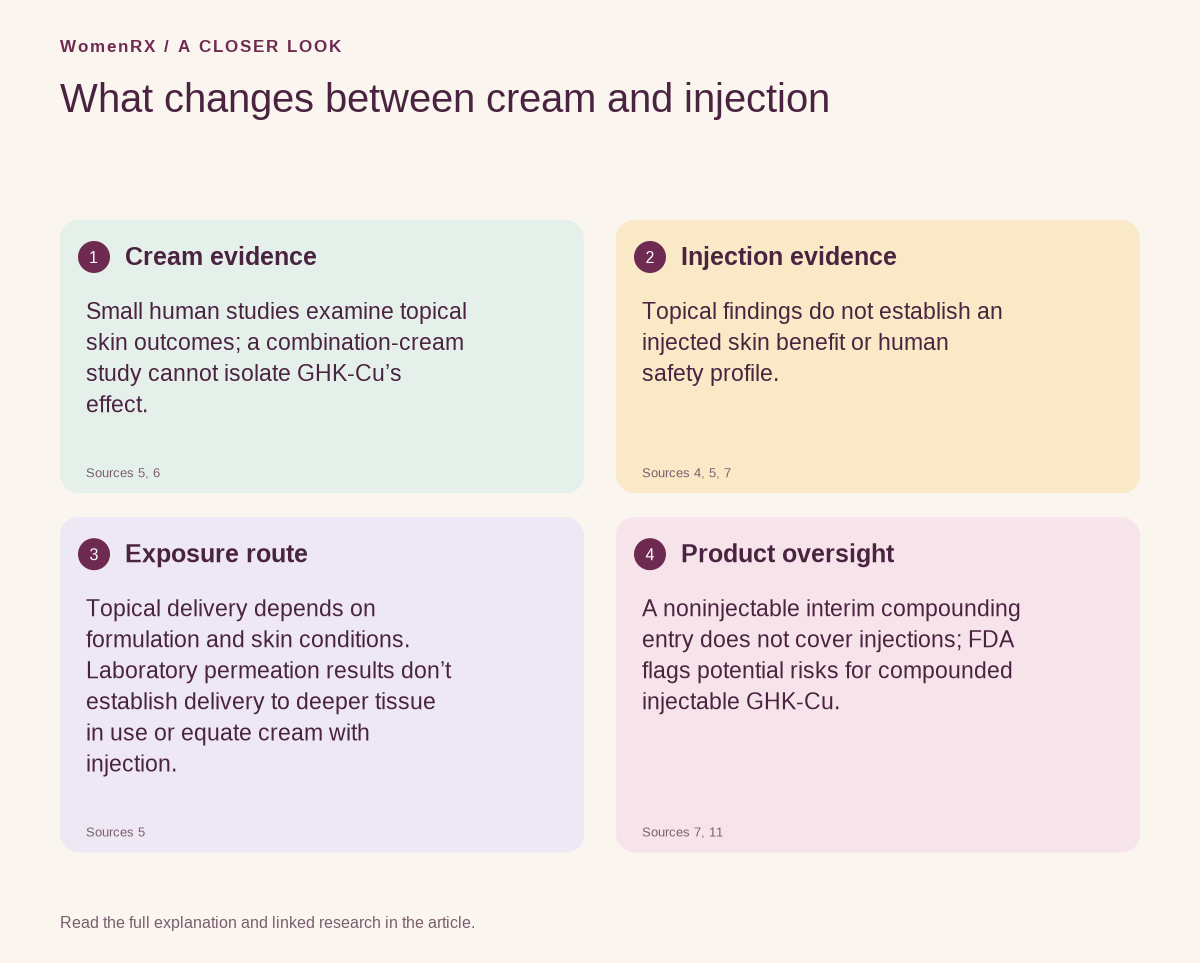
What changes between cream and injection
Cream evidence: Small human studies examine topical skin outcomes; a combination-cream study cannot isolate GHK-Cu’s effect.56
Injection evidence: Topical findings do not establish an injected skin benefit or human safety profile.457
Exposure route: Topical delivery depends on formulation and skin conditions. Laboratory permeation results don’t establish delivery to deeper tissue in use or equate cream with injection.5
Product oversight: A noninjectable interim compounding entry does not cover injections; FDA flags potential risks for compounded injectable GHK-Cu.711
Read the figure as text
The same ingredient name does not make evidence or oversight interchangeable across routes.- Cream evidence: Small human studies examine topical skin outcomes; a combination-cream study cannot isolate GHK-Cu’s effect.56
- Injection evidence: Topical findings do not establish an injected skin benefit or human safety profile.457
- Exposure route: Topical delivery depends on formulation and skin conditions. Laboratory permeation results don’t establish delivery to deeper tissue in use or equate cream with injection.5
- Product oversight: A noninjectable interim compounding entry does not cover injections; FDA flags potential risks for compounded injectable GHK-Cu.711
More questions, answered
Does an anti-wrinkle study of GHK-Cu prove an injectable works better?
No. The small human findings described here involve skin applications, including a cream with another active ingredient. They don’t compare a cream with an injection or establish an injectable benefit.56
Can I use the dietary copper upper limit to judge an injection?
No. The copper upper limits in NIH dietary guidance apply to copper from food and supplements for healthy people. They aren’t a safety threshold for injected GHK-Cu.1
Sources you can check
- Copper - Health Professional Fact SheetAccessed 2026-09-25Return to first citation
- Breastfeeding | Benefits of Breastfeeding | MedlinePlusAccessed 2026-09-25Return to first citation
- Pregnancy and Medicines | MedlinePlusAccessed 2026-09-25Return to first citation
- Injectable Peptide Therapy: A Primer for Orthopaedic and Sports Medicine Physicians.Mayfield CK, Bolia IK, Feingold CL, Lin EH, Liu JN, Rick Hatch GF, Gamradt SC, Weber AE. · The American journal of sports medicine · 2026Return to first citation
- Topically applied GHK as an anti-wrinkle peptide: Advantages, problems and prospective.Mortazavi SM, Mohammadi Vadoud SA, Moghimi HR. · BioImpacts : BI · 2025Return to first citation
- Augmented Skin Beneficial Effects of Thermus Thermophilus and Bacillus Subtilis Mixed-Culture Ferment Extract by Tripeptide GHK-Cu.Wang J, Tao K, Huang H, Chang H. · Skin research and technology : official journal of International Society for Bioengineering and the Skin (ISBS) [and] International Society for Digital Imaging of Skin (ISDIS) [and] International Society for Skin Imaging (ISSI) · 2026Return to first citation
- Certain Bulk Drug Substances for Use in Compounding that May Present Significant Safety Risks | FDAAccessed 2026-09-26Return to first citation
- Bulk Drug Substances Used in Compounding Under Section 503A of the FD&C Act | FDAAccessed 2026-09-26Return to first citation
- Is It a Cosmetic, a Drug, or Both? (Or Is It Soap?) | FDAAccessed 2026-09-26Return to first citation
- 21CFR216.23, displayed current through September24,2026Accessed 2026-09-26Return to first citation
- FDA503A nominated substances: current linked May14,2026 listAccessed 2026-09-26Return to first citation