GHK-Cu for Skin and Hair: What Human Studies Show
There’s limited human evidence for skin benefits, while a promising hair-growth experiment was done in mice.
GHK-Cu has been studied in people for some skin outcomes, but the findings don’t show that every GHK-Cu serum improves wrinkles. A small trial after laser resurfacing found no objective wrinkle advantage, while a later review reported a wrinkle benefit in its clinical findings. A topical hair-growth experiment was conducted in mice, not women with hair loss. 4 5 2
GHK-Cu is a peptide bound to copper. You may see it marketed for firmer skin and fuller hair, sometimes as though those claims have the same backing. They don’t. The useful distinction is what was tested: a skin-care regimen after a procedure, other aesthetic applications summarized in a review, or an experimental scalp-delivery system tested in mice. 4 5 2
Skin: human findings depend on the outcome
In a 2006 randomized trial, 13 participants completed a study after carbon dioxide laser resurfacing around the mouth. They used post-treatment skin-care regimens with or without GHK-Cu. Computer analysis and blinded evaluators found no significant difference between groups in how quickly redness resolved. The study also found no objective advantage for wrinkles or overall skin appearance. Participants using GHK-Cu did, however, report greater improvement in overall skin quality on a questionnaire. That’s a difference between what people reported and what the study’s objective assessments found, not proof that either result applies to daily use on skin that hasn’t been laser-treated. 4
A 2026 systematic review of GHK-Cu in aesthetic medicine included 20 studies: 18 preclinical studies and two randomized controlled trials. Its abstract reports a reduction in wrinkle volume and depth compared with controls among the clinical findings. It does not say that both trials found that wrinkle benefit. The reviewers also noted differences in methods and a limited number of well-designed clinical trials. Taken alongside the post-laser trial, this is an early signal for some skin outcomes, not a reliable prediction of what a particular cream will do. 5 4
The formula is part of the claim
GHK-Cu has difficulty passing through the skin’s outer barrier. A review of skin-permeation research describes interest in carriers called liposomes, but says that transport of liposome-encapsulated GHK-Cu through skin has received little direct study. Putting GHK-Cu in a carrier and showing that it reaches the intended skin layers are separate steps; showing a visible benefit is another. 3
For example, researchers designed an ionic-liquid microemulsion to improve topical delivery of GHK-Cu and tested hair-growth effects in mice. That result belongs to the experimental formulation. It cannot be transferred to a standard facial cream or scalp serum simply because both list a copper peptide. 2
Hair: a mouse result isn’t a result for women
The microemulsion study reported hair-growth effects and investigated related biological pathways in mice. It did not test whether GHK-Cu improves hair density, reduces shedding, or treats female-pattern hair loss in women. Nor does it establish how an ordinary scalp product would perform. The study gives researchers a reason to investigate GHK-Cu further, but it isn’t evidence of hair regrowth in people. 2
If you’re comparing product claims, ask what the study actually measured and whether its formulation matches the product. A wrinkle result doesn’t establish hair growth. A mouse study of a specialized scalp carrier doesn’t establish that a serum works for female-pattern hair loss. And neither topical line of research establishes a benefit from taking copper supplements or using a different route of GHK-Cu. 1 2 4 5
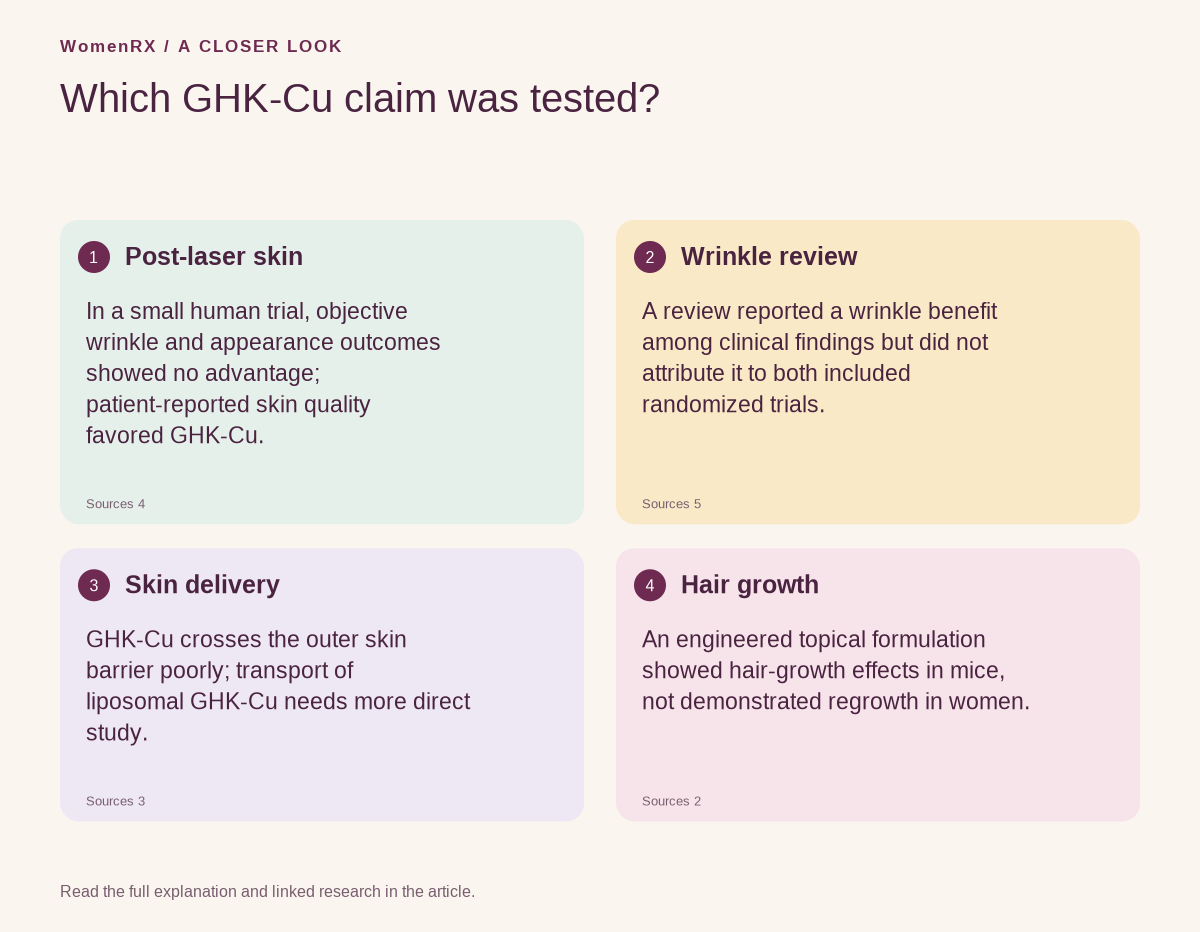
Which GHK-Cu claim was tested?
Post-laser skin: In a small human trial, objective wrinkle and appearance outcomes showed no advantage; patient-reported skin quality favored GHK-Cu.4
Wrinkle review: A review reported a wrinkle benefit among clinical findings but did not attribute it to both included randomized trials.5
Skin delivery: GHK-Cu crosses the outer skin barrier poorly; transport of liposomal GHK-Cu needs more direct study.3
Hair growth: An engineered topical formulation showed hair-growth effects in mice, not demonstrated regrowth in women.2
Read the figure as text
Separate the outcome, study setting, and formulation before applying a finding to a product.- Post-laser skin: In a small human trial, objective wrinkle and appearance outcomes showed no advantage; patient-reported skin quality favored GHK-Cu.4
- Wrinkle review: A review reported a wrinkle benefit among clinical findings but did not attribute it to both included randomized trials.5
- Skin delivery: GHK-Cu crosses the outer skin barrier poorly; transport of liposomal GHK-Cu needs more direct study.3
- Hair growth: An engineered topical formulation showed hair-growth effects in mice, not demonstrated regrowth in women.2
More questions, answered
Is taking copper the same as using a GHK-Cu product?
No. Copper is an essential dietary mineral; GHK-Cu is a copper-bound peptide studied in particular topical formulations. Information about dietary copper does not show that a GHK-Cu product improves skin or grows hair. 1 3
Sources you can check
- Copper - Health Professional Fact SheetAccessed 2026-09-25Return to first citation
- Thermodynamically stable ionic liquid microemulsions pioneer pathways for topical delivery and peptide application.Liu T, Liu Y, Zhao X, Zhang L, Wang W, Bai, Liao Y, Wang Z, Wang M, Zhang J. · Bioactive materials · 2024Return to first citation
- Are We Ready to Measure Skin Permeation of Modern Antiaging GHK-Cu Tripeptide Encapsulated in Liposomes?Ogórek K, Nowak K, Wadych E, Ruzik L, Timerbaev AR, Matczuk M. · Molecules (Basel, Switzerland) · 2025Return to first citation
- Effects of topical copper tripeptide complex on CO2 laser-resurfaced skin.Miller TR, Wagner JD, Baack BR, Eisbach KJ. · Archives of facial plastic surgery · 2006Return to first citation
- The Regenerative Potential of GHK-Cu in Aesthetic Medicine.Mokhtar J, Mohamad B, Haddad J, Said A, Menon A, Kreutz-Rodrigues L, Vyas KS, Cetrulo CL, Lellouch AG. · Aesthetic surgery journal · 2026Return to first citation