GHK-Cu for Skin: What Human Studies Have Measured
A small study of a cream containing GHK-Cu reported changes in wrinkles and skin condition, but it can’t show what the peptide alone does.
The clearest human finding is an early signal, not proof that GHK-Cu alone improves skin. In a study of 32 adults, mostly women, researchers tested a cream containing both GHK-Cu and a fermented extract and reported improvements in wrinkles and several skin measures. Because the ingredients were combined, the results don’t establish the effect of GHK-Cu by itself, or whether it reduces irritation. 1
What the human study actually tested
A 2026 study tested a face cream containing 0.2% GHK-Cu and 5% ferment extract. The clinical group included 32 adults with sensitive skin, ages 30 to 57: 31 were women and one was a man. Researchers reported improvements in wrinkles, water content, elasticity, skin tone, and barrier condition. 1
That’s relevant human evidence, but it applies to the tested cream, not automatically to every product labeled with copper peptides. The formula combined GHK-Cu with a ferment extract, so the study can’t tell how much either ingredient contributed or whether their combination mattered. The reported study details don’t give effect sizes or enough information to judge how large or lasting the changes were. 1
Match each claim to the outcome
Wrinkles and appearance: The combination cream study reported fewer wrinkles, along with changes in elasticity and skin tone. That offers an early product-level signal for appearance, not proof that GHK-Cu alone smooths wrinkles. 1
Hydration and barrier condition: The same study reported improvements in water content and skin barrier condition. Those are different outcomes from wrinkle appearance. They don’t, by themselves, show that the cream treats a skin condition or makes sensitive skin less reactive. 1
Irritation or sensitivity: The participants had sensitive skin, but the reported results focus on skin measurements and appearance. They don’t provide a clear finding about irritation, such as how often it occurred or whether the cream reduced stinging or redness. Being tested in people with sensitive skin isn’t the same as demonstrating an anti-irritation effect. 1
Why lab findings aren’t the same as a skin-care result
A review of GHK’s potential as an anti-aging peptide describes anti-inflammatory and tissue-remodeling effects reported in laboratory and other preclinical research. Those findings help explain why researchers study the ingredient, but they don’t establish a visible benefit from a cream in everyday use. The review itself calls for more clinical research. 2
The 2026 study also tested the combination in human skin explants exposed to ultraviolet light. That’s useful for studying tissue responses, but an explant is not the same as a person using a product over time. And because the explant cream contained both ingredients, it still doesn’t isolate GHK-Cu’s contribution. 1
A fair way to compare product claims
When you see a GHK-Cu claim, ask what was tested: the peptide as a stand-alone ingredient, a finished product, or a blend? Then look for the outcome. A wrinkle claim needs human measurements of wrinkles; a barrier claim needs barrier-related measures; and an irritation claim needs clear tolerability or irritation results. Evidence for one outcome shouldn’t be used as proof of another.
Concentration and the rest of the formula matter when comparing products because the human study tested one specific cream with two active ingredients. Its results can’t establish that a different concentration, cream base, or product will perform the same way. The study’s 0.2% GHK-Cu concentration describes what researchers tested; it isn’t a recommended product level. 1
For now, the most grounded summary is modest: one small study in a group made up almost entirely of women reported improvements across several skin measures from a combination cream. It does not establish that GHK-Cu alone changes skin appearance, prevents irritation, or produces the same result in other formulations. 1
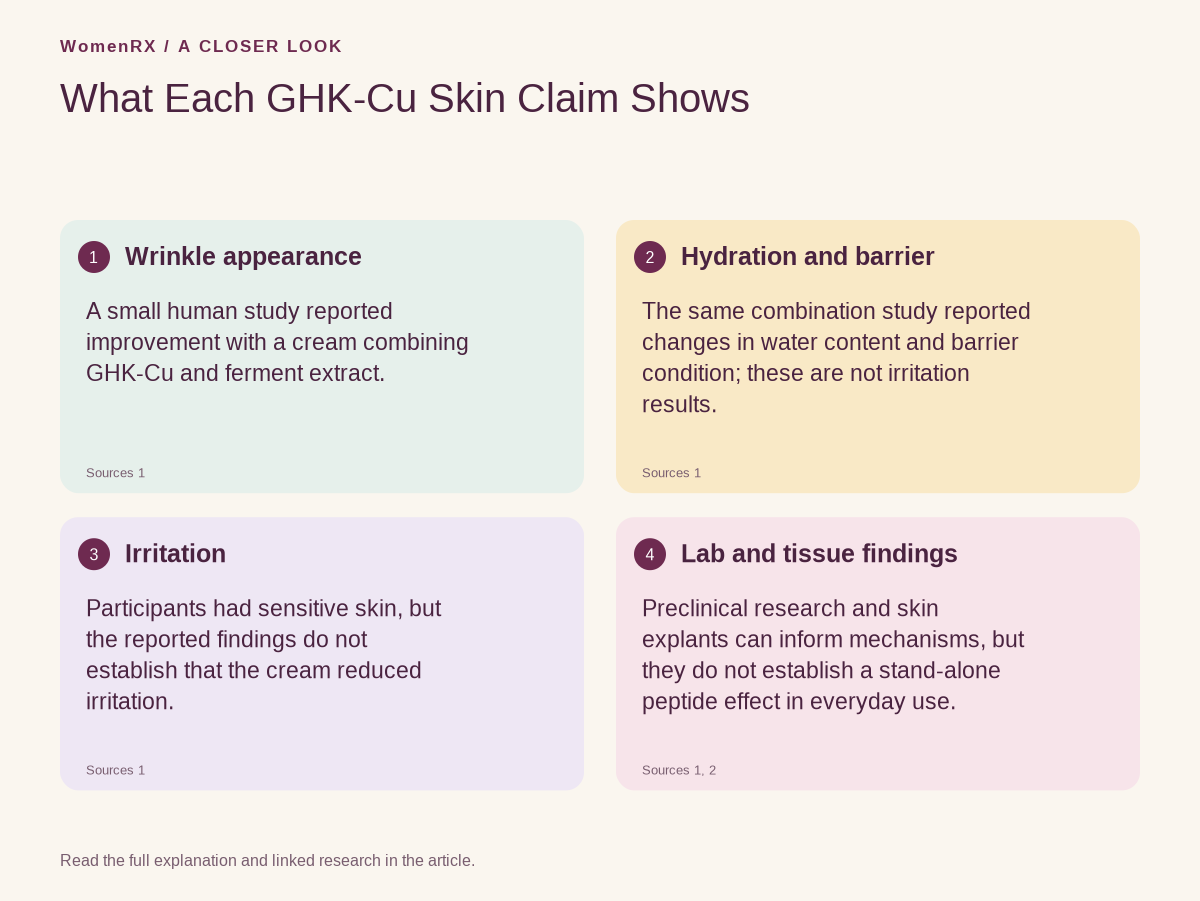
What Each GHK-Cu Skin Claim Shows
Wrinkle appearance: A small human study reported improvement with a cream combining GHK-Cu and ferment extract.1
Hydration and barrier: The same combination study reported changes in water content and barrier condition; these are not irritation results.1
Irritation: Participants had sensitive skin, but the reported findings do not establish that the cream reduced irritation.1
Lab and tissue findings: Preclinical research and skin explants can inform mechanisms, but they do not establish a stand-alone peptide effect in everyday use.12
Read the figure as text
The measured outcome and study type determine what a finding can support. The human results here come from one combination cream, not GHK-Cu tested alone.- Wrinkle appearance: A small human study reported improvement with a cream combining GHK-Cu and ferment extract.1
- Hydration and barrier: The same combination study reported changes in water content and barrier condition; these are not irritation results.1
- Irritation: Participants had sensitive skin, but the reported findings do not establish that the cream reduced irritation.1
- Lab and tissue findings: Preclinical research and skin explants can inform mechanisms, but they do not establish a stand-alone peptide effect in everyday use.12
More questions, answered
Does GHK-Cu have evidence for reducing skin irritation?
The human study included people with sensitive skin and reported changes in barrier condition, but it doesn’t provide a clear result showing that GHK-Cu reduced irritation. It also tested GHK-Cu with a ferment extract, so any effect can’t be assigned to the peptide alone. 1
Sources you can check
- Augmented Skin Beneficial Effects of Thermus Thermophilus and Bacillus Subtilis Mixed-Culture Ferment Extract by Tripeptide GHK-Cu.Wang J, Tao K, Huang H, Chang H. · Skin research and technology : official journal of International Society for Bioengineering and the Skin (ISBS) [and] International Society for Digital Imaging of Skin (ISDIS) [and] International Society for Skin Imaging (ISSI) · 2026Return to first citation
- The potential of GHK as an anti-aging peptide.Dou Y, Lee A, Zhu L, Morton J, Ladiges W. · Aging pathobiology and therapeutics · 2020Return to first citation