Copper Peptides in Skin Care: What Safety Evidence Can Tell You
A lab study found low irritation potential for GHK-Cu in skin cells, but that doesn’t establish how a finished serum will feel on your skin.
GHK-Cu is a specific copper-peptide complex, and limited laboratory findings suggest it caused less irritation-related activity in cultured skin cells than two other copper compounds. That isn’t a safety test of every cosmetic formula, or proof that copper-peptide products deliver their advertised results. If your skin is already irritated, wait; otherwise, check the ingredient list and try any new product cautiously. 1
What the research does, and doesn’t, say
GHK-Cu is the copper complex of the peptide glycyl-L-histidyl-L-lysine. In a laboratory study, researchers treated cultured skin cells with GHK-Cu and two other copper compounds. GHK-Cu did not show cytotoxicity or a significant change in the irritation-related markers they measured, while copper chloride and copper acetate changed several markers at the tested concentrations. This is a useful early comparison between compounds, not a clinical trial of people using face products. 1
A separate study looked at GHK-Cu delivered through skin pretreated with microneedles. It used skin models and reported little penetration through intact human skin compared with microneedle-treated skin. That experimental delivery method is different from applying an ordinary cosmetic serum, so its results don’t establish how much a typical product penetrates or how well it works. 2
The practical distinction is simple: evidence about the ingredient under laboratory conditions is not evidence that every finished product is effective or well tolerated. A formula also contains other ingredients, and the studies here don’t compare retail products or establish their real-world irritation rates.
A cautious way to assess a product
Start with the label and the claim. Check whether the product identifies GHK-Cu, rather than relying only on broad phrases such as “copper complex” or “peptide technology.” Then ask what the product promises. This evidence does not establish that a cosmetic GHK-Cu product reduces wrinkles, repairs skin, or changes pigmentation in people. A confident claim on the package is not the same as a demonstrated result.
If your skin is calm and you choose to try a product, introduce just that one new product and test a small area first. This can help you notice an obvious reaction, but it cannot guarantee that your skin will tolerate continued use. Don’t start while your skin is actively irritated. Stop using the product if it causes persistent itching, redness, swelling, or pain. These are among the signs associated with skin irritation described in the research. 1
The cell study compared GHK-Cu with copper salts, not with every copper-containing ingredient or finished formula. So a reaction doesn’t tell you that copper peptides as a whole are the cause; other parts of the formula may matter too. If symptoms are severe, spreading, or don’t settle after stopping the product, seek medical advice rather than trying to push through.
Skin changes across life stages
The available GHK-Cu irritation findings don’t establish different effects during pregnancy, postpartum, perimenopause, or postmenopause. They also don’t show that copper peptides work differently by sex. If your skin has become more reactive during one of these stages, that experience is a reason to be especially cautious with any new product, not evidence that GHK-Cu has a proven life-stage-specific effect.
For now, judge a copper-peptide product by what its own evidence can support, how your skin responds, and whether its claims go beyond what has been demonstrated. A low-irritation signal in cultured cells is encouraging as an early finding, but it is not a guarantee for your skin or a finished formula. 1
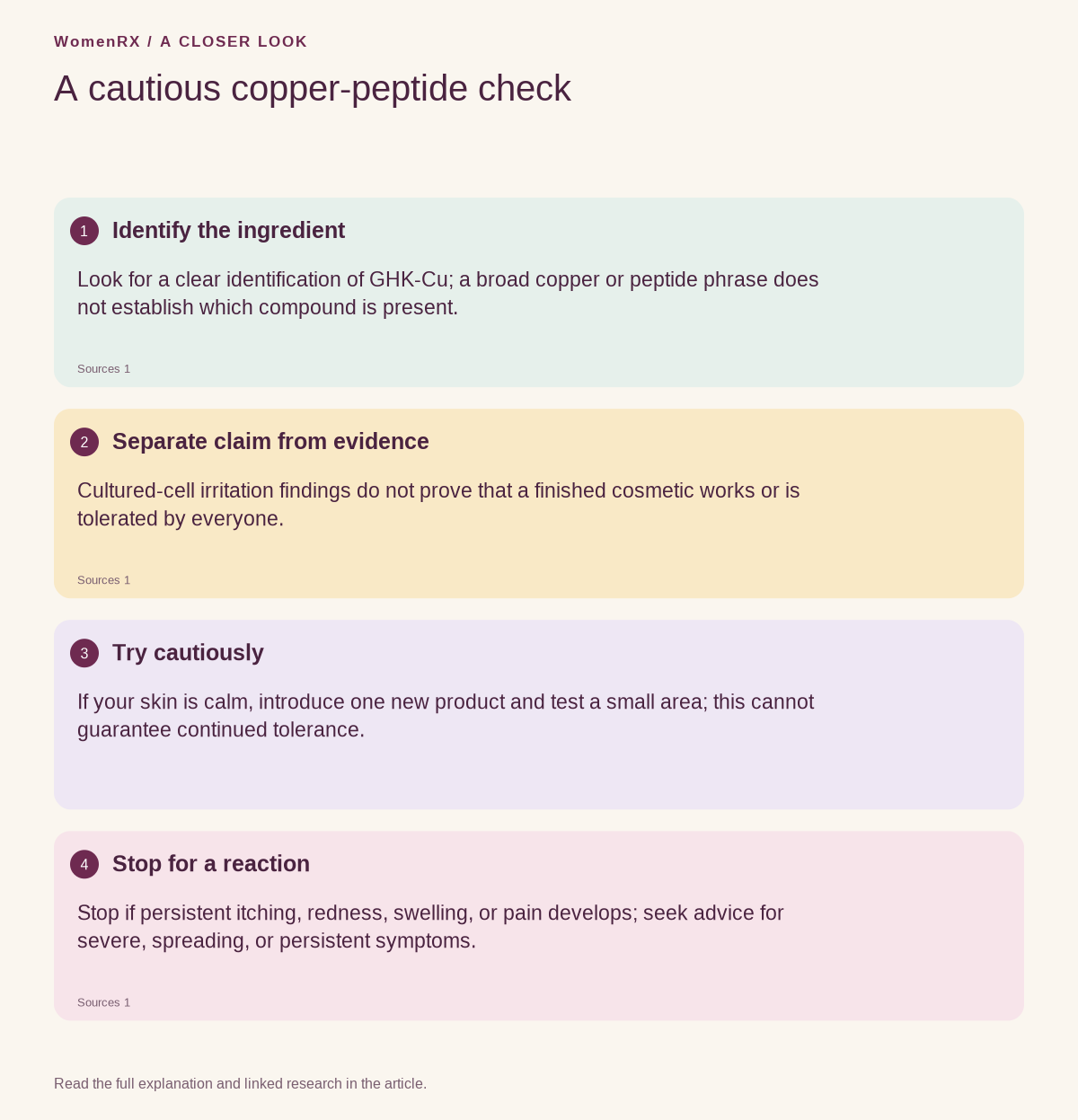
A cautious copper-peptide check
Identify the ingredient: Look for a clear identification of GHK-Cu; a broad copper or peptide phrase does not establish which compound is present.1
Separate claim from evidence: Cultured-cell irritation findings do not prove that a finished cosmetic works or is tolerated by everyone.1
Try cautiously: If your skin is calm, introduce one new product and test a small area; this cannot guarantee continued tolerance.
Stop for a reaction: Stop if persistent itching, redness, swelling, or pain develops; seek advice for severe, spreading, or persistent symptoms.1
Read the figure as text
Use these distinctions to assess the label, the evidence behind a claim, and your skin’s response without treating an ingredient study as proof about a finished formula.- Identify the ingredient: Look for a clear identification of GHK-Cu; a broad copper or peptide phrase does not establish which compound is present.1
- Separate claim from evidence: Cultured-cell irritation findings do not prove that a finished cosmetic works or is tolerated by everyone.1
- Try cautiously: If your skin is calm, introduce one new product and test a small area; this cannot guarantee continued tolerance.
- Stop for a reaction: Stop if persistent itching, redness, swelling, or pain develops; seek advice for severe, spreading, or persistent symptoms.1
More questions, answered
Does a small-area test prove a copper-peptide product is safe?
No. It may help you notice an obvious reaction, but it can’t guarantee future tolerance or establish that a product is effective. The GHK-Cu irritation finding came from cultured skin cells, not a test of people using finished products. 1
Sources you can check
- Selected Biomarkers Revealed Potential Skin Toxicity Caused by Certain Copper Compounds.Li H, Toh PZ, Tan JY, Zin MT, Lee CY, Li B, Leolukman M, Bao H, Kang L. · Scientific reports · 2016Return to first citation
- Microneedle-Mediated Delivery of Copper Peptide Through Skin.Li H, Low YS, Chong HP, Zin MT, Lee CY, Li B, Leolukman M, Kang L. · Pharmaceutical research · 2015Return to first citation