Celiac Disease or Gluten Sensitivity: What Testing Tells You
If gluten seems to trigger symptoms, testing for celiac disease before changing your diet can make the answer much clearer.
Celiac disease and non-celiac gluten sensitivity can cause similar symptoms, but only celiac disease causes the characteristic small-intestine damage. Celiac testing usually starts with blood tests while you’re eating gluten and may include a small-intestine biopsy. Going gluten-free first can make those tests harder to interpret. Gluten sensitivity has no specific diagnostic blood test; clinicians consider it after evaluating for celiac disease and, when relevant, wheat allergy.1567
Why the distinction matters
Bloating, abdominal pain, diarrhea, or fatigue after eating wheat might make gluten look like the obvious culprit. Those symptoms alone can’t tell you which condition, if any, you have. Celiac disease is an autoimmune response to gluten that damages the small intestine. Non-celiac gluten sensitivity can cause overlapping symptoms without that characteristic damage. Wheat allergy is different again and can include symptoms such as itchy eyes or trouble breathing.156
The distinction affects more than the name on your chart. Confirmed celiac disease calls for lifelong, strict avoidance of gluten and follow-up for nutritional problems and other effects of the disease. When celiac disease has been ruled out, a clinician may consider gluten sensitivity, but there is no single blood test that confirms it.567
Start with the question of gluten intake
If you’re still eating gluten, tell the clinician you’d like to be evaluated before you cut it out. Celiac blood tests look for an immune response while gluten is part of your diet, and the intestinal changes sought on biopsy can also fade after you stop eating it. A negative test after a period of gluten avoidance may therefore leave the original question unanswered.25
If you’ve already stopped, say so when discussing any test result. Genetic testing for celiac-associated HLA genes can sometimes help in that situation: a negative result can rule out celiac disease, while a positive result shows susceptibility, not a diagnosis. Further evaluation may involve a supervised return to eating gluten, but that can bring symptoms back, and there isn’t a one-size-fits-all plan to start on your own.25
What celiac testing looks for
The usual starting point is celiac blood testing, particularly an IgA antibody test against tissue transglutaminase, often called tTG-IgA. Depending on the results, other antibody tests may help. A clinician may also recommend an upper endoscopy to take small-intestine biopsies and look for characteristic changes. Whether a biopsy is needed can depend on the circumstances and the diagnostic approach used; a positive blood test isn’t an invitation to skip the conversation about confirmation.145
Celiac disease doesn’t always announce itself through digestive symptoms. Iron deficiency anemia, low bone density, and fertility problems or recurrent pregnancy loss are among the findings associated with it. For example, if you have unexplained iron deficiency alongside bloating, or you’re discussing recurrent pregnancy loss, those details are worth raising when you ask whether celiac testing makes sense. None of them proves celiac disease, and each can have other causes that deserve attention too.15
If celiac tests don’t explain the symptoms
A negative or inconclusive result needs context, especially if you weren’t eating gluten when tested. If wheat brings on allergy-like symptoms, wheat allergy is another distinct possibility to discuss. Once celiac disease and relevant alternatives have been evaluated, a clinician may consider non-celiac gluten sensitivity.2568
There is no specific established biomarker for gluten sensitivity. Clinicians may look at whether symptoms improve when gluten-containing foods are removed and whether they return when those foods are reintroduced, but this isn’t a definitive home test. Expectation can affect a symptom challenge, and wheat-containing foods have components besides gluten that may contribute to digestive symptoms. Feeling better off bread, for example, is useful information, but it doesn’t by itself identify gluten as the cause.78
For someone whose symptoms improve without a celiac diagnosis, the practical next question is how to eat comfortably without unnecessarily narrowing the diet. If avoiding gluten helps, it’s still worth paying attention to fiber, vitamins, and minerals rather than assuming every gluten-free replacement provides the same nourishment.6
What changes after a confirmed celiac diagnosis
Treatment is a strict, lifelong gluten-free diet, avoiding wheat, barley, and rye. Follow-up has a purpose beyond asking whether your stomach feels better: it can include checking whether initially abnormal celiac antibodies improve and assessing nutritional status or problems such as anemia and low bone density when relevant. If symptoms or abnormal results persist, the explanation may need another look rather than simply adding more food restrictions.35
The useful sequence is to discuss your current gluten intake, test for celiac disease while the results can be interpreted, and then decide what dietary changes fit the diagnosis. That order gives you a better chance of understanding why a food seems to bother you and what kind of follow-up you actually need.256
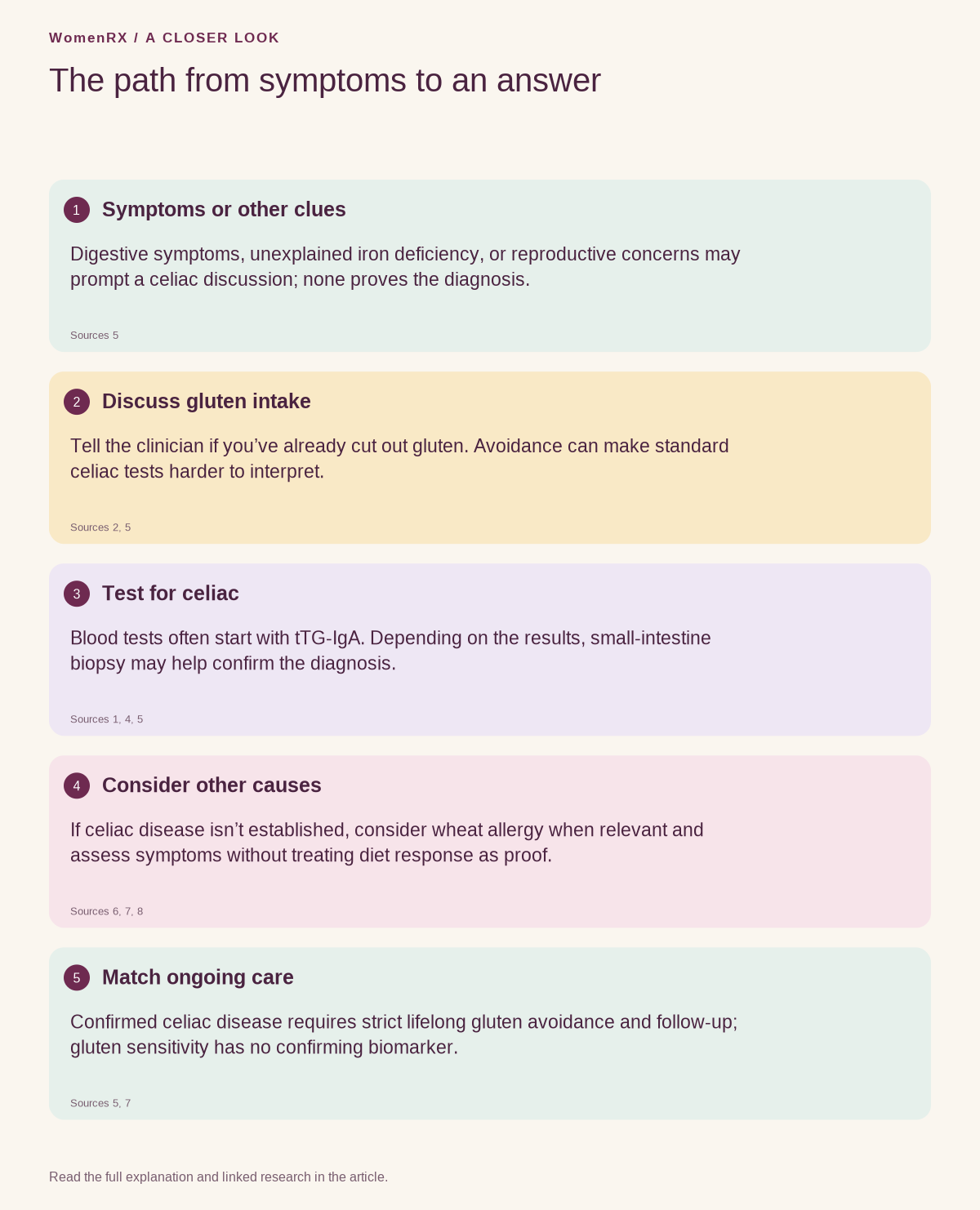
The path from symptoms to an answer
Symptoms or other clues: Digestive symptoms, unexplained iron deficiency, or reproductive concerns may prompt a celiac discussion; none proves the diagnosis.5
Discuss gluten intake: Tell the clinician if you’ve already cut out gluten. Avoidance can make standard celiac tests harder to interpret.25
Test for celiac: Blood tests often start with tTG-IgA. Depending on the results, small-intestine biopsy may help confirm the diagnosis.145
Consider other causes: If celiac disease isn’t established, consider wheat allergy when relevant and assess symptoms without treating diet response as proof.678
Match ongoing care: Confirmed celiac disease requires strict lifelong gluten avoidance and follow-up; gluten sensitivity has no confirming biomarker.57
Read the figure as text
This flow shows why gluten intake belongs in the first testing conversation and why symptom improvement alone does not settle the diagnosis.- Symptoms or other clues: Digestive symptoms, unexplained iron deficiency, or reproductive concerns may prompt a celiac discussion; none proves the diagnosis.5
- Discuss gluten intake: Tell the clinician if you’ve already cut out gluten. Avoidance can make standard celiac tests harder to interpret.25
- Test for celiac: Blood tests often start with tTG-IgA. Depending on the results, small-intestine biopsy may help confirm the diagnosis.145
- Consider other causes: If celiac disease isn’t established, consider wheat allergy when relevant and assess symptoms without treating diet response as proof.678
- Match ongoing care: Confirmed celiac disease requires strict lifelong gluten avoidance and follow-up; gluten sensitivity has no confirming biomarker.57
More questions, answered
Can a genetic test tell me whether I have celiac disease?
Not by itself. A negative result for celiac-associated HLA genes can rule celiac disease out; a positive result means you’re genetically susceptible, not that you have it. Genetic testing can be particularly useful when you stopped eating gluten before the usual diagnostic tests.5
Does feeling better on a gluten-free diet confirm gluten sensitivity?
No. Symptom improvement is useful to discuss, but there’s no specific biomarker that confirms non-celiac gluten sensitivity, and wheat-containing foods have components other than gluten that may affect symptoms. Celiac disease should be evaluated before a diet change obscures its tests.2678
Sources you can check
- Celiac Disease | MedlinePlusAccessed 2026-09-25Return to first citation
- Plasma Proteins Invariant to Diet in Celiac Disease: Results From a Proteomics Study on the UK Biobank.Hujoel IA, Loh PR, Hujoel MLA. · Gastro hep advances · 2026Return to first citation
- Risk of malignancy and surveillance of premalignant gastrointestinal lesions in adult celiac disease.Bures J, Kamaradova K, Rezacova V, Zapletalova M, Cvanova M, Suchanek S, Drastich P, Brodyuk N, Dolezal J, Tuma T, Malik J, Grega T, Vokurkova D, Pohnan R, Urbanek P, Zavoral M, Ko... · Frontiers in oncology · 2026Return to first citation
- Celiac Disease.Murray JA, Husby S. · The New England journal of medicine · 2026Return to first citation
- Celiac DiseaseTaylor AK, Lebwohl B, Snyder CL, Green PHR. · 1993Return to first citation
- Gluten Sensitivity | Gluten Intolerance | MedlinePlusAccessed 2026-09-25Return to first citation
- An overview of progress in establishing a diagnostic tool for non-celiac gluten sensitivity.Catassi G, Catassi C. · Expert review of molecular diagnostics · 2025Return to first citation
- Non celiac gluten sensitivity and diagnostic challenges.Casella G, Villanacci V, Di Bella C, Bassotti G, Bold J, Rostami K. · Gastroenterology and hepatology from bed to bench · 2018Return to first citation