Exercise and Insulin Sensitivity: What Helps Most?
Aerobic, resistance, and combined exercise can support glucose control in adults with type 2 diabetes, though the studies comparing them usually measure blood sugar rather than insulin sensitivity directly.
Walking or another aerobic activity, resistance training, and a combination are all reasonable ways to support glucose control. Reviews of trials in people with type 2 diabetes report favorable results for combined exercise, while findings vary by population and exercise type. You could start with short walks across several days and add resistance-band exercises on two days, building gradually. 2 3 4
First, what does “insulin sensitivity” mean?
Insulin helps glucose move from your bloodstream into cells for energy. When cells respond less well to insulin, glucose can remain in the blood. But a study can measure several different things: a direct measure of insulin sensitivity, a blood glucose reading, or HbA1c, which reflects average blood glucose over about three months. Those outcomes are related, but they are not interchangeable. 1
The exercise comparisons below studied glucose control in people with type 2 diabetes. They don’t establish which kind of exercise is best for insulin sensitivity in women generally. 3 4
How the exercise options compare
Aerobic activity includes brisk walking, biking, and swimming. In a review of randomized trials involving older adults with type 2 diabetes, continuous aerobic exercise was associated with an estimated improvement in HbA1c compared with control. 2 3
Resistance training includes activities that challenge your muscles, such as weights or resistance bands. The same older-adult review estimated an HbA1c improvement compared with control. Its point estimate was smaller than the estimate for continuous aerobic exercise, but that does not establish that resistance training is less useful for every person. 2 3
Combined training pairs aerobic and resistance exercise. In the older-adult review, its estimated HbA1c change was larger than the estimates for continuous aerobic or resistance training alone. A separate review of 22 randomized trials, involving 1,448 people with type 2 diabetes, found improvements in fasting glucose, after-meal glucose, and HbA1c across exercise programs; its network comparisons favored combined aerobic and resistance exercise for those measures. These results support combined activity as a reasonable option, not a guarantee that it will work best for every person. 3 4
There’s a wrinkle: the review focused on older adults with type 2 diabetes found the largest estimated HbA1c reduction with high-intensity interval training, followed by combined training. The studies and populations differ, and the review noted wider uncertainty around some estimates. That doesn’t establish interval training as the overall winner, especially if it doesn’t suit your health, preferences, or current ability. 3
What “how much” can look like
MedlinePlus gives general adult activity targets of 150 to 300 minutes of moderate-intensity aerobic activity per week, or 75 to 150 minutes of vigorous activity, plus muscle-strengthening activity on two or more days. Moderate effort means you can speak a few words at a time but not sing. These are general adult activity targets, not a proven insulin-sensitivity prescription. 2
If that feels like a big jump, start smaller. The guidance suggests spreading activity across several days rather than doing it all in one or two, breaking it into shorter chunks, and increasing gradually; some activity is better than none. For an aerobic start, try a short walk on several days and build from there. If strength work feels more approachable, try resistance bands or weights on two days, repeating each movement 8 to 12 times and working toward two or three rounds as you get stronger. If you want both, pair those strength days with walks on other days. These are adaptable examples, not required programs. 2
That guidance concerns scheduling across the week, not a particular time of day. The exercise comparisons do not establish whether exercising after a meal is better than exercising at another time. Choose a mix of movement and strength that fits your schedule and that you can repeat. 2 3 4
Glucose changes aren’t the same as weight changes
The exercise comparisons above focus on blood glucose or HbA1c. Those measurements tell you about glucose control; they do not tell you whether a person lost weight. Nor do they prove that weight change caused the glucose results. A separate review combined diet and exercise interventions and reported changes in both HbA1c and body weight, but because the interventions included both, it cannot isolate exercise’s contribution to either outcome. 4 5
So it’s more useful to treat glucose control and weight change as distinct outcomes, rather than assuming one has to happen for the other to matter. If you have diabetes, activity is one part of care, not a replacement for diabetes medicine or your existing treatment plan. Blood glucose targets vary, and MedlinePlus advises working with your care team on a target that fits your situation. 1
Adapting the plan to your life
If you’re pregnant, check with your provider about appropriate activity types and amounts before using the general adult targets or the starting examples above. MedlinePlus specifically advises this for pregnant people. 2
After birth, the general adult targets above don’t set a return-to-exercise timetable, and the type 2 diabetes exercise comparisons don’t address postpartum recovery. 2 3 4
If you’re in perimenopause or postmenopause, these exercise comparisons do not identify a distinct best mode for that life stage. The walking and strength options above are general adult options, not menopause-specific findings; choose a starting point that suits your current ability and preferences. 2 3 4
The practical takeaway: aerobic, resistance, or a combination can be a sensible starting point for glucose-supportive activity. Combined training has favorable findings in some type 2 diabetes comparisons, while other analyses differ by population and exercise mode. Choose a starting option you can adapt and sustain.
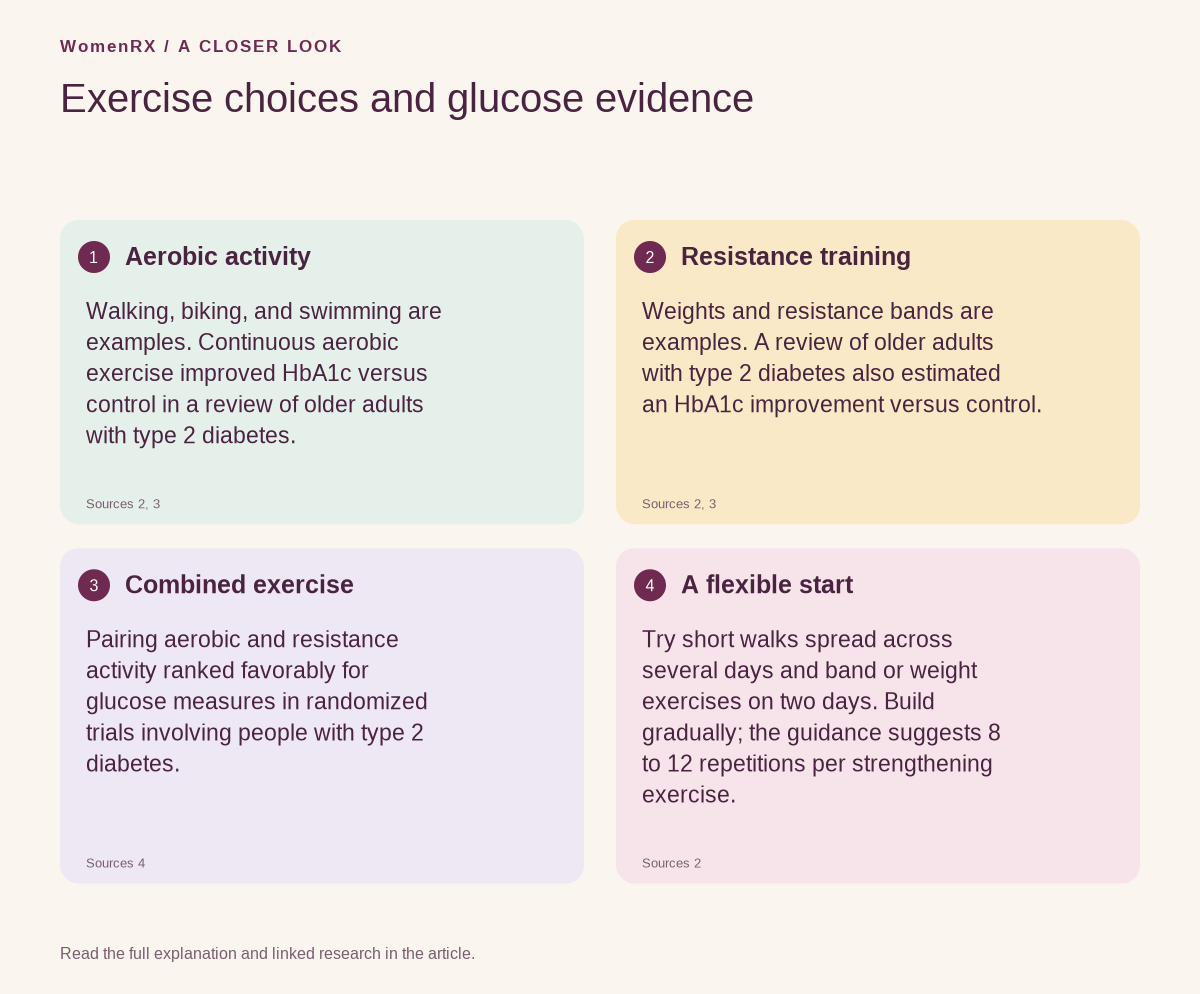
Exercise choices and glucose evidence
Aerobic activity: Walking, biking, and swimming are examples. Continuous aerobic exercise improved HbA1c versus control in a review of older adults with type 2 diabetes.23
Resistance training: Weights and resistance bands are examples. A review of older adults with type 2 diabetes also estimated an HbA1c improvement versus control.23
Combined exercise: Pairing aerobic and resistance activity ranked favorably for glucose measures in randomized trials involving people with type 2 diabetes.4
A flexible start: Try short walks spread across several days and band or weight exercises on two days. Build gradually; the guidance suggests 8 to 12 repetitions per strengthening exercise.2
Read the figure as text
Compare what each option involves and what glucose studies can, and cannot, tell you about it.- Aerobic activity: Walking, biking, and swimming are examples. Continuous aerobic exercise improved HbA1c versus control in a review of older adults with type 2 diabetes.23
- Resistance training: Weights and resistance bands are examples. A review of older adults with type 2 diabetes also estimated an HbA1c improvement versus control.23
- Combined exercise: Pairing aerobic and resistance activity ranked favorably for glucose measures in randomized trials involving people with type 2 diabetes.4
- A flexible start: Try short walks spread across several days and band or weight exercises on two days. Build gradually; the guidance suggests 8 to 12 repetitions per strengthening exercise.2
More questions, answered
Do I need to lose weight for exercise to help glucose control?
The studies comparing exercise types here mainly report blood glucose or HbA1c, not whether weight loss is required for those changes. A review that combined diet and exercise found changes in both HbA1c and body weight, but it could not separate the effects of exercise from the dietary intervention. 4 5
Is high-intensity interval training the best choice?
Not for everyone based on these findings. A review in older adults with type 2 diabetes found the largest estimated HbA1c reduction with interval training, but its estimates carried uncertainty. It doesn’t establish interval training as the best option for all adults. 3
Sources you can check
- Blood Glucose | Blood Sugar | Diabetes | MedlinePlusAccessed 2026-09-25Return to first citation
- How Much Exercise Do I Need?: MedlinePlusAccessed 2026-09-25Return to first citation
- Optimal dose and exercise modality to improve HbA1c in older adults with type 2 diabetes mellitus: a systematic review with pairwise, network, and dose-response meta-analyses.Park Y, Shin YH, Yuan Y, Jeon JY, Zhang Y, Ferrari G, Rezende LFM, Giovannucci EL, Lee DH. · Diabetes research and clinical practice · 2026Return to first citation
- Bayesian network meta-analysis of the impact of exercise therapy on blood glucose in type 2 diabetes patients.Liu H, Wang W, Sun J. · Frontiers in endocrinology · 2025Return to first citation
- Effectiveness of diet-combined exercise interventions for glycemic control in patients with type 2 diabetes: a meta-analysis of randomized controlled trials.Huang X, Huang G, Jiang M, Wei G. · The Journal of sports medicine and physical fitness · 2026Return to first citation