Can Exercise Help Your Energy and Mood?
Movement may support mood, sleep, and energy, but the evidence differs by outcome and exercise isn’t a fix for every kind of fatigue.
Yes, regular movement may help mood and sleep, and can leave you feeling more energetic. But those outcomes aren’t interchangeable: research in particular groups of women has found improvements in mood and fatigue, while it doesn’t show that exercise will resolve persistent fatigue or treat depression on its own. Start with an activity and amount that feel manageable, then build gradually if it suits you. 1 2 3 4
Exercise can be worth trying when you feel flat or low on energy, but “feeling better” can mean different things. A lift in mood, less fatigue, better sleep, and improved day-to-day wellbeing are related, not identical outcomes. Research supports some of these benefits, but it doesn’t promise that every woman will notice all of them.
Mood, fatigue, and sleep are different outcomes
Regular physical activity may support mental health and mood, help with stress and anxiety, improve sleep, and boost energy. Those broad benefits are a useful reason to make room for movement, but they aren’t proof that a particular workout will treat depression or explain ongoing exhaustion. 2
Trials involving women add some detail, but their results apply most directly to the groups studied. In a six-month trial of older women experiencing socioeconomic vulnerability, 88 participants were included in the analysis. The study compared resistance training with two programs combining resistance work and aerobic training. Total mood disturbance improved in all three groups, while changes in other mood measures varied by program. Fatigue scores improved in the resistance-training group. Because all three groups did exercise, the trial can’t show how those changes compare with no added exercise. 3
Sleep and fatigue can also shift together. In a small randomized trial of 66 early postmenopausal women, fatigue and sleep scores improved within both groups assigned to an eight-week combined aerobic and resistance program, delivered in person or through an app. The trial also included an education-only control, but the reported fatigue and sleep results don’t tell us whether either exercise group improved more than the control group. Depressive-symptom scores improved significantly in the app group; the in-person group’s improvement did not meet the study’s adjusted threshold for significance. These findings are promising for this specific group and program, not a guarantee of the same results for every woman. 4
Choose movement for the outcome you want to support
If your goal is a more positive mood, choose an activity you’re willing to repeat. The research in older women found improvements across more than one kind of community exercise, without establishing one clearly superior option. A walk, a dance class, or strength exercises may all be reasonable ways to begin; enjoyment and fit with your routine matter when you’re trying to keep going. 2 3 5
If your goal is less fatigue, don’t assume that harder is better. In the older-women trial, fatigue scores improved in the resistance-training group, but that result doesn’t establish that resistance exercise will relieve fatigue caused by illness, poor sleep, stress, or another factor. Exercise itself can also produce ordinary tiredness, especially as you adjust. 1 3
If your goal is better sleep, movement may help, and the postmenopausal trial found improved sleep scores within both exercise groups after its combined program. The study tested an eight-week plan in early postmenopausal women, so it doesn’t tell us whether the same pattern holds for women in other life stages or with different sleep problems. 2 4
Make the first step small enough to repeat
You don’t need to begin with a formal workout. There’s no need to find a single perfect starting amount. Instead, choose an amount that feels manageable for your current energy and ability, then notice how you feel during and afterward. For example, that might mean walking to the end of your block or moving to one favorite song. Those are flexible examples, not a required target. If the first step feels okay, you can gradually add more activity. MedlinePlus recommends starting slowly and describes small ways to add activity to daily life. 2
The exercise programs in research trials can show what has been studied, but they aren’t automatically starting prescriptions. For example, the postmenopausal trial used combined aerobic and resistance exercise three days a week. Its results don’t mean you need to copy that schedule to get started. 4
Women’s life stages aren’t interchangeable in this evidence. A review of nine randomized trials involving 1,581 pregnant women reported benefits of strength training for aspects of mood and quality of life, while also calling for better standardization and reporting. Findings in pregnant women shouldn’t be treated as a direct guide to exercise during the cycling years or after menopause. The cited trials also don’t establish whether the effects of exercise differ across menstrual-cycle phases. 6
When low energy needs more than a workout
Fatigue is a symptom, not a diagnosis. It can follow physical activity, stress, or too little sleep, but it can also have medical or mental-health causes. If you’ve been tired for weeks and it isn’t improving, contact a care provider to look for the cause rather than relying on exercise alone. This is especially relevant when fatigue is overwhelming, doesn’t ease with rest, or is getting in the way of ordinary activities. 1
Movement can be one useful part of caring for your wellbeing. The most practical starting point is one you can manage today, with room to adjust based on how you feel afterward.
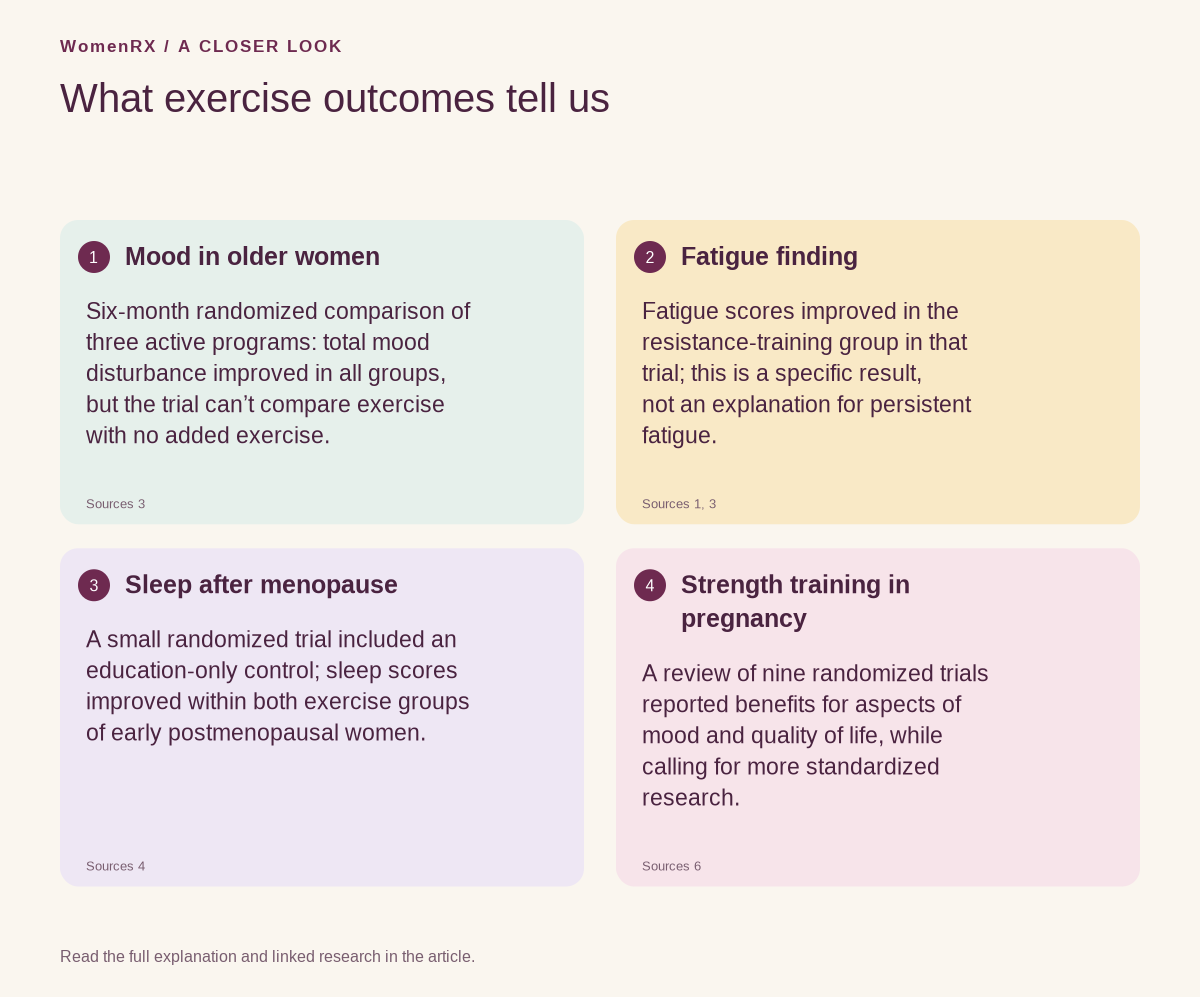
What exercise outcomes tell us
Mood in older women: Six-month randomized comparison of three active programs: total mood disturbance improved in all groups, but the trial can’t compare exercise with no added exercise.3
Fatigue finding: Fatigue scores improved in the resistance-training group in that trial; this is a specific result, not an explanation for persistent fatigue.13
Sleep after menopause: A small randomized trial included an education-only control; sleep scores improved within both exercise groups of early postmenopausal women.4
Strength training in pregnancy: A review of nine randomized trials reported benefits for aspects of mood and quality of life, while calling for more standardized research.6
Read the figure as text
Study design changes what a result can tell you: one trial compared three active exercise programs, while another included an education-only control. These findings come from specific groups of women.- Mood in older women: Six-month randomized comparison of three active programs: total mood disturbance improved in all groups, but the trial can’t compare exercise with no added exercise.3
- Fatigue finding: Fatigue scores improved in the resistance-training group in that trial; this is a specific result, not an explanation for persistent fatigue.13
- Sleep after menopause: A small randomized trial included an education-only control; sleep scores improved within both exercise groups of early postmenopausal women.4
- Strength training in pregnancy: A review of nine randomized trials reported benefits for aspects of mood and quality of life, while calling for more standardized research.6
More questions, answered
Does exercise work the same way at every life stage?
These studies involve specific groups, including older women, early postmenopausal women, and pregnant women. They don’t establish that results are the same across life stages, or whether effects differ across menstrual-cycle phases. 3 4 6
Sources you can check
- Fatigue: MedlinePlusAccessed 2026-09-25Return to first citation
- Benefits of Exercise: MedlinePlusAccessed 2026-09-25Return to first citation
- Effects of intensity and modality of community-based exercise programs on mood profile and functional physical capacity in older women under socioeconomic vulnerability: A randomized trial.Zanini GS, Teixeira do Amaral V, Fernandes B, Verardi CEL, Ciolac EG. · Women's health (London, England) · 2025Return to first citation
- Effectiveness of face-to-face and web-based exercise programs on health outcomes in early postmenopausal women: a randomized trial.Kurç D, Tunalı Van Den Berg AN. · BMC women's health · 2026Return to first citation
- Comparative effects of Baduanjin and square dance on working memory, executive function performance, mood, and fatigue in older women: a randomized controlled trial.Zheng Y, Mao K, Lin L, Hu G. · Frontiers in psychology · 2026Return to first citation
- Effects of strength training on quality of life in pregnant women: A systematic review.Redondo-Delgado P, Blanco-Giménez P, López-Ortiz S, García-Chico C, Vicente-Mampel J, Maroto-Izquierdo S. · Acta obstetricia et gynecologica Scandinavica · 2025Return to first citation