Can Exercise Change Posture? What to Work On
Exercise may improve some posture measurements, but pain relief and easier movement are separate outcomes worth judging on their own.
Yes, targeted exercise can change measured posture in some people, especially in studies of people with forward head posture and neck pain. A 2026 review also found improvements in pain and neck function, but that doesn’t mean posture alone caused the pain or that one ideal alignment is necessary. Choose exercises by the outcome you want, and assess progress in that outcome. 3
Posture is a measurement, not a verdict
“Posture” can mean different things: the position of your head and shoulders, the curve of your back, how steadily you hold yourself, or how comfortably you move. A study might measure one feature, such as the angle of the head relative to the neck. That measurement can change without telling you, by itself, whether you feel better or function better.
It’s also too simple to assume that a posture difference is the cause of pain. Pain can have more than one contributor, and sometimes there isn’t a clear cause. Stress and beliefs about pain can also affect how pain feels and how you respond to it. 2
A more useful question than “Is my posture perfect?” is “What do I want to change?” That might be a posture measurement, neck discomfort, or a daily activity that has become difficult.
What exercise research does, and doesn’t, show
A 2026 systematic review pooled 10 randomized trials involving 550 people with forward head posture and neck pain. Compared with control groups, therapeutic exercise improved a measure of head-and-neck alignment, pain intensity, and neck function. The review described the overall certainty as low to moderate, with substantial differences among studies. 3
The exercises studied included neck-flexor strengthening, shoulder-blade stabilization, stretching the chest or upper trapezius, and exercises for neck position sense. These approaches target different things: strength and control, mobility, or awareness of head and neck position. The review doesn’t establish one best exercise for everyone, and its findings apply most directly to people with neck pain and forward head posture, not to every posture concern. 3
A small randomized trial in 35 young adults with postural kyphosis reported significant changes over time on a majority of outcomes in both home-exercise groups, but its abstract doesn’t identify which outcomes changed within each group. Compared with exercise alone, adding motor imagery led to greater improvements in some posture and quality-of-life measures, but not in pain reduction or postural stability. This is a limited study, not proof that imagery is needed or that the same results apply to other adults. 4
The review and trial summaries do not provide sex-specific results. They therefore don’t show that these exercise effects are different for women. 3 4
Pick an exercise by the outcome you care about
If your goal is neck strength or control, neck-flexor strengthening and shoulder-blade stabilization are examples of approaches studied in people with forward head posture and neck pain. If your goal is mobility, chest or upper-trapezius stretching is another studied approach. If you’re working on awareness of position, neck proprioception exercises target that skill. These are categories, not a personalized routine or a guarantee of a posture change. 3
Keep the measure matched to the goal. If you care about comfort, notice whether pain changes. If you care about function, notice whether a meaningful activity becomes easier. If you care about visible alignment, a posture measure is more relevant, but it still doesn’t tell the whole story. The review found changes in all three kinds of outcomes, but those outcomes are distinct. 3
For general health, regular physical activity can support muscle strength and may help reduce pain and improve function in adults with arthritis. Those broad benefits are not evidence that exercise will correct a particular posture pattern. 1
When pain needs an explanation
Pain can feel sharp, dull, burning, or tingling, and those sensations alone don’t identify its cause. Pain may follow an injury, relate to a longer-term condition, or have no clear cause. If you’re unsure what’s behind your pain, an assessment can help identify possible causes and guide management. 2
Don’t treat pain as a posture-only project if it starts suddenly after an injury, continues beyond the time you expected to heal, or is disrupting daily life. Describe any other symptoms you’re having when you seek an assessment. The cause and type of pain matter because they can change what treatment is useful. 2
The practical takeaway: use posture as one possible measure, not the sole test of success. A helpful exercise is one that targets your goal and supports the way you want to feel or move.
Three ways to judge posture exercise
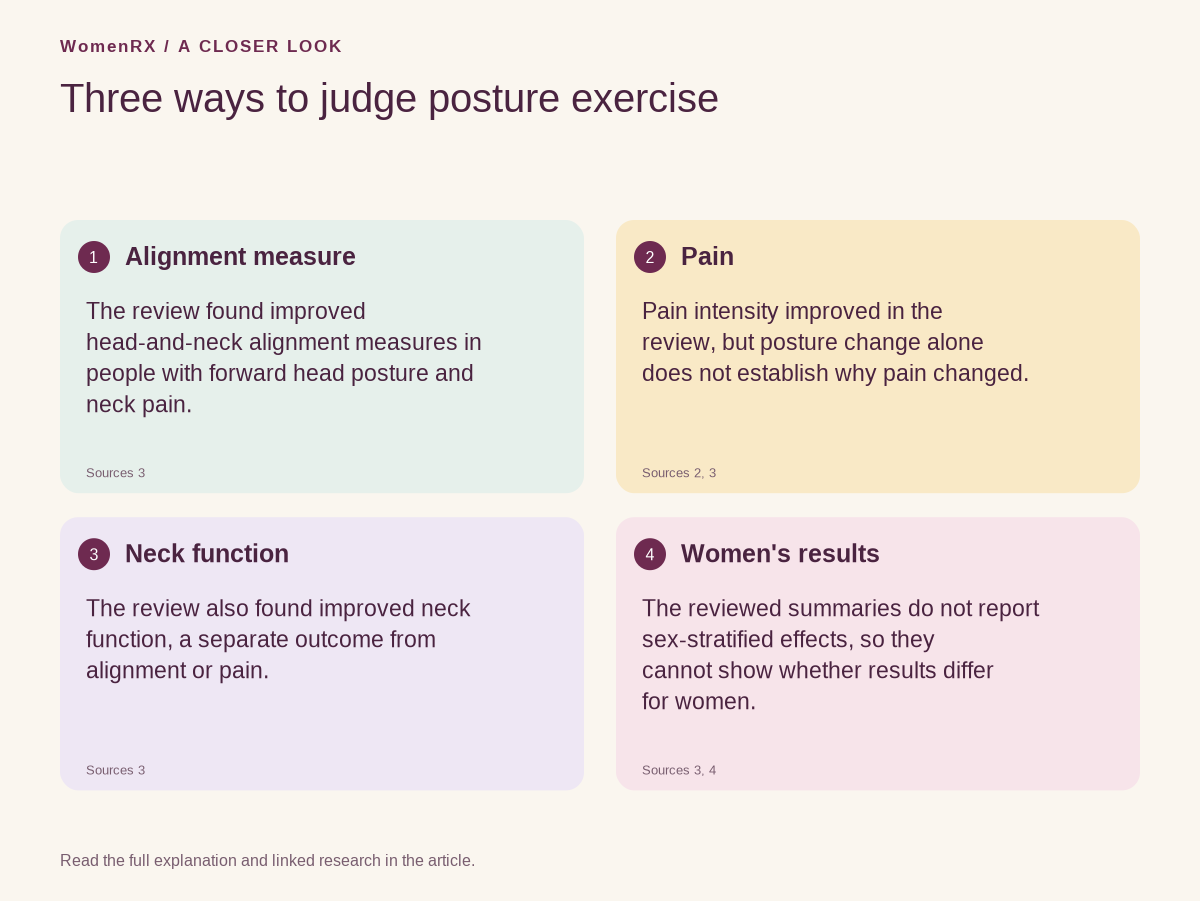
Alignment measure: The review found improved head-and-neck alignment measures in people with forward head posture and neck pain.3
Pain: Pain intensity improved in the review, but posture change alone does not establish why pain changed.23
Neck function: The review also found improved neck function, a separate outcome from alignment or pain.3
Women's results: The reviewed summaries do not report sex-stratified effects, so they cannot show whether results differ for women.34
Read the figure as text
Posture measurements, pain, and everyday function are related outcomes, but each answers a different question.- Alignment measure: The review found improved head-and-neck alignment measures in people with forward head posture and neck pain.3
- Pain: Pain intensity improved in the review, but posture change alone does not establish why pain changed.23
- Neck function: The review also found improved neck function, a separate outcome from alignment or pain.3
- Women's results: The reviewed summaries do not report sex-stratified effects, so they cannot show whether results differ for women.34
Sources you can check
- Benefits of Exercise: MedlinePlusAccessed 2026-09-25Return to first citation
- Pain | MedlinePlusAccessed 2026-09-25Return to first citation
- Therapeutic Exercise for Forward Head Posture in Neck Pain Patients: A Systematic Review and Meta-Analysis.Xing Y, Wang R, Zhao X, Xu A. · Journal of pain research · 2026Return to first citation
- Effects of a Telerehabilitation-Based Motor Imagery and Exercise Program on Postural Kyphosis in Young Adults: A Randomized Controlled Trial.Zirek E, Acar D, Zeynallı F, Akbaba YA. · Physiotherapy research international : the journal for researchers and clinicians in physical therapy · 2026Return to first citation