Exercise During Menopause: What It Can and Cannot Do for Weight Change
Exercise can support fitness and muscle, even when changes in weight or body fat are less clear.
Exercise can support weight management, but it doesn’t guarantee a predictable drop on the scale. During the menopause transition, changes in body fat and muscle can overlap with aging, energy balance, and lifestyle factors, so weight, waist size, and fitness may tell different stories. A small trial in early postmenopausal women found modest muscle gains and improved predicted fitness with combined exercise. 2 3 4
The scale is only one outcome
Body weight includes muscle, fat, bone, and water, so the scale can’t show which of those has changed. Waist circumference offers another perspective: abdominal fat, compared with fat around the hips, can have different health implications. BMI also can’t distinguish fat, muscle, and bone. None of these measures tells the whole story on its own. 1
That distinction matters around menopause. A recent review describes a pattern of increasing central body fat and declining muscle mass and strength for some women, but says it’s difficult to separate menopause’s contribution from ordinary aging, energy balance, and lifestyle. The precise mechanisms, including the role of hormonal changes in resting energy expenditure, remain uncertain. Menopause doesn’t make weight gain inevitable. 3
What exercise may change
Fitness and muscle: A randomized trial of 66 early postmenopausal women tested an eight-week program combining walking, resistance, core, and balance exercises. Muscle mass increased modestly in both exercise groups. Predicted aerobic fitness improved in both groups, although only the app-based group’s result met the study’s threshold for statistical significance after correction for multiple comparisons. 4
Body fat, weight, and waist: In the same trial, between-group differences in body fat were negligible. The reported results do not establish how the program affected scale weight or waist size. Taken together, the findings show that muscle and predicted fitness can improve without a clear between-group difference in body fat over this short study. 4
Why the scale can tell a different story: Exercise can help with weight management, but it works alongside eating and drinking patterns rather than overriding them. Weight is also influenced by factors such as activity, stress, and family history. That’s why the same exercise routine can lead to different scale outcomes for different people. 1 2
Keep these outcomes distinct when you review progress. Scale weight tracks total mass; strength and fitness describe what your body can do. Regular activity can help maintain muscle and strength as you age, which matters even if the scale doesn’t change as you hoped. 1 2
A useful combination, not a magic workout
For a realistic starting point, combine aerobic movement you can keep doing with muscle-strengthening activity. That pairing matches the program tested in the small postmenopausal trial, but the study doesn’t prove it is the best or only approach. As a practical starting point, choose activities that suit your current ability and that you can return to consistently. 4
If weight change is a main goal, think of exercise as one part of the picture. A 2026 review reports evidence that combined diet-and-exercise interventions can improve weight, body composition, and metabolic risk factors during the menopause transition. It doesn’t provide a single plan or guarantee an individual result. 5
A practical way to review progress is to keep the measures separate: scale weight for total mass, waist measurement for abdominal size, and strength or fitness for what your body can do. You don’t need to treat any one measure as a verdict. If your goal is weight loss and your weight isn’t changing, consider eating patterns and other factors alongside your activity. Exercise may still support fitness and muscle. 1 2 5
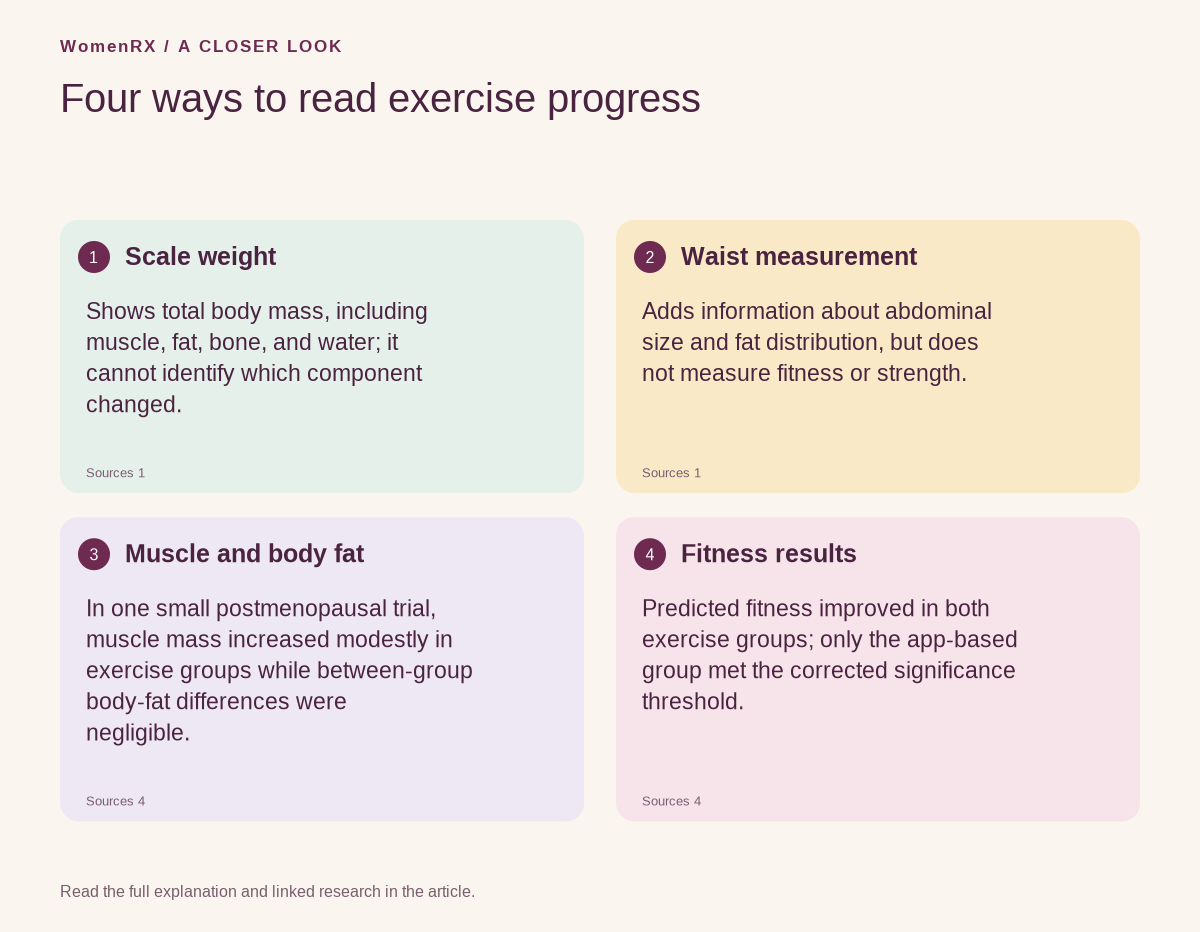
Four ways to read exercise progress
Scale weight: Shows total body mass, including muscle, fat, bone, and water; it cannot identify which component changed.1
Waist measurement: Adds information about abdominal size and fat distribution, but does not measure fitness or strength.1
Muscle and body fat: In one small postmenopausal trial, muscle mass increased modestly in exercise groups while between-group body-fat differences were negligible.4
Fitness results: Predicted fitness improved in both exercise groups; only the app-based group met the corrected significance threshold.4
Read the figure as text
Weight, waist, body composition, and fitness are related, but each describes a different part of the picture.- Scale weight: Shows total body mass, including muscle, fat, bone, and water; it cannot identify which component changed.1
- Waist measurement: Adds information about abdominal size and fat distribution, but does not measure fitness or strength.1
- Muscle and body fat: In one small postmenopausal trial, muscle mass increased modestly in exercise groups while between-group body-fat differences were negligible.4
- Fitness results: Predicted fitness improved in both exercise groups; only the app-based group met the corrected significance threshold.4
More questions, answered
Should I track my waist as well as my weight?
They describe different things: weight is total body mass, while waist circumference can help show whether fat is concentrated around the abdomen. Neither measure captures fitness or strength, so consider them alongside what you can do physically. 1 2
Sources you can check
- Body Weight: MedlinePlusAccessed 2026-09-25Return to first citation
- Benefits of Exercise: MedlinePlusAccessed 2026-09-25Return to first citation
- Menopause and Body Composition: A Complex Field.Juppi HK, Karppinen JE, Laakkonen EK. · Seminars in reproductive medicine · 2025Return to first citation
- Effectiveness of face-to-face and web-based exercise programs on health outcomes in early postmenopausal women: a randomized trial.Kurç D, Tunalı Van Den Berg AN. · BMC women's health · 2026Return to first citation
- Weight Management in Menopause: Diet, Physical Activity, Medication, and Surgery.Lu V, Tayachew B, Chevtsov A, Nicklas JM. · Obstetrics and gynecology clinics of North America · 2026Return to first citation