Exercise During Pregnancy: What to Keep, Change, or Pause
Most people can stay active during pregnancy, but the right adjustment depends on your usual activity, how your pregnancy is going, and how you feel while moving.
If your pregnancy is uncomplicated, you can generally continue activity you already do comfortably, adjusting it as your body changes. If you’re starting from little activity, build up gradually rather than jumping into strenuous exercise. A pregnancy complication or a concerning new symptom calls for individual advice; vaginal bleeding that’s more than spotting, leaking fluid, fainting, chest pain, or trouble breathing calls for immediate medical care. 567
Start with what you do now
You don’t need to replace every familiar activity with a special pregnancy workout. For a pregnancy without complications, guidance supports continuing physical activity you already do and changing it as pregnancy progresses. If you haven’t been active, a gradual start makes more sense than suddenly taking up strenuous exercise. Walking is one example of a way to begin; it isn’t a requirement or a test of whether you’re doing enough. 57
Activity has reasons to stay on the table. The 2019 Canadian pregnancy guideline links prenatal physical activity, in the absence of contraindications, with lower risks of gestational diabetes and some other pregnancy complications, as well as improvements in some maternal symptoms. It also recognizes that fatigue or discomfort may make usual activity harder at times. You can adjust what you do without treating a slower week as a failure. 5
Let effort and comfort guide the adjustment
Moderate activity is the common recommendation across professional guidance for healthy pregnant people, but there isn’t one routine that fits every person or every stage. A practical effort check is whether you can hold a conversation while moving. If talking leaves you breathless, ease off. You may also need to slow down as pregnancy progresses. 47
Think about the setting and movement as well as the workout’s name. For example, if a class has you exercising strenuously in hot weather, changing the conditions or intensity addresses a concern identified in pregnancy exercise guidance. The NHS advises against contact sports where you could be hit, such as kickboxing or judo. It separately advises caution with activities that carry a risk of falling, such as horse riding or downhill skiing, because a fall can harm your baby. Familiarity with a sport doesn’t remove those risks. 17
Position can matter later in pregnancy, too. NHS guidance advises against lying flat on your back for long periods, particularly after 16 weeks, because it can make you feel faint. If a floor exercise starts to make you lightheaded, stop that position rather than trying to finish the set. 7
When your pregnancy needs a more individual plan
General advice for an uncomplicated pregnancy can’t settle what to do when you have a pregnancy complication or a medical condition affecting exercise. Ask your prenatal care team how that condition changes your activity before starting something new or continuing a workout you’re unsure about. The useful question is specific: Which parts of my current activity can I continue, and what should prompt me to change or stop? Pregnancy guidelines distinguish exercise advice for people with and without contraindications, even while encouraging activity for many pregnant people. 35
Gestational diabetes is an example where a diagnosis doesn’t automatically mean stopping exercise. A review of 15 clinical guidelines found consistent support for activity during pregnancy with gestational diabetes, alongside pre-exercise screening. That points toward a tailored plan, not assuming either that exercise is off-limits or that your old routine needs no changes. 2
Know when to stop and get help
There’s a difference between needing an easier pace and having a symptom that needs care. If you become too breathless to talk during an activity, stop or ease off and reassess how you feel. Don’t use the conversation check to explain away trouble breathing that is sudden, severe, or doesn’t settle. 67
Stop exercising and seek medical care immediately for vaginal bleeding that’s more than spotting, fluid leaking from the vagina, fainting, chest pain, trouble breathing, or severe belly pain that doesn’t go away. A worsening or persistent severe headache, vision changes, and a noticeable slowing or stopping of your baby’s usual movements also call for immediate medical care. These symptoms matter whether or not they began during a workout. 6
If you feel lightheaded, pause the activity rather than pushing through. Seek medical care immediately if dizziness is ongoing or comes and goes over many days. If you have another symptom that worries you, even if it isn’t on that list, call your prenatal care team. 6
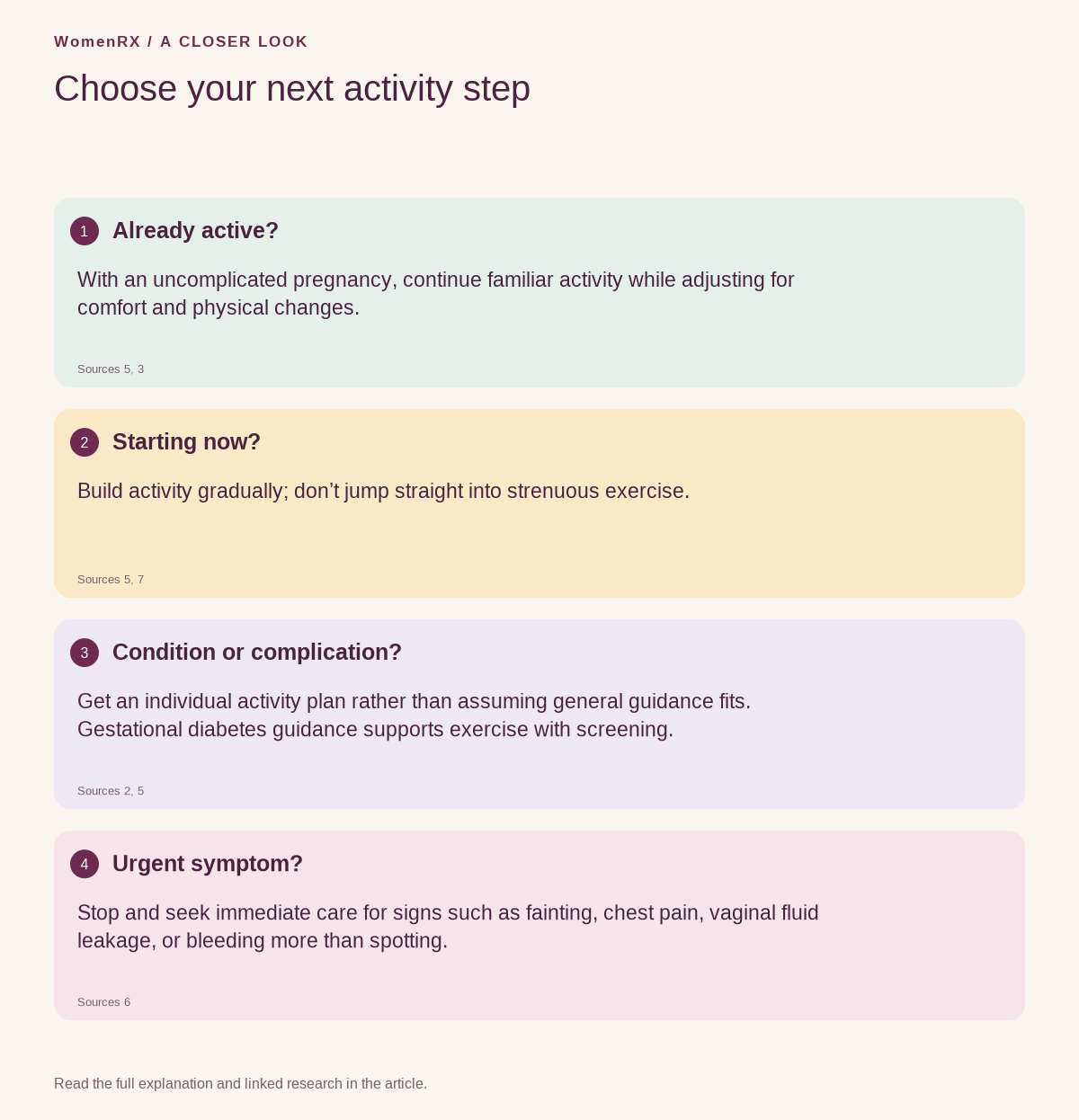
Choose your next activity step
Already active?: With an uncomplicated pregnancy, continue familiar activity while adjusting for comfort and physical changes.53
Starting now?: Build activity gradually; don’t jump straight into strenuous exercise.57
Condition or complication?: Get an individual activity plan rather than assuming general guidance fits. Gestational diabetes guidance supports exercise with screening.25
Urgent symptom?: Stop and seek immediate care for signs such as fainting, chest pain, vaginal fluid leakage, or bleeding more than spotting.6
Read the figure as text
Follow the branch that fits your starting point and what’s happening in your pregnancy. Urgent symptoms take priority over any workout plan.- Already active?: With an uncomplicated pregnancy, continue familiar activity while adjusting for comfort and physical changes.53
- Starting now?: Build activity gradually; don’t jump straight into strenuous exercise.57
- Condition or complication?: Get an individual activity plan rather than assuming general guidance fits. Gestational diabetes guidance supports exercise with screening.25
- Urgent symptom?: Stop and seek immediate care for signs such as fainting, chest pain, vaginal fluid leakage, or bleeding more than spotting.6
More questions, answered
Do I need to stop running because I’m pregnant?
Not automatically. Guidance says previously active people may continue activity during pregnancy, modifying it as needed. Whether running still fits depends on your comfort, your pregnancy, and the risks of the particular setting; a complication or concerning symptom changes that conversation. 57
Is it too late to start exercising if I wasn’t active before pregnancy?
No. Pregnancy guidance supports progressively increasing activity if you aren’t currently active. Start with something manageable rather than suddenly beginning strenuous exercise, and ask your prenatal care team for an individual plan if you have a complication or medical condition that may affect activity. 57
Sources you can check
- Guidelines for Physical Activity during Pregnancy: Comparisons From Around the World.Evenson KR, Barakat R, Brown WJ, Dargent-Molina P, Haruna M, Mikkelsen EM, Mottola MF, Owe KM, Rousham EK, Yeo S. · American journal of lifestyle medicine · 2014Return to first citation
- Clinical practice guidelines on physical activity and exercise for pregnant women with gestational diabetes mellitus: A systematic review.Yang X, Han R, Xiang Z, Li H, Zhao Q, Chen L, Gao L. · International journal of nursing practice · 2023Return to first citation
- Australian guidelines for physical activity in pregnancy and postpartum.Brown WJ, Hayman M, Haakstad LAH, Lamerton T, Mena GP, Green A, Keating SE, Gomes GAO, Coombes JS, Mielke GI. · Journal of science and medicine in sport · 2022Return to first citation
- Professional Exercise Recommendations for Healthy Women Who Are Pregnant: A Systematic Review.Rudin LR, Dunn L, Lyons K, Livingston J, Waring ME, Pescatello LS. · Women's health reports (New Rochelle, N.Y.) · 2021Return to first citation
- No. 367-2019 Canadian Guideline for Physical Activity throughout Pregnancy.Mottola MF, Davenport MH, Ruchat SM, Davies GA, Poitras V, Gray C, Jaramillo Garcia A, Barrowman N, Adamo KB, Duggan M, Barakat R, Chilibeck P, Fleming K, Forte M, Korolnek J, Nagp... · Journal of obstetrics and gynaecology Canada : JOGC = Journal d'obstetrique et gynecologie du Canada : JOGC · 2018Return to first citation
- Urgent Maternal Warning Signs and Symptoms | HEAR HER Campaign | CDCAccessed 2026-09-25Return to first citation
- Exercise in pregnancy - NHSAccessed 2026-09-25Return to first citation