Exercise During Perimenopause: What It Can and Can’t Do
Exercise can support mood and weight management, but the evidence is stronger for general health than for specific perimenopause symptoms.
Exercise can support weight management and may lift mood, but it can’t guarantee weight loss or reliably ease every perimenopause symptom. General health guidance supports activity for mood, sleep, strength, and weight management. A FIGO review describes possible mental-health benefits but includes postmenopausal research; a perimenopausal swimming survey cannot establish a treatment effect. A sustainable routine is one you can adjust and assess by more than the scale. 1 4 5
Set expectations by outcome
Exercise can be worthwhile even if your weight barely changes. Regular activity can support weight management and improve mood, sleep, energy, and muscle strength. These are general benefits, not a promise that exercise alone will prevent weight gain or make the scale move. 1
Weight is only one part of the picture. It includes muscle, fat, bone, and water, so a stable number doesn’t tell you whether strength, fitness, or how you feel has changed. 2 Strengthening activity can help maintain or increase muscle mass, which is one reason a routine can be helping even when weight loss isn’t its main result. 1
The distinction matters in perimenopause: evidence that exercise supports health broadly is not the same as evidence that a particular workout prevents midlife weight gain or treats a menopause symptom.
Mood: encouraging, but not a guaranteed fix
Regular exercise can improve mood and help with stress and anxiety in the general population. 1 Menopause-focused research also reports potential mental-health benefits. However, some of the evidence summarized in a 2026 FIGO review comes from postmenopausal women, including a review of 27 studies of different exercise types. That makes it relevant, but not a precise forecast for someone in perimenopause. 4
One study directly asked women about perimenopause symptoms and cold-water swimming. It was an online survey of women who already swam regularly, not a trial comparing swimming with no swimming. Participants reported perceived symptom improvements, including in mood. Those experiences are worth acknowledging, but the survey can’t show that cold water caused the changes or that other exercise will have the same effect. 5
If low mood is persistent or disrupting daily life, don’t treat exercise as the only answer. It can be one support, but perimenopause-related mental health deserves attention in its own right. 4
Weight: think support, not a promise
Physical activity can be part of managing weight, but it doesn’t guarantee weight loss on its own. 1 General guidance supports exercise as one part of weight management, but it doesn’t show that a particular routine prevents weight gain specifically during perimenopause. It’s more useful to see movement as one part of health and weight management, alongside the other factors that affect body weight. 1 2
A practical way to judge progress is to choose a few outcomes that matter to you besides pounds: for example, whether you feel stronger carrying groceries, sleep better, have more energy, or notice a change in mood. These are personal measures, not a diagnostic test. If you do use the scale, consider it one piece of information rather than the whole scorecard. 2
Build a routine that can bend
There’s no need to find a perfect workout before you begin. MedlinePlus suggests starting slowly, adding activity to everyday life, choosing enjoyable options, and mixing activities to avoid boredom. 1
Try building your week around two kinds of movement:
- Activity that gets you moving: walking, dancing, or another option you enjoy. General exercise guidance links regular activity with mood, sleep, and weight management. 1
- Strengthening activity: a form of movement that challenges your muscles. Muscle-strengthening activity can help maintain or increase muscle mass. 1
Treat that as a flexible framework, not a test you pass or fail. For example, on a packed week, a walk during an errand and a short strength session may be more realistic than a rigid schedule. If a symptom-heavy day changes your plans, return to movement when it feels manageable rather than deciding the whole routine has failed.
To see what’s helping, choose one or two outcomes to notice for a few weeks, such as mood, sleep, energy, or strength. Keep the notes simple: a brief check-in is enough. Change one part of the routine at a time when you can, so it’s easier to tell what feels useful. This is a personal experiment, not proof that exercise caused every change.
Keep symptom relief separate from fitness benefits
Exercise may support your overall wellbeing without easing hot flashes or other specific menopause symptoms. The North American Menopause Society’s 2023 position statement did not recommend exercise as a treatment for vasomotor symptoms, such as hot flashes and night sweats. 3 That doesn’t cancel out exercise’s broader benefits; it means symptom relief shouldn’t be assumed just because a routine is good for your health.
The realistic goal is not to make exercise solve perimenopause. It’s to find movement that fits your changing life, supports outcomes you care about, and can be adjusted when your schedule or symptoms shift.
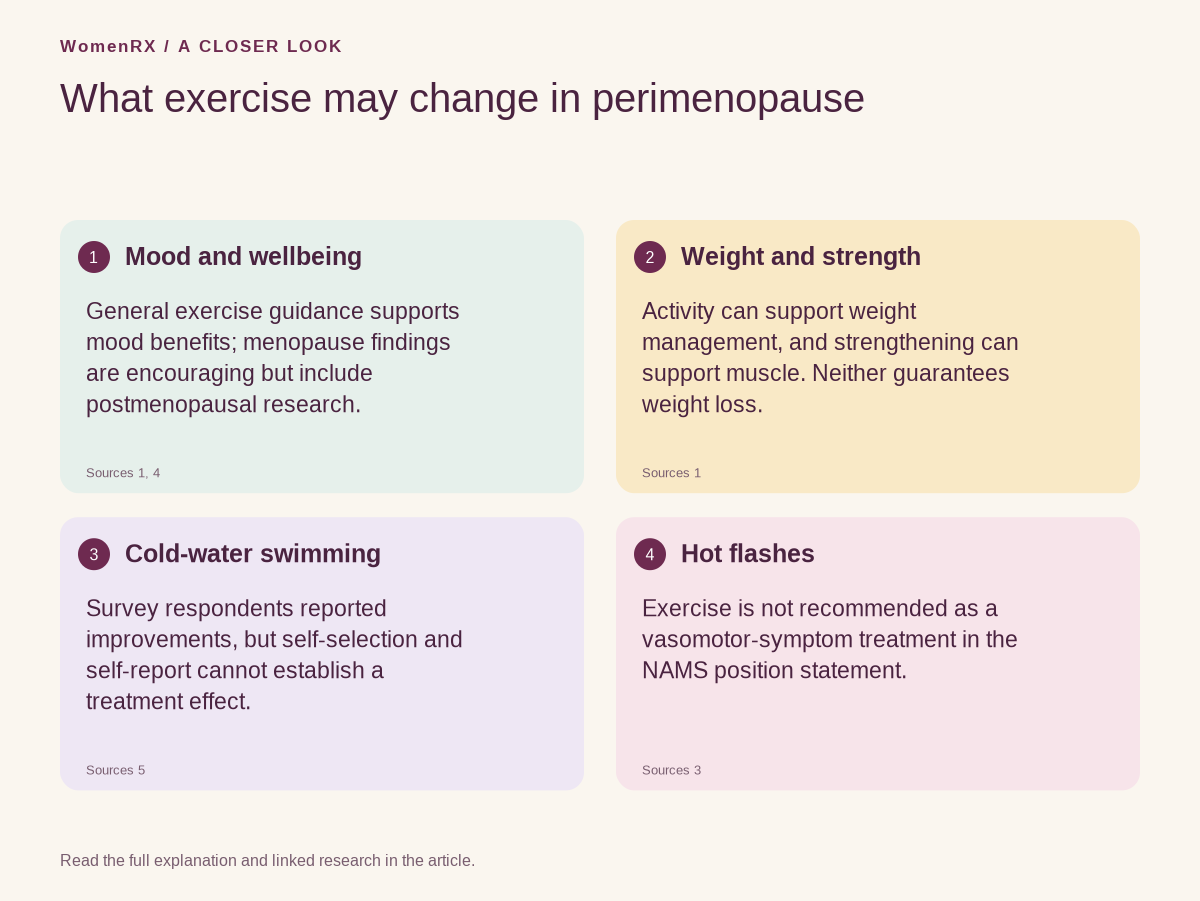
What exercise may change in perimenopause
Mood and wellbeing: General exercise guidance supports mood benefits; menopause findings are encouraging but include postmenopausal research.14
Weight and strength: Activity can support weight management, and strengthening can support muscle. Neither guarantees weight loss.1
Cold-water swimming: Survey respondents reported improvements, but self-selection and self-report cannot establish a treatment effect.5
Hot flashes: Exercise is not recommended as a vasomotor-symptom treatment in the NAMS position statement.3
Read the figure as text
A quick distinction between broad exercise benefits, indirect menopause findings, and outcomes that should not be promised.- Mood and wellbeing: General exercise guidance supports mood benefits; menopause findings are encouraging but include postmenopausal research.14
- Weight and strength: Activity can support weight management, and strengthening can support muscle. Neither guarantees weight loss.1
- Cold-water swimming: Survey respondents reported improvements, but self-selection and self-report cannot establish a treatment effect.5
- Hot flashes: Exercise is not recommended as a vasomotor-symptom treatment in the NAMS position statement.3
Sources you can check
- Benefits of Exercise: MedlinePlusAccessed 2026-09-25Return to first citation
- Body Weight: MedlinePlusAccessed 2026-09-25Return to first citation
- The 2023 nonhormone therapy position statement of The North American Menopause Society.Menopause (New York, N.Y.) · 2023Return to first citation
- FIGO best practice recommendations for the mental health of women at menopausal age.Khadilkar S, Divakar H, Benedetto C, Genazzani A, Ramos D, Argale E, Deshpande G, Hicky M, Filho ALDS, Herrera E, Balkrishnan M. · International journal of gynaecology and obstetrics: the official organ of the International Federation of Gynaecology and Obstetrics · 2026Return to first citation
- How do women feel cold water swimming affects their menstrual and perimenopausal symptoms?Pound M, Massey H, Roseneil S, Williamson R, Harper CM, Tipton M, Shawe J, Felton M, Harper JC. · Post reproductive health · 2024Return to first citation