Exercise in Perimenopause: Build a Routine Around Your Goals
A useful perimenopause routine can combine aerobic activity and strength work, with the balance shaped by what you want to improve and what feels doable.
There isn’t one best exercise for perimenopause. Aerobic activity supports general fitness, while resistance exercise builds muscle and may benefit bone density. Regular activity is worthwhile for health, but exercise isn’t an established treatment for hot flashes. Start with activities you can repeat, then adjust the mix for your experience, symptoms, and health conditions. 1 2 5
Choose by the result you want
Perimenopause doesn’t call for a special exercise that works for everyone. A more useful question is what you want your routine to do: improve aerobic fitness, maintain strength, support bone health, or simply make it easier to move regularly. You can combine activities rather than asking one workout to cover every goal.
For aerobic fitness: Walking, cycling, swimming, or another activity that gets you moving steadily can be a practical starting point. Regular physical activity supports heart health and can help with blood pressure, blood glucose, and chronic conditions. These are general adult health benefits, not proof that one aerobic activity works best during perimenopause. 1 3
For strength and muscle: Resistance exercise, such as using weights, resistance bands, or body weight, gives you a way to work on muscle strength. A review of eight randomized trials in women across the transition from perimenopause to postmenopause found benefits from regular aerobic and strength exercise for aspects of vitality, mental health, and quality of life. The review also reported that resistance exercise strengthened muscles and increased bone density. The studies covered a broad transition, not perimenopause alone. 5
For bone health: Strength work is one option, and everyday leisure activity may also matter. In the SWAN cohort, greater increases in leisure-time activity during the menopause transition were associated with a slower decline in femoral-neck bone mineral density. This was an observational analysis, so it shows an association, not proof that a particular exercise prevents bone loss. Walking was the most common activity in the cohort. 4
For weight management: Movement can be part of a weight-management plan, but it doesn’t guarantee weight loss on its own. MedlinePlus explains that weight loss involves using more energy than you take in through food and drink. It may be more useful to choose activity for several benefits, including fitness and strength, rather than judging the routine only by the scale. 1
What exercise can and can’t do for symptoms
Exercise may support general physical and psychological health in midlife, but it shouldn’t be treated as a reliable fix for every perimenopause symptom. The North American Menopause Society’s evidence review does not recommend exercise as a treatment for vasomotor symptoms such as hot flashes and night sweats. That distinction matters: a routine can be valuable for your health without controlling those symptoms. 2 3
A review of eight trials reported improvements in some menopause symptoms overall, but also noted a lack of studies supporting aerobic exercise for vasomotor symptoms. The evidence therefore doesn’t justify promising that a specific workout will stop hot flashes. 5
If symptoms make a planned session feel difficult, you can change the activity or choose a time and setting that feels more manageable. For example, you might swap a run for a walk or cycling session on a day when higher-impact movement doesn’t feel appealing. That’s an adjustment for comfort and consistency, not a proven symptom treatment.
Make the plan fit your starting point
If you’re new to exercise or returning after a long break, begin with a version you can manage and build gradually. MedlinePlus notes that starting slowly is reasonable and that even small amounts of activity are better than none. You don’t have to begin with a complicated program. 1
One example of a balanced week might include walks or another aerobic activity on some days and a resistance session on another. A different mix may suit you better. If joint pain affects what you can do, lower-impact movement may be easier to try; regular activity can reduce pain and improve function for adults with arthritis, though the right choice depends on your situation. 1
If a health condition limits your movement or a particular activity worsens symptoms, adapt the plan to that constraint rather than trying to push through it. The goal is a routine you can return to, not a perfect schedule. For hot flashes that are disrupting daily life, exercise alone isn’t the evidence-supported answer; the menopause society review lists other treatment options with stronger evidence. 2
Match movement to your goal
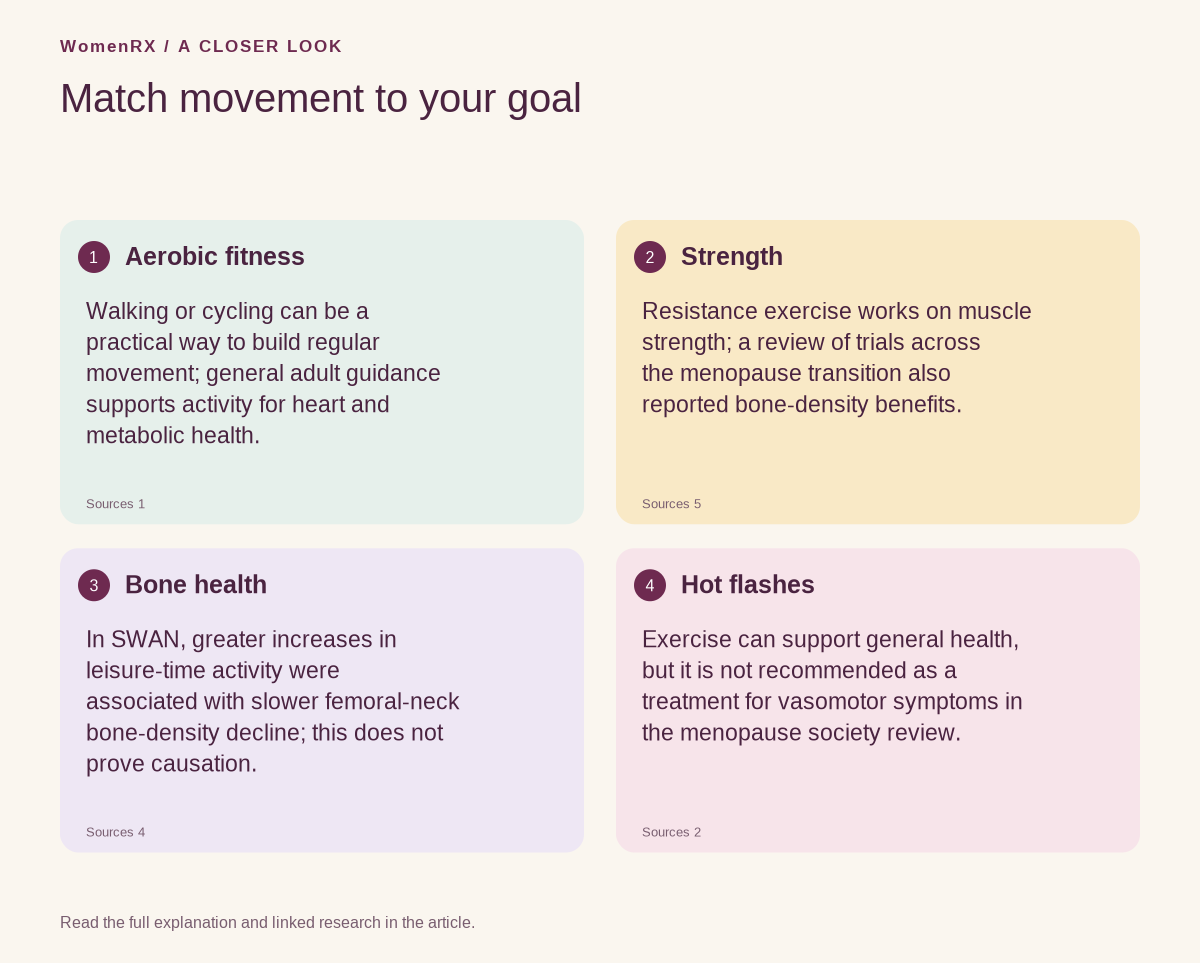
Aerobic fitness: Walking or cycling can be a practical way to build regular movement; general adult guidance supports activity for heart and metabolic health.1
Strength: Resistance exercise works on muscle strength; a review of trials across the menopause transition also reported bone-density benefits.5
Bone health: In SWAN, greater increases in leisure-time activity were associated with slower femoral-neck bone-density decline; this does not prove causation.4
Hot flashes: Exercise can support general health, but it is not recommended as a treatment for vasomotor symptoms in the menopause society review.2
Read the figure as text
Different activity types can support different goals. The symptom column distinguishes general health value from evidence for hot-flash treatment.- Aerobic fitness: Walking or cycling can be a practical way to build regular movement; general adult guidance supports activity for heart and metabolic health.1
- Strength: Resistance exercise works on muscle strength; a review of trials across the menopause transition also reported bone-density benefits.5
- Bone health: In SWAN, greater increases in leisure-time activity were associated with slower femoral-neck bone-density decline; this does not prove causation.4
- Hot flashes: Exercise can support general health, but it is not recommended as a treatment for vasomotor symptoms in the menopause society review.2
More questions, answered
Will exercise stop perimenopause hot flashes?
It may support overall health, but exercise isn’t recommended as a treatment for vasomotor symptoms in the North American Menopause Society’s evidence review. The evidence does not support promising that a particular workout will stop hot flashes. 2 5
Do I need to do the same kind of exercise every day?
No. Aerobic activity and resistance exercise address different goals, so a mix can be more useful than relying on one activity. Choose a pattern that fits your preferences and health needs. 1 5
Sources you can check
- Benefits of Exercise: MedlinePlusAccessed 2026-09-25Return to first citation
- The 2023 nonhormone therapy position statement of The North American Menopause Society.Menopause (New York, N.Y.) · 2023Return to first citation
- Detrimental Changes in Health during Menopause: The Role of Physical Activity.Hulteen RM, Marlatt KL, Allerton TD, Lovre D. · International journal of sports medicine · 2023Return to first citation
- Leisure time physical activity and bone mineral density preservation during the menopause transition and postmenopause: a longitudinal cohort analysis from the Study of Women's Health Across the Nation (SWAN).Greendale GA, Jackson NJ, Shieh A, Cauley JA, Karvonen-Gutierrez C, Ylitalo KR, Gabriel KP, Sternfeld B, Karlamangla AS. · Lancet regional health. Americas · 2023Return to first citation
- Effects of Physical Exercise on Symptoms and Quality of Life in Women in Climacteric: A Systematic Review and Meta-Analysis.Trujillo-Muñoz PJ, Sánchez-Ojeda MA, Rodríguez-Huamán EC, Mezyani-Haddu K, Hoyo-Guillot I, Navarro-Prado S. · Healthcare (Basel, Switzerland) · 2025Return to first citation