How to Build a Minoxidil Routine You Can Keep
The right routine starts with the minoxidil formulation in your hands, not directions meant for someone else’s product.
First, check whether you have a scalp product or an oral prescription. For a topical product, follow its directions for where and how often to apply it, and check its instructions for missed use and scalp care. Choose a reminder that fits those directions, then arrange a review of changes and unwanted effects. Topical minoxidil has evidence of benefit for female pattern hair loss; oral treatment is a separate decision. 3 5
First, confirm what you’re treating and what you have
Minoxidil can help with female pattern hair loss, a type of gradual thinning in which hair follicles produce progressively finer hairs. It won’t be the right answer to every kind of hair loss. For example, hair loss can also follow an illness. If the reason for your hair loss hasn’t been established, clarify that before assuming a pattern-hair-loss routine fits. 1 3
Next, read the front of the package or your prescription and identify the route: a product applied to the scalp or a tablet taken by mouth. Don’t use directions for one as directions for the other. Topical minoxidil has been studied in trials of women with female pattern hair loss. Low-dose oral minoxidil is also used for hair loss, but an expert review describes that use as lacking standardized best practices. An oral prescription needs its own plan from the prescriber. 3 5
Make the topical directions usable in real life
If you have a scalp product, keep its package instructions where you can refer to them. Before your first use, find four details: the product’s strength, the scalp area it tells you to treat, how often it says to use it, and its application directions. Check any separate instructions for missed applications, washing your hair, and using other scalp products. If a direction is unclear, a pharmacist can help you interpret it for the product you actually have.
Then choose a reminder that matches those directions. For example, you might put a reminder next to something you already do at the relevant time of day. The reminder is there to help you follow your instructions, not to change the frequency or make up for a missed use. If the timing repeatedly clashes with washing or styling your hair, bring the product and that practical problem to a pharmacist or the clinician who recommended it. That’s more useful than quietly changing the routine.
Consistency matters because minoxidil’s effect on pattern hair loss lasts only while treatment continues. That doesn’t mean you need to force yourself through a routine that isn’t working for you. It means difficulty keeping it up belongs in the treatment conversation. 1
Review both your hair and the effort of using it
Set a follow-up point with the clinician who recommended minoxidil. At that review, bring the product name or package and explain how often you’ve actually been able to use it. Note what you’ve observed about your hair and any unwanted effects. If it helps you compare over time, you could take photos of the same areas in similar lighting; they’re a record for discussion, not a test of whether treatment has succeeded.
Don’t judge the plan by a few applications. A consensus from hair-transplant specialists describes an expected response within four to six months for people with pattern hair loss in that care setting. It’s a useful reason to agree on a review point, not a promise that every woman will see a change on that schedule. 2
If your scalp becomes irritated or the product is getting onto areas you didn’t intend to treat, don’t just push through or invent a different application method. Check the directions and describe what’s happening to a pharmacist or clinician. In a review of trials in women, unwanted hair growth away from the scalp was reported more often with one studied topical minoxidil regimen than with placebo. 3
When an oral prescription or pregnancy changes the plan
If applying a scalp product is too difficult to sustain, you can ask whether another approach makes sense. Don’t switch yourself to oral minoxidil: it has different considerations and needs an individual prescribing plan. In a survey of women who had used low-dose oral minoxidil for female pattern hair loss, unwanted hair growth, often on the face, arms, or legs, was commonly reported. Because the survey included women already treated with it and had no comparison group, it can describe their experiences but can’t tell you your personal likelihood of that effect. 4 5
If you’re pregnant, planning a pregnancy, or breastfeeding, raise it before starting or continuing either form. A hair-transplant-focused expert consensus recommends avoiding minoxidil during pregnancy and breastfeeding; pregnancy plans are a reason to discuss the treatment decision ahead of time. 2
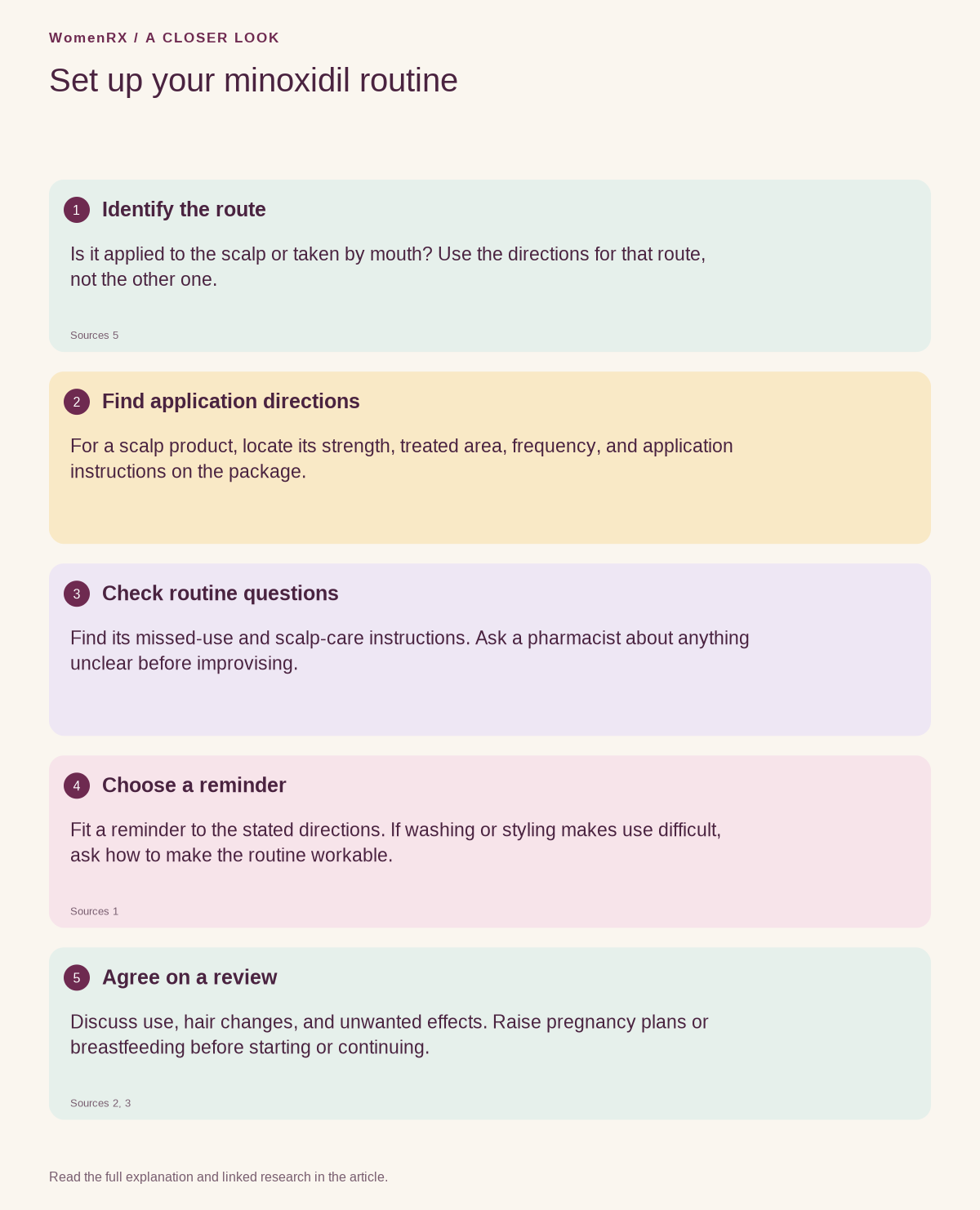
Set up your minoxidil routine
Identify the route: Is it applied to the scalp or taken by mouth? Use the directions for that route, not the other one.5
Find application directions: For a scalp product, locate its strength, treated area, frequency, and application instructions on the package.
Check routine questions: Find its missed-use and scalp-care instructions. Ask a pharmacist about anything unclear before improvising.
Choose a reminder: Fit a reminder to the stated directions. If washing or styling makes use difficult, ask how to make the routine workable.1
Agree on a review: Discuss use, hair changes, and unwanted effects. Raise pregnancy plans or breastfeeding before starting or continuing.23
Read the figure as text
Use this sequence with the product or prescription you actually have. It isn’t a substitute for its directions.- Identify the route: Is it applied to the scalp or taken by mouth? Use the directions for that route, not the other one.5
- Find application directions: For a scalp product, locate its strength, treated area, frequency, and application instructions on the package.
- Check routine questions: Find its missed-use and scalp-care instructions. Ask a pharmacist about anything unclear before improvising.
- Choose a reminder: Fit a reminder to the stated directions. If washing or styling makes use difficult, ask how to make the routine workable.1
- Agree on a review: Discuss use, hair changes, and unwanted effects. Raise pregnancy plans or breastfeeding before starting or continuing.23
More questions, answered
What if I miss a topical application?
Look for the missed-use directions on your exact product. If you can’t find them or they’re unclear, ask a pharmacist. Don’t borrow a catch-up instruction from a different formulation.
Sources you can check
- Hair loss - NHSAccessed 2026-09-25Return to first citation
- Low-dose oral minoxidil (LDOM) and topical minoxidil: consensus recommendations for managing male and female pattern hair loss in hair transplant patients using a modified Delphi process.Gupta AK, Talukder M, Williams G, Abdelhamid H, Akiska YM, Alpeter D, Boden SA, Erfan R, Farjo B, Farjo N, Gabel S, Harris JA, Hekimian KJ, Keene S, Krejci-Manwaring J, Leonard RT,... · Expert opinion on pharmacotherapy · 2026Return to first citation
- Interventions for female pattern hair loss.van Zuuren EJ, Fedorowicz Z, Carter B, Andriolo RB, Schoones J. · The Cochrane database of systematic reviews · 2012Return to first citation
- Quality of life and patient-reported side effects of low-dose oral minoxidil in treating female pattern hair loss.Sharma D, Mo L, Patel D, Piontkowski A, Medina C, Hawkins K, Shokrian N, Ungar B. · The Journal of dermatological treatment · 2026Return to first citation
- Summation and recommendations for the safe and effective use of topical and oral minoxidil.Olsen EA, Sinclair R, Hordinsky M, Mesinkovska NA, Sadick N, Shapiro J, Bergfeld W. · Journal of the American Academy of Dermatology · 2025Return to first citation