Female Pattern Hair Loss: How Treatments Compare
Topical minoxidil has the clearest support for female pattern hair loss, but the cause of thinning, daily routine, and pregnancy plans shape the choice.
If a widening part or thinning crown is due to female pattern hair loss, topical minoxidil is the most established treatment among these options, and it requires continued use to maintain its benefit. Oral minoxidil and hormone-related medicines bring different uncertainties and safety considerations, so they aren’t automatic upgrades. First, check whether the change is pattern thinning or another kind of hair loss. 1 7

First, make sure you’re treating the right kind of loss
A gradually widening part or thinning crown may prompt you to look into female pattern hair loss. But a change in hair density doesn’t identify its cause on its own. Hair loss can also be temporary or related to a medical condition, and a scalp and hair assessment can help sort out what’s happening. That matters because a treatment aimed at pattern loss may not address another cause. 1
Think about the change you’ve noticed. Is it a gradual change in how much scalp you can see through your hair, or are you mainly noticing more hair coming out? Those descriptions can help you explain the problem, but neither is a diagnosis by itself. If the loss doesn’t seem gradual or pattern-like, identifying the cause is a better first move than choosing a pattern-loss medicine. 1
Topical minoxidil: established, but ongoing
Topical minoxidil is the established medicine in this comparison. A clinical trial report notes that keeping up with application can be difficult. NHS hair-loss guidance says minoxidil can be used for female pattern hair loss and makes the long-term trade-off clear: it works only for as long as it’s used. 1 7
That makes the routine part of the treatment decision. For example, if applying something to your scalp regularly feels manageable, topical treatment may be a reasonable option to discuss. If you know that routine would be hard to sustain, say so. It’s more useful to compare realistic options than to choose a treatment you’re unlikely to keep using.
Oral minoxidil: less scalp routine, different trade-offs
Low-dose oral minoxidil may appeal to someone who doesn’t want a topical routine, but convenience doesn’t establish that it works better. A survey at one institution asked 102 women who had taken it for at least a month about their experiences. They reported improvement in hair-loss severity, while 71.6% reported unwanted hair growth, most often on the face, arms, or legs. Because the survey had no comparison group, it can’t show whether oral minoxidil is more effective than topical minoxidil. 6
A consensus statement focused on people receiving hair-transplant care recommends checking blood pressure and body weight before starting low-dose oral minoxidil, with other checks individualized. That’s a reminder that changing from a scalp product to a pill changes the safety discussion too. The statement’s transplant-care focus means it shouldn’t be mistaken for a head-to-head treatment trial in all women with pattern loss. 5
Hormone-related options: don’t assume an add-on helps
Spironolactone and finasteride may come up when you’re researching hair loss, but they shouldn’t be treated as interchangeable alternatives to minoxidil. The US spironolactone prescribing information establishes safety considerations, not how well it treats female pattern hair loss. Severe kidney problems or a history of high blood potassium can affect whether spironolactone is suitable. Its prescribing information advises avoiding it during pregnancy because of a potential risk to a male fetus. 2 3
NHS hair-loss guidance says women should not use finasteride. That statement is UK guidance, not evidence that finasteride is a proven routine choice for women in the US. If it’s suggested to you, ask what evidence supports its use for your diagnosis and what reproductive precautions would apply. 1
There’s also a broader reason not to assume more medicines mean more hair. In a randomized trial, adding the antiandrogen bicalutamide to oral minoxidil did not significantly improve hair density compared with oral minoxidil alone after 24 weeks. In another randomized study of 43 women, adding topical 17α-ethinylestradiol to minoxidil produced no statistically significant extra improvement over six months, while menstrual irregularities were more common with the combination. Neither result settles the value of every hormone-related treatment, but each is a check on the idea that an add-on is automatically better. 4 7
Pregnancy plans and life stage change the conversation
Bring up a current pregnancy, plans to become pregnant, or breastfeeding before choosing a treatment. The US prescribing information advises avoiding spironolactone during pregnancy. A consensus statement for hair-transplant patients advises avoiding minoxidil during pregnancy and breastfeeding. For spironolactone while breastfeeding, NHS medicine guidance says it may be possible to take it after an individual discussion; that isn’t a blanket endorsement for treating hair loss during breastfeeding. 2 3 5
If your thinning became noticeable around perimenopause or after menopause, that timing is worth mentioning as context, but it doesn’t by itself establish the cause or a different best treatment.
For your next step, separate two questions: What type of hair loss do I have? and Which treatment can I use safely and keep up with? Once the first is clearer, topical minoxidil’s established role, oral treatment’s distinct trade-offs, and any pregnancy or breastfeeding plans become much easier to weigh.
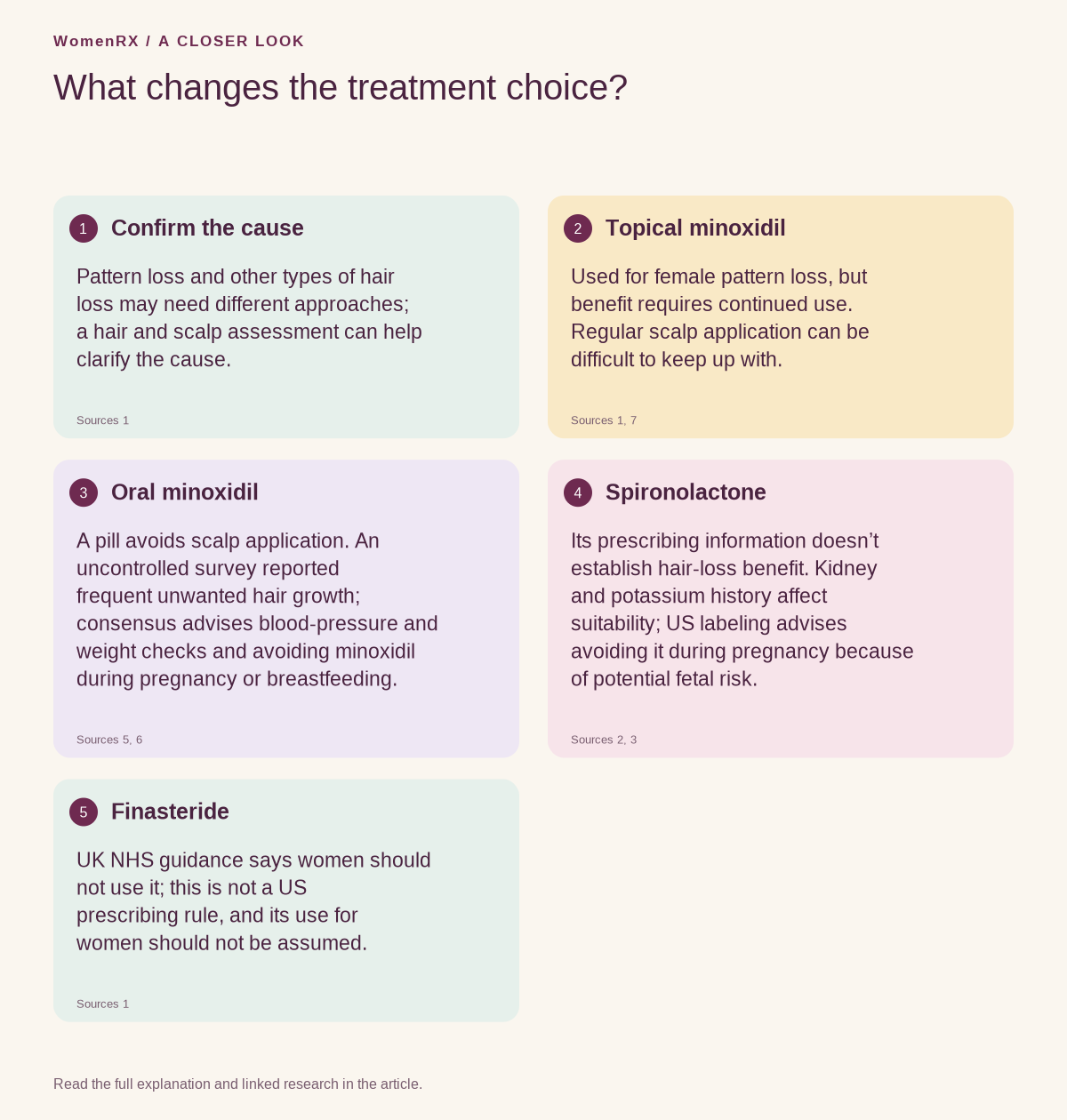
What changes the treatment choice?
Confirm the cause: Pattern loss and other types of hair loss may need different approaches; a hair and scalp assessment can help clarify the cause.1
Topical minoxidil: Used for female pattern loss, but benefit requires continued use. Regular scalp application can be difficult to keep up with.17
Oral minoxidil: A pill avoids scalp application. An uncontrolled survey reported frequent unwanted hair growth; consensus advises blood-pressure and weight checks and avoiding minoxidil during pregnancy or breastfeeding.56
Spironolactone: Its prescribing information doesn’t establish hair-loss benefit. Kidney and potassium history affect suitability; US labeling advises avoiding it during pregnancy because of potential fetal risk.23
Finasteride: UK NHS guidance says women should not use it; this is not a US prescribing rule, and its use for women should not be assumed.1
Read the figure as text
Compare the options by evidence, practical demands, and the safety questions each one raises.- Confirm the cause: Pattern loss and other types of hair loss may need different approaches; a hair and scalp assessment can help clarify the cause.1
- Topical minoxidil: Used for female pattern loss, but benefit requires continued use. Regular scalp application can be difficult to keep up with.17
- Oral minoxidil: A pill avoids scalp application. An uncontrolled survey reported frequent unwanted hair growth; consensus advises blood-pressure and weight checks and avoiding minoxidil during pregnancy or breastfeeding.56
- Spironolactone: Its prescribing information doesn’t establish hair-loss benefit. Kidney and potassium history affect suitability; US labeling advises avoiding it during pregnancy because of potential fetal risk.23
- Finasteride: UK NHS guidance says women should not use it; this is not a US prescribing rule, and its use for women should not be assumed.1
Sources you can check
- Hair loss - NHSAccessed 2026-09-25Return to first citation
- Spironolactone - NHSAccessed 2026-09-25Return to first citation
- SPIRONOLACTONE TABLET, FILM COATED [REMEDYREPACK INC.] | US prescribing information and patient instructionsAccessed 2026-09-25Return to first citation
- Efficacy and safety of combined topical estradiol with minoxidil vs. topical minoxidil in female pattern hair loss: a trichoscopic randomized controlled trial.Bedair NI, El-Komy MHM, Mohamed RE, Shamma RN, Amer MA. · Clinical and experimental dermatology · 2025Return to first citation
- Low-dose oral minoxidil (LDOM) and topical minoxidil: consensus recommendations for managing male and female pattern hair loss in hair transplant patients using a modified Delphi process.Gupta AK, Talukder M, Williams G, Abdelhamid H, Akiska YM, Alpeter D, Boden SA, Erfan R, Farjo B, Farjo N, Gabel S, Harris JA, Hekimian KJ, Keene S, Krejci-Manwaring J, Leonard RT,... · Expert opinion on pharmacotherapy · 2026Return to first citation
- Quality of life and patient-reported side effects of low-dose oral minoxidil in treating female pattern hair loss.Sharma D, Mo L, Patel D, Piontkowski A, Medina C, Hawkins K, Shokrian N, Ungar B. · The Journal of dermatological treatment · 2026Return to first citation
- Bicalutamide 25 mg combined with minoxidil 1 mg versus minoxidil 1 mg for female pattern hair loss: A randomized double-blind clinical trial.Libório RDS, Motta AVD, Miot HA, Müller Ramos P. · JAAD international · 2025Return to first citation