Finasteride for Women’s Hair Loss: What to Weigh
Finasteride may be discussed for female pattern hair loss, but the evidence is limited and pregnancy safety needs to be part of the decision.
Finasteride is used off-label for female pattern hair loss, and its benefit in women is uncertain: two controlled studies found no benefit over placebo or no treatment, while reported successes mostly came from uncontrolled studies. The evidence doesn’t clearly establish who benefits by dose or menopause status. Because finasteride is contraindicated during pregnancy, pregnancy potential and reliable contraception need explicit discussion before treatment. 2 3
What the evidence can, and can’t, tell you
Finasteride is not an FDA-approved treatment for hair loss in women; its use for female pattern hair loss is off-label. The strongest distinction in the available evidence is study design: reported improvements have mainly come from uncontrolled studies and anecdotal reports, while two controlled studies found no benefit over placebo or no treatment. That leaves a real possibility of benefit for some women, but it doesn’t establish that the medicine works reliably. 2 3
Dose is another uncertainty. A review discusses oral finasteride at 1 mg, the dose used for male pattern hair loss, but the summary doesn’t establish that this dose works for women. It also doesn’t provide enough detail to compare results across different doses. So a discussion of a particular dose shouldn’t be mistaken for strong evidence that it will help your hair. 2
Menopause doesn’t resolve the uncertainty. The review found that menopausal status did not appear to predict response, but it also described the evidence as sparse. That isn’t the same as a well-powered comparison of premenopausal and postmenopausal women. 2
Pregnancy potential changes the conversation
Finasteride is contraindicated during pregnancy because of known teratogenicity. The review says women who could become pregnant must use reliable contraception while receiving it. If pregnancy is possible, or you’re planning a pregnancy, ask your prescriber how that affects whether treatment is appropriate and how pregnancy prevention will be handled. 2
Sexual side effects are another area where the evidence needs careful reading. A 2026 systematic review found that sexual adverse effects were not consistently reported in women treated with 5-alpha-reductase inhibitors for androgenetic hair loss. That finding is not proof that women cannot experience them: it points to limited or inconsistent reporting, not a definitive estimate of risk for women taking finasteride. 4
Questions that make the decision more specific
Rather than treating finasteride as a standard next step, ask your clinician to connect the option to your situation:
- What type of hair loss do you think I have, and what supports that assessment?
- What benefit would you hope for in my case, given that controlled studies in women haven’t shown a clear benefit?
- What evidence applies to the dose you’re proposing, and what remains uncertain about dose and menopause status?
- If I could become pregnant, what contraception and pregnancy-planning considerations apply?
- How will we decide whether it’s helping, and what other options fit my situation?
Topical minoxidil is an established option for female pattern hair loss and is FDA-approved for women, according to a recent review. It’s reasonable to ask how its evidence, suitability, and tradeoffs compare with an off-label finasteride discussion. 1 3
The useful takeaway is not that finasteride never helps women, or that it is a routine choice. It’s that the evidence is uncertain, the available summaries don’t settle dose or menopause-specific benefit, and pregnancy safety is a central part of deciding whether to consider it.
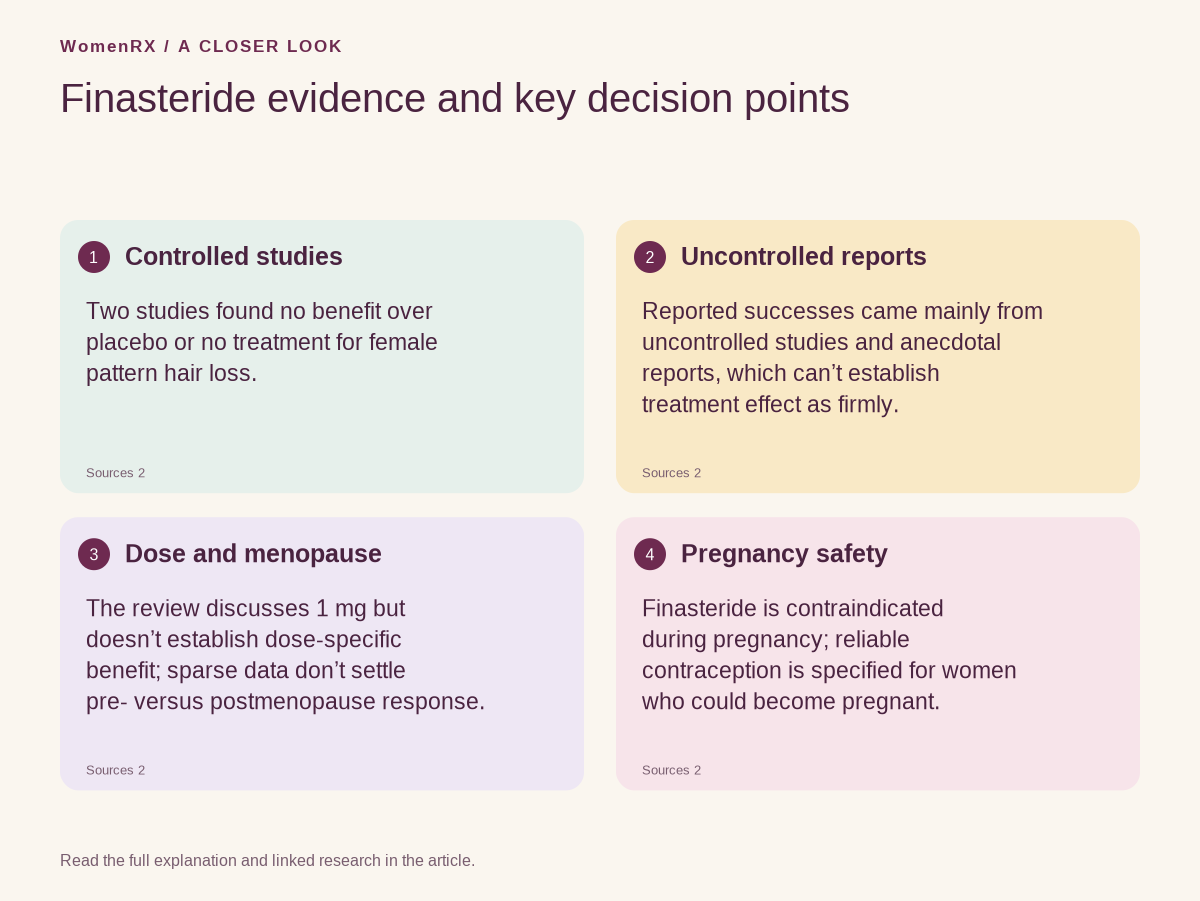
Finasteride evidence and key decision points
Controlled studies: Two studies found no benefit over placebo or no treatment for female pattern hair loss.2
Uncontrolled reports: Reported successes came mainly from uncontrolled studies and anecdotal reports, which can’t establish treatment effect as firmly.2
Dose and menopause: The review discusses 1 mg but doesn’t establish dose-specific benefit; sparse data don’t settle pre- versus postmenopause response.2
Pregnancy safety: Finasteride is contraindicated during pregnancy; reliable contraception is specified for women who could become pregnant.2
Read the figure as text
The evidence differs by study design, while the available review leaves dose and menopause comparisons unresolved. Pregnancy safety is a separate, central consideration.- Controlled studies: Two studies found no benefit over placebo or no treatment for female pattern hair loss.2
- Uncontrolled reports: Reported successes came mainly from uncontrolled studies and anecdotal reports, which can’t establish treatment effect as firmly.2
- Dose and menopause: The review discusses 1 mg but doesn’t establish dose-specific benefit; sparse data don’t settle pre- versus postmenopause response.2
- Pregnancy safety: Finasteride is contraindicated during pregnancy; reliable contraception is specified for women who could become pregnant.2
More questions, answered
Does finasteride work better after menopause?
The review found that menopausal status didn’t appear to predict response, but it also described the evidence as sparse. That doesn’t establish equal effectiveness before and after menopause. 2
Does the lack of reported sexual side effects in women mean there is no risk?
No. A systematic review found that sexual adverse effects weren’t consistently reported in women treated for androgenetic hair loss. Inconsistent reporting can’t establish that the risk is zero or give a reliable rate for women. 4
Sources you can check
- Hair loss - NHSAccessed 2026-09-25Return to first citation
- Finasteride treatment of hair loss in women.Stout SM, Stumpf JL. · The Annals of pharmacotherapy · 2010Return to first citation
- Using the Mechanisms of Action Involved in the Pathogenesis of Androgenetic Alopecia to Treat Hair Loss.Sekhavat H, Bar Yehuda S, Asotra S. · International journal of molecular sciences · 2025Return to first citation
- Sexual dysfunction associated with 5α-reductase inhibitors in the treatment of androgenetic alopecia: a systematic review.Złotowska A, Jastrząb-Miśkiewicz B, Krajewski PK. · Frontiers in medicine · 2026Return to first citation