PRP for Female Pattern Hair Loss: What Studies Show
A small trial in women found improved hair measurements after PRP, but different treatment methods and study comparisons make results hard to predict.
PRP may improve measured hair density in female pattern hair loss, but it isn’t a predictable or standardized treatment. A small trial in women found better results in PRP-treated scalp areas than in saline-treated areas. A newer trial compared PRP with two other platelet treatments, not with a placebo. Before considering it, check whether a clinic’s method and promised results match the study it cites. 2 3 5
The clearest comparison was small
Platelet-rich plasma (PRP) is prepared from a person’s own blood and injected into the scalp. For someone considering it for female pattern hair loss, the key question isn’t simply whether a study found more hair. It’s who was studied, what PRP was compared with, and how improvement was measured.
In one randomized, placebo-controlled study, 30 women with female pattern hair loss had PRP injected into one selected scalp area and saline injected into another. Researchers reported better hair density and thickness in the PRP-treated areas, measured with a folliscope. They also reported that improvements seen in photographs and patient assessments were maintained through follow-up six months after the final session. This is a directly relevant comparison, but 30 participants and that follow-up period can’t tell you how reliably another clinic’s treatment will work or how long any benefit might last. 3
A 2026 multicenter randomized trial asked a different question. It enrolled patients with female pattern hair loss and compared PRP with injectable platelet-rich fibrin and concentrated growth factors. Among the 74 patients who completed the study, target-area hair counts increased from baseline in all three groups at 24 weeks. The percentage increases were greater with the other two treatments than with PRP; increases in hair diameter did not differ significantly between groups. Because there was no saline or no-treatment group, this trial helps compare the three approaches but cannot isolate PRP’s effect against a placebo or no treatment. Its reported results do not state participants’ sex distribution or provide results by sex. 2
A broader systematic review found a favorable pooled hair-density result for PRP compared with placebo across seven randomized trials in pattern hair loss. But those trials came from a review covering male and female pattern hair loss, not a women-only estimate. Results varied substantially between studies, and the reviewers judged the risk of bias unclear in most. That makes the pooled result less useful as a forecast for one woman. 4
Why the clinic’s version of PRP matters
PRP isn’t one fixed preparation and treatment plan. Reviews of female pattern hair loss describe differing preparation methods and treatment regimens and say procedures including PRP lack standardization. Even the two trials above used different schedules: the placebo-controlled study gave up to four weekly sessions, while the three-treatment trial gave four sessions at four-week intervals. Neither schedule is established as the right one for everyone. 2 3 5 6
The outcome matters just as much as the protocol. A hair count in a defined scalp area, measured hair thickness, photographs, and your own impression of fullness answer related but different questions. For example, an increase in target-area hair count doesn’t tell you by itself whether you’d notice a change when styling your hair. Ask a clinic what it means by “improvement,” which measure supports that claim, and when it checks the result.
The trial in 30 women does not report separate outcomes by reproductive stage. The newer trial likewise does not report results by cycling years, perimenopause, or postmenopause. These reports therefore cannot tell you whether PRP works differently at those stages. 2 3
Questions worth asking before you commit
First, get a clear explanation of the cause of your thinning. Hair loss can have different causes, and general hair-loss guidance recommends establishing the cause before turning to a commercial hair clinic. 1
Then use the clinic’s own proposal to make the research comparison concrete:
- Who was in the study behind this claim? Were participants women with diagnosed female pattern hair loss? If it was a mixed group, were women’s results reported separately?
- What was PRP compared with? A saline-controlled study can answer a different question from a trial comparing three active platelet treatments. 2 3
- How does your preparation and treatment plan match the study? Ask which platelet preparation the clinic uses, how many sessions it proposes, and where its method differs from the research it cites. 2 3 5
- What result will you be able to assess? Ask whether the same scalp area and measurement method will be used at follow-up, and whether a quoted result concerns hair count, thickness, photographs, or patient-reported change.
- How long were study participants followed? The small placebo-controlled study reported follow-up six months after the last session; that does not establish permanent regrowth. 3
PRP may be worth weighing if your diagnosis is clear and you understand what the proposed treatment can and cannot reasonably promise. The useful test of a clinic’s claim is whether it connects its actual method to a relevant study, rather than treating every result labeled “PRP” as interchangeable.
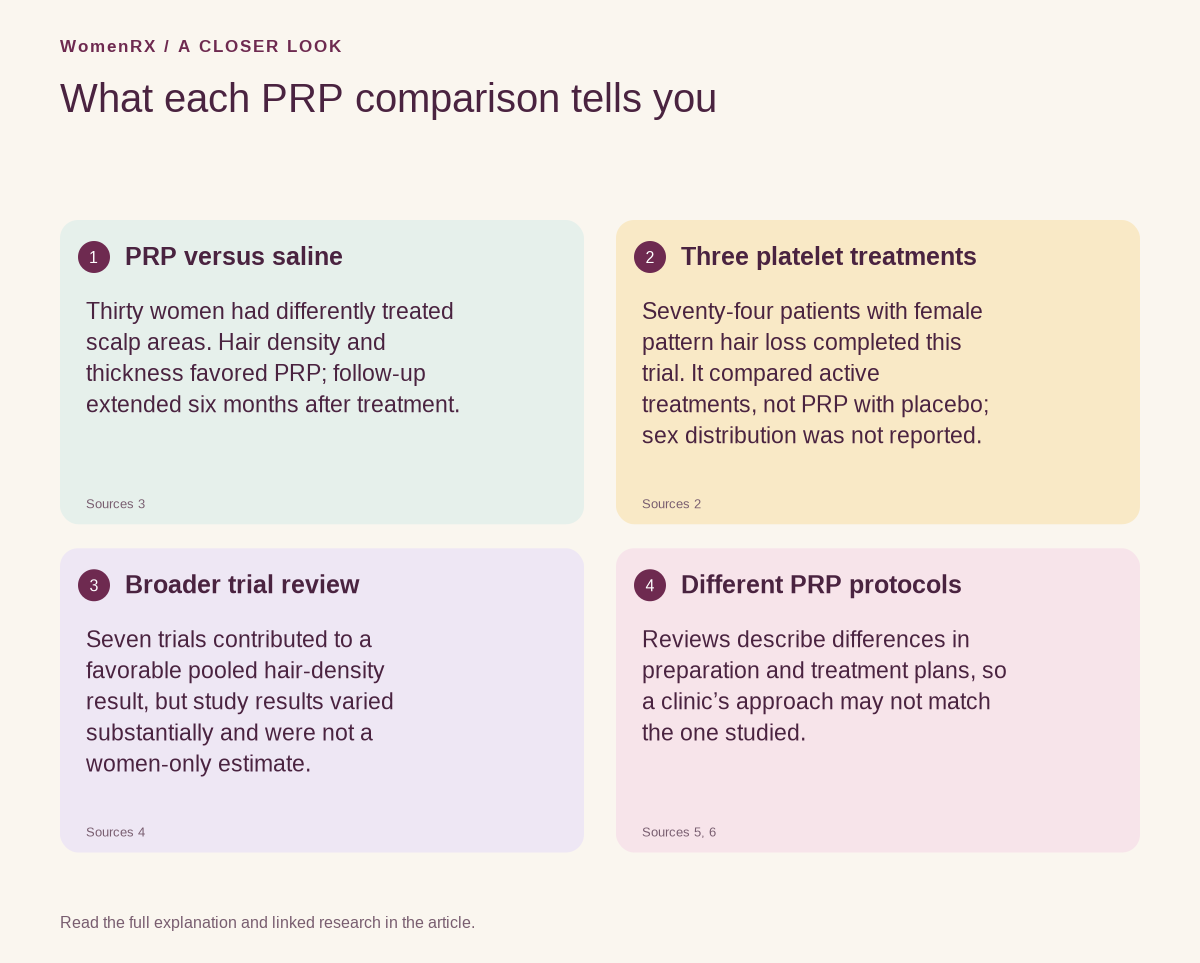
What each PRP comparison tells you
PRP versus saline: Thirty women had differently treated scalp areas. Hair density and thickness favored PRP; follow-up extended six months after treatment.3
Three platelet treatments: Seventy-four patients with female pattern hair loss completed this trial. It compared active treatments, not PRP with placebo; sex distribution was not reported.2
Broader trial review: Seven trials contributed to a favorable pooled hair-density result, but study results varied substantially and were not a women-only estimate.4
Different PRP protocols: Reviews describe differences in preparation and treatment plans, so a clinic’s approach may not match the one studied.56
Read the figure as text
The comparison group and outcome measure change what a positive result can mean.- PRP versus saline: Thirty women had differently treated scalp areas. Hair density and thickness favored PRP; follow-up extended six months after treatment.3
- Three platelet treatments: Seventy-four patients with female pattern hair loss completed this trial. It compared active treatments, not PRP with placebo; sex distribution was not reported.2
- Broader trial review: Seven trials contributed to a favorable pooled hair-density result, but study results varied substantially and were not a women-only estimate.4
- Different PRP protocols: Reviews describe differences in preparation and treatment plans, so a clinic’s approach may not match the one studied.56
More questions, answered
Does PRP permanently stop female pattern hair loss?
The placebo-controlled study in women reported follow-up six months after the final session. It does not establish permanent regrowth or show what happens over a longer period. 3
Sources you can check
- Hair loss - NHSAccessed 2026-09-25Return to first citation
- Comparative efficacy and safety of platelet-rich plasma (PRP), injectable platelet-rich fibrin (i-PRF) and concentrated growth factors (CGF) for female pattern hair loss (FPHL): a prospective multicenter randomized clinical trial.Li M, Bai Y, Ye Z, Zhang D, He Z, Ge Z, Tan A, Han Y, Chen A, Wang W, Zhuo F. · The Journal of dermatological treatment · 2026Return to first citation
- The effect of autologous activated platelet-rich plasma injection on female pattern hair loss: A randomized placebo-controlled study.Tawfik AA, Osman MAR. · Journal of cosmetic dermatology · 2018Return to first citation
- Autologous platelet-rich plasma therapy for pattern hair loss: A systematic review.Dervishi G, Liu H, Liu H, Peternel S, Labeit A, Peinemann F. · Journal of cosmetic dermatology · 2020Return to first citation
- Minimally invasive procedures for the management of female pattern hair loss.Melo DF, Cortez de Almeida RF, Frattini SC, Santos LDN, Ramos PM. · Journal of cosmetic dermatology · 2022Return to first citation
- Platelet-Rich Plasma in Female Androgenic Alopecia: A Comprehensive Systematic Review and Meta-Analysis.Zhou S, Qi F, Gong Y, Zhang C, Zhao S, Yang X, He Y. · Frontiers in pharmacology · 2021Return to first citation