Low-Level Light Therapy for Hair Loss: What the Trials Show
Some sham-controlled trials found increased hair density, but the results apply to the devices and treatment routines actually studied.
Low-level light therapy has shown a hair-density benefit over sham devices in trials of pattern hair loss, including studies with women. But results from one lasercomb or helmet don’t establish that another device will work as well. Before buying, check whether the specific model was studied in women, what change it measured, and whether you can keep up with its treatment schedule. 2 3
The evidence is promising, but device-specific
Low-level light or laser therapy (LLLT) is intended to treat pattern hair loss. It isn’t one standardized treatment: home devices vary in design, and trials have used lasercombs and helmet-style devices. A result for one model, wavelength, or schedule shouldn’t be treated as proof for every device on the market. 2 3
The most useful question isn’t simply whether “laser therapy works.” It’s whether a particular device has credible results for women with female pattern hair loss, and whether the benefit is meaningful enough to justify the cost and regular use.
What a sham-controlled trial found in women
A multicenter, randomized, double-blind study tested lasercombs against sham devices in separate trials for women and men with pattern hair loss. Women used the device over the whole scalp three times a week for 26 weeks. In the efficacy analysis, mean terminal hair count in the women’s target scalp area increased from baseline by 20.2 hairs per cm² with a 9-beam comb and 20.6 with a 12-beam comb. The corresponding increases with sham devices were 2.8 and 3.0 hairs per cm². 2
Those figures are changes from baseline within each group, not a promise that you’ll gain that many hairs. They also come from different female trial groups, not a head-to-head comparison of the two combs. Nineteen of the 141 women randomized weren’t included in the efficacy analysis, another reason to read the study details rather than focus on a headline result. 2
A 2021 systematic review and meta-analysis of seven double-blind, randomized trials also found greater hair-density improvement with home-use LLLT than with sham devices. Its analyses included men and women and found positive results in both comb- and helmet-type device subgroups. That supports a treatment signal across the trials, but it doesn’t show that every comb is equivalent to every helmet, or identify a best device. 3
A separate review found that the studies differed in their populations and that three evaluated women only. Its authors reported positive findings across the sham-controlled trials, while also noting industry relationships in some included studies. A review can summarize results, but differences in devices and study design still matter when applying those findings to a specific purchase. 4
Check what the trial actually measured
A trial may measure terminal hair density, hair diameter, or another hair parameter. These are not interchangeable outcomes, and an improvement in a measured scalp area doesn’t necessarily tell you how noticeable the change will be across your whole head. For example, the sham-controlled lasercomb study counted terminal hairs in a target area and also asked participants about perceived improvement. 2
When comparing a device with a study, look for the exact model or a clearly identified device design, the participant group, the comparison group, the outcome measure, and the length and frequency of treatment. A claim based on a different model or a different population is less directly relevant to you. The evidence reviews themselves call for longer follow-up and direct comparisons between devices and energy sources. 2 3
The routine is part of the decision
In the female lasercomb trials, the schedule was three sessions a week for 26 weeks. In a separate randomized trial in Chinese women with female pattern hair loss, the tested helmet was used for 20 minutes every other day for 24 weeks, alongside topical minoxidil. Those schedules describe the studies, not instructions for using a device you own; follow the directions for the specific product. 2 1
The combination trial compared minoxidil alone with minoxidil plus the helmet, not the helmet alone against a sham device. It reported a difference in mean hair diameter in the midscalp favoring the combination group, but a lower increase in intermediate-hair percentage there. That mixed set of outcomes doesn’t establish that the helmet by itself works, or tell you how much extra benefit to expect from adding one. 1
Regular use for months is a real commitment. If you’re unlikely to follow the studied schedule, a positive trial result may be less useful for your decision. Ask whether the device’s instructions and practical design make consistent use realistic for you, and check whether the evidence is for that device rather than for LLLT in general.
A practical check before spending
Before buying, see if you can answer these questions from reliable information about the device:
- Was this specific model, or a clearly comparable design, tested against a sham device?
- Did the trial include women with female pattern hair loss?
- Did it measure an objective hair outcome, and over what treatment period?
- Is the tested schedule realistic for your routine?
- Does the evidence support using it alone, or only alongside another treatment?
LLLT is a plausible option with positive trial results for pattern hair loss, including in women. The evidence is more useful when it matches the device and routine you’re considering; it doesn’t justify a blanket promise of regrowth or a product ranking. 2 3
What the device trials can tell you
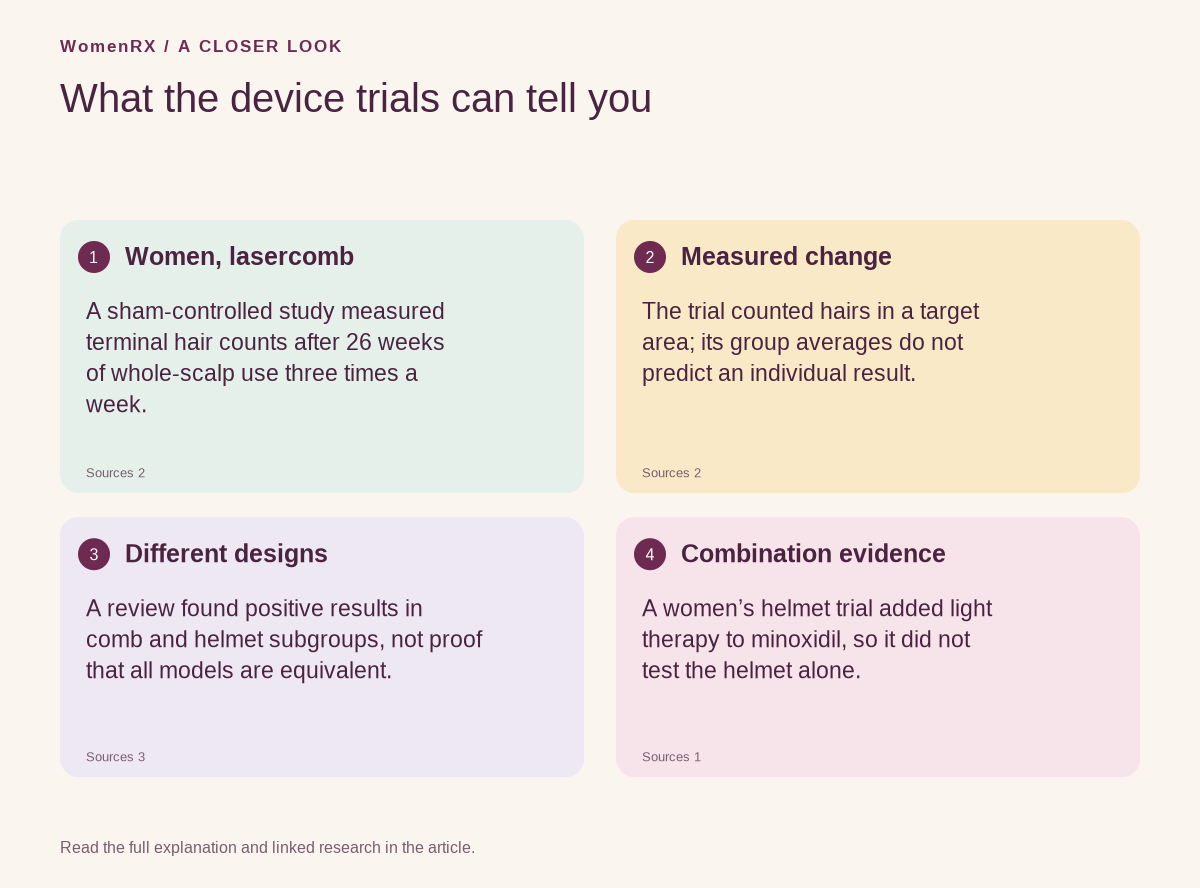
Women, lasercomb: A sham-controlled study measured terminal hair counts after 26 weeks of whole-scalp use three times a week.2
Measured change: The trial counted hairs in a target area; its group averages do not predict an individual result.2
Different designs: A review found positive results in comb and helmet subgroups, not proof that all models are equivalent.3
Combination evidence: A women’s helmet trial added light therapy to minoxidil, so it did not test the helmet alone.1
Read the figure as text
The evidence is easiest to apply when the study population, device, outcome, and treatment schedule match the purchase you’re considering.- Women, lasercomb: A sham-controlled study measured terminal hair counts after 26 weeks of whole-scalp use three times a week.2
- Measured change: The trial counted hairs in a target area; its group averages do not predict an individual result.2
- Different designs: A review found positive results in comb and helmet subgroups, not proof that all models are equivalent.3
- Combination evidence: A women’s helmet trial added light therapy to minoxidil, so it did not test the helmet alone.1
More questions, answered
Does a result for a lasercomb apply to a helmet?
Not automatically. Reviews report benefits in trials of both comb- and helmet-type devices, but that doesn’t show the designs or individual products are interchangeable. Look for evidence that matches the model and treatment routine you’re considering. 3
Has light therapy been tested alongside minoxidil in women?
Yes. A randomized trial in Chinese women with female pattern hair loss compared topical minoxidil alone with minoxidil plus a 655 nm laser helmet for 24 weeks. It tested the combination, not the helmet as a standalone treatment, and reported differing results across hair measures. 1
Sources you can check
- Comparative efficacy of 2% minoxidil alone against combination of 2% minoxidil and low-level laser therapy in female pattern hair loss-A randomized controlled trial in Chinese females.Yang X, Qiao R, Cheng W, Lan X, Li Y, Jiang Y. · Photodiagnosis and photodynamic therapy · 2024Return to first citation
- Efficacy and safety of a low-level laser device in the treatment of male and female pattern hair loss: a multicenter, randomized, sham device-controlled, double-blind study.Jimenez JJ, Wikramanayake TC, Bergfeld W, Hordinsky M, Hickman JG, Hamblin MR, Schachner LA. · American journal of clinical dermatology · 2014Return to first citation
- A Systematic Review and Meta-analysis of Randomized Controlled Trials of United States Food and Drug Administration-Approved, Home-use, Low-Level Light/Laser Therapy Devices for Pattern Hair Loss: Device Design and Technology.Lueangarun S, Visutjindaporn P, Parcharoen Y, Jamparuang P, Tempark T. · The Journal of clinical and aesthetic dermatology · 2021Return to first citation
- Examining the Safety and Efficacy of Low-Level Laser Therapy for Male and Female Pattern Hair Loss: A Review of the Literature.Egger A, Resnik SR, Aickara D, Maranda E, Kaiser M, Wikramanayake TC, Jimenez JJ. · Skin appendage disorders · 2020Return to first citation