Hair Loss in Midlife: Causes to Consider
A widening part, increased shedding, and scalp changes can offer different clues, but none identifies the cause on its own.
Hair loss around midlife can be gradual pattern thinning, another type of hair loss, or a change related to illness or a health condition. A widening central part may fit female-pattern hair loss, though women with that pattern can also notice shedding. Menopause may coincide with changes in hair density, but timing alone can’t explain unexplained loss. 1 4 5
First, notice what is changing
Female-pattern hair loss often develops gradually. You may notice a wider part, less volume in your ponytail, or thinning over the central scalp while the front hairline remains relatively preserved. In this pattern, follicles become smaller and produce finer hairs, reducing overall density. 4 5
Shedding is worth describing, but it doesn’t neatly separate one cause from another. Women with female-pattern hair loss may report progressive shedding, too. Illness and other health factors can also contribute to hair loss, so the timing of a change is useful context, not a diagnosis. 1 4
If you have distinct areas of loss or visible scalp changes, mention those specifically. Hair loss has different forms, including alopecia areata and scarring conditions, and distinguishing them may require an examination. 3 4
Menopause may overlap with hair changes, but it isn’t an explanation by itself
Female-pattern hair loss becomes more common with age, and studies describe it in women after menopause. That overlap doesn’t show that menopause caused a particular person’s hair loss. 4 5
The hormonal explanation isn’t settled in the same way across reviews. One clinical review describes female-pattern hair loss as involving sensitivity to androgens. Another review says the direct relationship between androgens and female-pattern hair loss remains unclear, and that its underlying causes are not fully understood. Taken together, a hormonal contribution is possible, but menopause timing alone can’t establish it. 4 5
Put iron and thyroid clues in context
Iron is one nutritional factor discussed in reviews of female hair loss, but seeing more hair come out doesn’t show that your iron is low. Heavy periods can increase the likelihood of low iron, as can some digestive conditions or problems absorbing iron. If these apply, include them in the conversation about your hair and overall health. 2 3
Avoid starting iron just because your hair is thinning. Too much iron can harm the body, and supplements can cause problems such as nausea, constipation, and abdominal pain. Whether iron testing makes sense depends on your history and other findings. 2
Thyroid dysfunction and other endocrine abnormalities may also be considered when evaluating hair loss. A history of thyroid problems is useful context, but it doesn’t prove that the thyroid is causing the change. 4
Bring the timeline, not a guess
Before an appointment, note when you first noticed the change and whether it has been gradual or more noticeable over a shorter period. Describe where you see thinning, whether you’re also shedding, and any scalp symptoms or visible changes. Add recent illnesses or other health changes, menstrual bleeding changes, and the names and start or stop dates of medicines and supplements. These details can help frame an assessment; they don’t establish that any one event or product caused the loss. 4
Mention supplements, including biotin. A review advises avoiding excessive biotin supplementation because it can interfere with diagnostic tests. 3
If the hair loss concerns you, or you notice distinct patches or changes to your scalp, seek an evaluation rather than assuming menopause is the cause. A clinician may be able to identify the type by examining your hair and scalp. 1 4
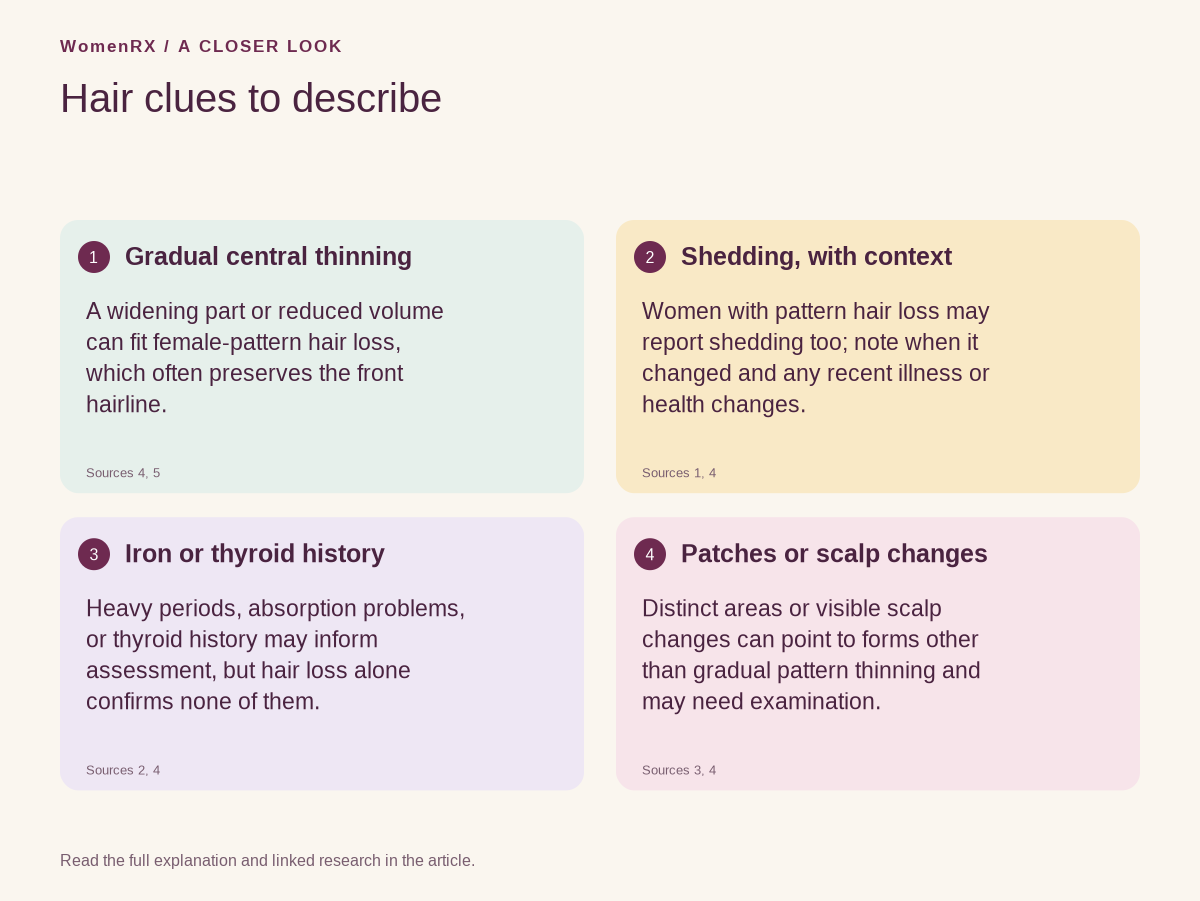
Hair clues to describe
Gradual central thinning: A widening part or reduced volume can fit female-pattern hair loss, which often preserves the front hairline.45
Shedding, with context: Women with pattern hair loss may report shedding too; note when it changed and any recent illness or health changes.14
Iron or thyroid history: Heavy periods, absorption problems, or thyroid history may inform assessment, but hair loss alone confirms none of them.24
Patches or scalp changes: Distinct areas or visible scalp changes can point to forms other than gradual pattern thinning and may need examination.34
Read the figure as text
These clues help organize what you’ve noticed. They are not a way to diagnose the cause at home.- Gradual central thinning: A widening part or reduced volume can fit female-pattern hair loss, which often preserves the front hairline.45
- Shedding, with context: Women with pattern hair loss may report shedding too; note when it changed and any recent illness or health changes.14
- Iron or thyroid history: Heavy periods, absorption problems, or thyroid history may inform assessment, but hair loss alone confirms none of them.24
- Patches or scalp changes: Distinct areas or visible scalp changes can point to forms other than gradual pattern thinning and may need examination.34
More questions, answered
Does hair loss mean I’m entering menopause?
No. Hair changes can happen around midlife, but hair loss alone doesn’t establish that menopause has begun or caused it. The pattern, health timeline, and scalp findings matter too. 1 4 5
Should I take iron for hair loss?
Not automatically. Hair loss doesn’t confirm low iron, and too much iron can be harmful. Heavy periods or problems with iron absorption may be relevant when deciding whether to check iron status. 2
Sources you can check
- Hair loss - NHSAccessed 2026-09-25Return to first citation
- Iron: MedlinePlusAccessed 2026-09-25Return to first citation
- Addressing the Root Causes of Female Hair Loss and Non-Pharmaceutical Interventions.Leavitt A, Hawkins SD, Kindred C, Frey C, Gainers M, Grekin SK, Leavitt M. · Journal of drugs in dermatology : JDD · 2025Return to first citation
- Male and female pattern hair loss.Iyengar L, Li J. · Australian prescriber · 2025Return to first citation
- Female Pattern Hair Loss: An Overview with Focus on the Genetics.Ho CY, Chen JY, Hsu WL, Yu S, Chen WC, Chiu SH, Yang HR, Lin SY, Wu CY. · Genes · 2023Return to first citation