Oral Minoxidil for Women: What the Evidence Shows
The pill may be worth discussing for gradual pattern thinning, but evidence in women is limited and oral treatment can cause whole-body side effects.
Low-dose oral minoxidil may help female pattern hair loss, but studies in women are small and don’t show that the pill works better than topical minoxidil. It’s used off-label for hair loss in the US. Before weighing convenience against possible side effects, make sure the thinning fits a pattern studied with minoxidil, and recognize that the cited studies do not establish pregnancy safety. 5 6
Start with the kind of hair loss
Oral minoxidil is most relevant to discuss when thinning has developed gradually in a recognizable pattern, such as a widening part or thinning over the crown. Female pattern hair loss is usually gradual and can involve the top of the scalp while the frontal hairline is often preserved. 5
That pattern matters because hair loss has other causes. Diffuse shedding, patches, or loss around the temples can have different explanations, including conditions that need their own assessment. Studies of oral minoxidil for androgenetic, or pattern, hair loss don’t establish that it treats these other causes. A review of oral minoxidil studies across several types of hair loss could not pool efficacy because the studies were too different. 2 4
If your loss doesn’t look like gradual pattern thinning, or you’re unsure, first focus the discussion on what may be causing it. Identifying the cause helps avoid treating the wrong problem.
What the studies in women can tell us
A 2025 review of four randomized trials comparing oral with topical minoxidil included two trials of women, one with both men and women, and one of men. The women-only trials enrolled 52 and 72 participants and compared oral with topical treatment over 24 weeks and nine months, respectively. Across the four trials, the review found no significant difference between oral and topical treatment in hair density. That result doesn’t prove the treatments are equivalent, and the review didn’t report a women-specific pooled result. 6
A separate randomized trial enrolled 90 men, of whom 68 completed the study; the reported results did not show oral minoxidil to be superior to topical minoxidil for the primary hair-density outcomes after 24 weeks. Because the participants were men and the study used a different oral regimen, it can’t tell us how well oral treatment works for women. 1
Taken together, the evidence supports a measured conversation, not a promise that a pill will outperform a topical product. The women-only comparisons lasted 24 weeks and nine months, so they don’t settle how well oral minoxidil works for an individual woman over longer-term use. 6
The convenience tradeoff includes whole-body effects
Taking a pill may be simpler than applying a topical product, especially if you find the application inconvenient or dislike how the product feels. But oral minoxidil acts throughout the body. In a systematic review pooling individual safety data from 14 studies and 442 people treated for different kinds of hair loss, unwanted hair growth was reported in 24%, swelling in the legs or feet in 2%, postural blood-pressure drops in 1.1%, and heart-rate changes in 1.3%. These figures combine different studies, hair-loss conditions, and doses; they aren’t precise predictions for women with female pattern hair loss. 2
A separate analysis of six studies found that higher oral doses were associated with both greater hair-density changes and more hypertrichosis and cardiovascular side effects after six months. Because this was a study-level statistical association, it doesn’t prove that increasing a dose will cause a particular outcome for you. It does show why “low dose” shouldn’t be taken to mean “no tradeoffs.” 3
Oral minoxidil is used off-label for hair loss in the US; it isn’t FDA-approved for that indication. 6 Ask what benefits are realistic for your specific pattern and how possible unwanted hair growth, swelling, blood-pressure changes, or heart-rate changes factor into your decision.
What the studies say about pregnancy
The hair-loss studies summarized here report hair outcomes, not pregnancy-safety findings. They don’t establish whether oral minoxidil is safe during pregnancy. 6 If you could become pregnant, discuss pregnancy possibility or plans with the prescribing clinician before deciding about treatment.
What to weigh before choosing oral minoxidil
A discussion is most useful when it separates three questions: Does the loss look like female pattern hair loss? Is topical treatment inconvenient or unsuitable for you? And what are the limits of the side-effect and pregnancy-safety evidence? Oral minoxidil may be one option to weigh, but current comparative evidence doesn’t show it to be better than topical treatment for women.
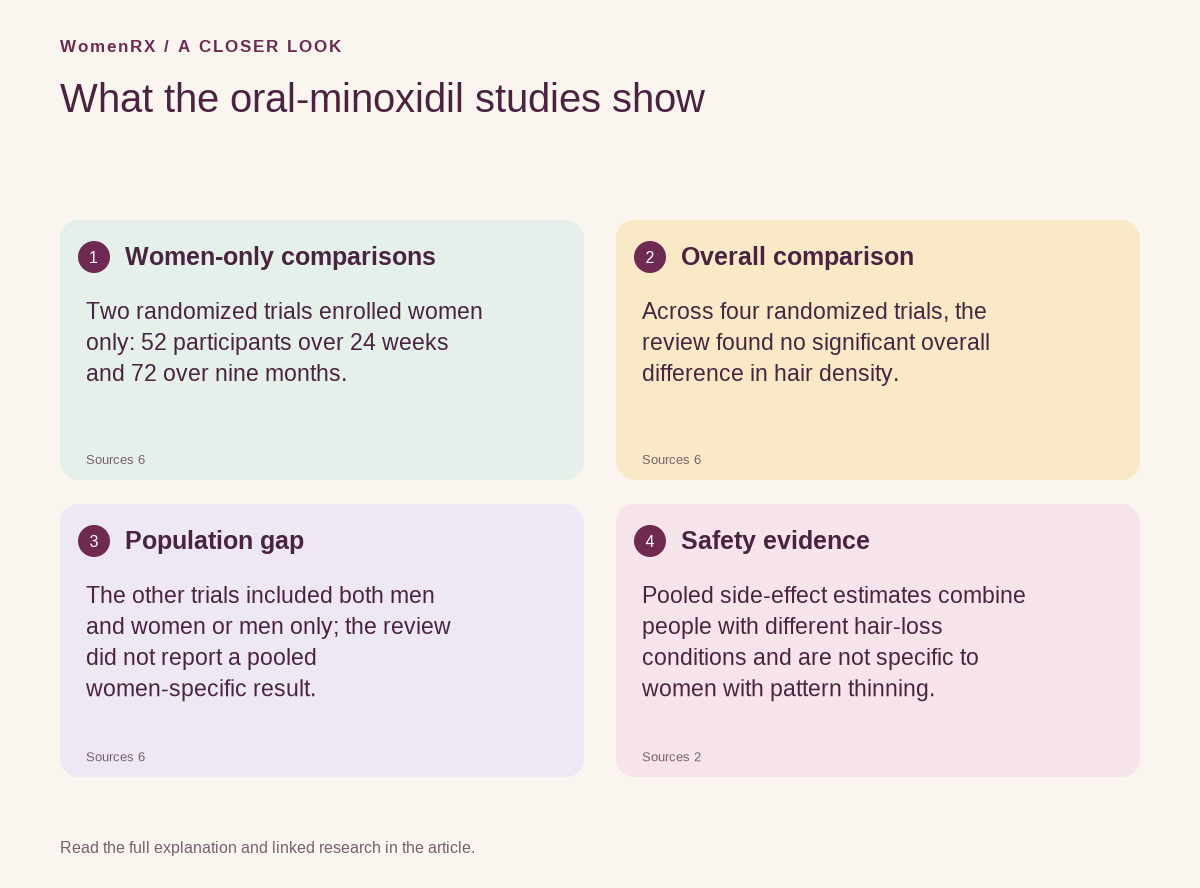
What the oral-minoxidil studies show
Women-only comparisons: Two randomized trials enrolled women only: 52 participants over 24 weeks and 72 over nine months.6
Overall comparison: Across four randomized trials, the review found no significant overall difference in hair density.6
Population gap: The other trials included both men and women or men only; the review did not report a pooled women-specific result.6
Safety evidence: Pooled side-effect estimates combine people with different hair-loss conditions and are not specific to women with pattern thinning.2
Read the figure as text
The evidence is promising enough to discuss, but the study populations and safety data limit what can be concluded for an individual woman.- Women-only comparisons: Two randomized trials enrolled women only: 52 participants over 24 weeks and 72 over nine months.6
- Overall comparison: Across four randomized trials, the review found no significant overall difference in hair density.6
- Population gap: The other trials included both men and women or men only; the review did not report a pooled women-specific result.6
- Safety evidence: Pooled side-effect estimates combine people with different hair-loss conditions and are not specific to women with pattern thinning.2
More questions, answered
Does oral minoxidil work for hair shedding from any cause?
The available comparison evidence is about androgenetic, or pattern, hair loss. A review covering multiple kinds of hair loss couldn’t analyze oral minoxidil’s efficacy across them because the studies were too heterogeneous. The cause of shedding matters before assuming this treatment applies. 2 6
Does the research show oral minoxidil is better than topical minoxidil for women?
No. A review of four randomized trials found no significant difference in hair density between oral and topical minoxidil overall, but it didn’t report a women-specific pooled result. Two trials enrolled only women, one lasted 24 weeks and the other nine months. They don’t establish that the pill is better for women. 6
Sources you can check
- Oral Minoxidil vs Topical Minoxidil for Male Androgenetic Alopecia: A Randomized Clinical Trial.Penha MA, Miot HA, Kasprzak M, Müller Ramos P. · JAMA dermatology · 2024Return to first citation
- Safety of low-dose oral minoxidil treatment for hair loss. A systematic review and pooled-analysis of individual patient data.Jimenez-Cauhe J, Saceda-Corralo D, Rodrigues-Barata R, Moreno-Arrones OM, Ortega-Quijano D, Fernandez-Nieto D, Jaen-Olasolo P, Vaño-Galvan S. · Dermatologic therapy · 2020Return to first citation
- There Is a Positive Dose-Dependent Association between Low-Dose Oral Minoxidil and Its Efficacy for Androgenetic Alopecia: Findings from a Systematic Review with Meta-Regression Analyses.Gupta AK, Hall DC, Talukder M, Bamimore MA. · Skin appendage disorders · 2022Return to first citation
- Bitemporal Scalp Hair Loss: Differential Diagnosis of Nonscarring and Scarring Conditions.De Souza B, Tovar-Garza A, Uwakwe LN, McMichael A. · The Journal of clinical and aesthetic dermatology · 2021Return to first citation
- Female pattern hair loss.Herskovitz I, Tosti A. · International journal of endocrinology and metabolism · 2013Return to first citation
- Can oral minoxidil be the game changer in androgenetic alopecia? A comprehensive review and meta-analysis comparing topical and oral minoxidil for treating androgenetic alopecia.Fazal F, Malik BH, Mumtaz Malik H, Sabir B, Mustafa H, Ahmed M, Abid A, Leeza Adil M, Shafi U, Saad M. · Skin health and disease · 2025Return to first citation