Oral Minoxidil Reviews: What Women Can Learn
Reviews can raise useful questions about routine and side effects, but they can’t show whether a treatment caused someone’s hair change or predict your result.
Use an online review as one person’s account, not proof that oral minoxidil works or is safe for you. A small survey captured differences in how people described ease of use and satisfaction; a separate chart review recorded reports of new shedding. Neither establishes cause, and neither tells you what to expect based on your diagnosis or life stage. 2 3

A review is a clue, not a forecast
An online account can put everyday questions into focus: Was a pill easier to fit into someone’s routine than applying a treatment to the scalp? What did the person call a side effect? What did “it worked” mean to them? Those details can help you decide what you want to ask about. They don’t prove that oral minoxidil caused a change or show how likely that experience is for you.
A review is also self-selected: it comes from someone who chose to post. People with especially positive or difficult experiences may be more inclined to share, while many people who tried a treatment may say nothing. A cluster of similar stories can be worth noticing, but it isn’t a reliable count of how often something happens.
What research on patient experience adds
A 2025 cross-sectional survey of 50 people using oral or topical minoxidil asked about treatment experience. Oral users reported greater ease of use and hair styling, fewer missed treatment days, and greater satisfaction on some hair-related measures. Hypertrichosis, or unwanted hair growth, was reported more often in the oral group. These are respondents’ reports in a small, one-time survey, not proof that the route caused the differences or a personal estimate of your chances. The results weren’t reported separately for women. 2
A different study reviewed medical charts for 115 people prescribed low-dose oral minoxidil. Six people, or 5.2% of that group, reported new hair shedding after starting treatment. The review relied on retrospective records and subjective reports; it cannot establish that minoxidil caused the shedding or tell you what will happen to you. 3
These studies answer different questions from online reviews. The survey offers a snapshot of what respondents said about use and satisfaction. The chart review looked back at clinical records and recorded reports of shedding. Neither is a controlled comparison that establishes treatment effect, and neither provides women-specific or life-stage-specific results. 2 3
Check whether the account matches your situation
Hair loss can have different causes, including medical conditions, medicines, stress, and poor nutrition. Treatment depends on the cause, so two people describing “thinning” may not be talking about the same condition. 1
When you read a review, look for whether the person names a diagnosis and explains what changed. A personal impression, a photograph, and a measured hair count are different kinds of evidence. Also notice whether the account mentions other treatments or health changes that could make the result harder to interpret.
For women, don’t assume an account applies to your circumstances just because the writer is also a woman. The oral-minoxidil findings described here don’t establish results specific to women or to pregnancy, postpartum, perimenopause, or postmenopause. A review that leaves out diagnosis and relevant circumstances may be relatable, but it can’t answer whether the same result is likely in your situation. 2 3
Turn a story into a practical question
Instead of asking only, “Did it work?”, try asking:
- What kind of hair loss was being treated? A clear diagnosis is more informative than a general description of thinning. 1
- What counted as a result? Ask whether the person describes their impression, a photo comparison, or another way of assessing change.
- What was manageable or difficult? Routine and styling are practical concerns. In a small survey, oral users reported greater ease than topical users, but that doesn’t mean the same will be true for you. 2
- What else changed? Other treatments or health circumstances may affect how you interpret a personal account.
- How was the experience recorded? A one-time survey and a retrospective review of clinical records gather information differently. Neither design, on its own, can show that oral minoxidil caused an outcome. 2 3
The useful takeaway isn’t a star rating or a promise that someone else’s result will repeat. It’s a clearer set of questions about diagnosis, routine, what “improvement” means, and which reported effects matter to you.
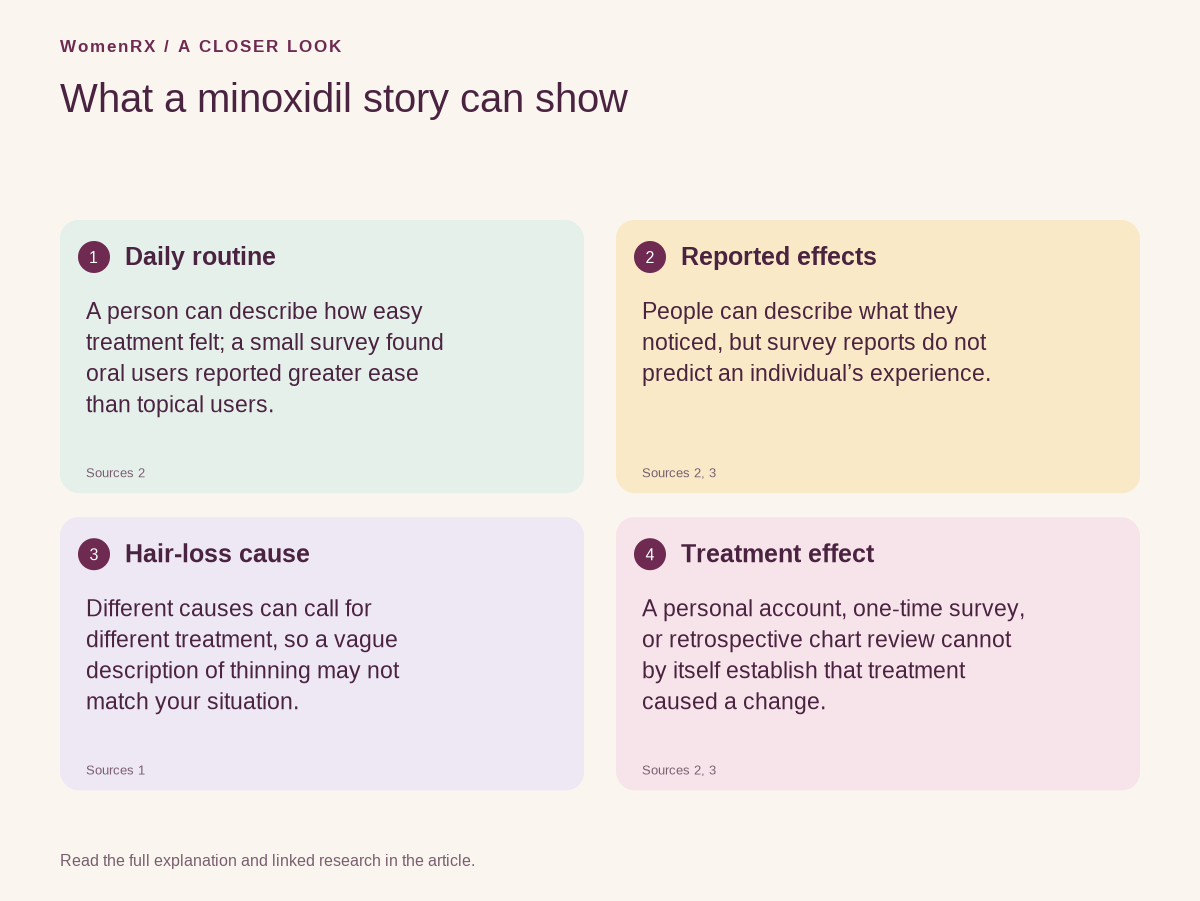
What a minoxidil story can show
Daily routine: A person can describe how easy treatment felt; a small survey found oral users reported greater ease than topical users.2
Reported effects: People can describe what they noticed, but survey reports do not predict an individual’s experience.23
Hair-loss cause: Different causes can call for different treatment, so a vague description of thinning may not match your situation.1
Treatment effect: A personal account, one-time survey, or retrospective chart review cannot by itself establish that treatment caused a change.23
Read the figure as text
Separate useful experience details from questions that require a diagnosis or stronger evidence.- Daily routine: A person can describe how easy treatment felt; a small survey found oral users reported greater ease than topical users.2
- Reported effects: People can describe what they noticed, but survey reports do not predict an individual’s experience.23
- Hair-loss cause: Different causes can call for different treatment, so a vague description of thinning may not match your situation.1
- Treatment effect: A personal account, one-time survey, or retrospective chart review cannot by itself establish that treatment caused a change.23
Sources you can check
- Hair Loss | Alopecia | Alopecia Areata | MedlinePlusAccessed 2026-09-25Return to first citation
- Comparing Adherence, Side Effects, and Satisfaction in Oral and Topical Minoxidil: A Cross-Sectional Study.Kobayashi S, Rose L, Minta A, Trovato S, Dulmage B. · Journal of drugs in dermatology : JDD · 2025Return to first citation
- Combating "dread shed": The impact of overlapping topical and oral minoxidil on temporary hair shedding during oral minoxidil initiation.Nohria A, Desai D, Sikora M, Mandal S, Shapiro J, Lo Sicco K. · JAAD international · 2024Return to first citation