Oral Minoxidil Side Effects: What Needs Attention?
Unwanted facial hair may be frustrating, while new swelling, dizziness, or breathing trouble calls for a different response.
With low-dose oral minoxidil for hair loss, extra facial or body hair is the most frequently reported side effect. Temporary scalp shedding can also happen. New ankle or foot swelling, dizziness, or a racing heartbeat without breathing trouble deserves a call to your prescriber. If palpitations come with difficulty breathing, seek urgent medical advice. If you’re gasping, cannot get words out because of breathlessness, or your chest feels tight or heavy, seek emergency care rather than waiting for a medication check-in. 3452
Oral minoxidil affects more than the hair on your scalp. Knowing which changes are mainly a treatment tradeoff and which could signal a circulation or fluid problem can help you respond without dismissing something serious.
Extra hair growth is common, but you get to decide if it’s acceptable
Minoxidil can stimulate hair growth beyond the scalp, a side effect called hypertrichosis. You might notice it on your face or elsewhere on your body. A review of studies in people taking low-dose oral minoxidil for hair loss describes it as the most frequent adverse effect, occurring in approximately 15% of patients overall. Reports vary with the dose and the people studied, so that figure isn’t a prediction of what will happen to you. 5
This usually isn’t an emergency, but it isn’t trivial if facial hair bothers you. Bring it up with the person who prescribed the medication. It’s a reason to revisit whether the scalp-hair benefit is worth the unwanted growth, rather than assuming you have to put up with it. A separate review reports that temporary scalp shedding can occur during treatment. 3 Tell your prescriber if shedding worries you or seems to be getting worse, since hair loss itself can have more than one cause. 1
Some research reports more hypertrichosis in women, but it doesn’t establish a simple women-versus-men side-effect rate you can apply to yourself. In one retrospective study of 310 people treated for androgenetic alopecia, women received lower average doses and had more adverse events overall, but differences did not persist when the researchers examined individual adverse-event subgroups. 54
Swelling and lightheadedness deserve a call
Oral minoxidil was originally developed as a blood-pressure medicine. Even at the lower doses used for hair loss, reported effects include lightheadedness or dizziness and fluid retention, which may show up as swelling in your feet or ankles. A review found fluid retention reported in 1.3% to 10% of patients across studies; that range reflects differing studies, not your personal odds. The retrospective study found that higher doses were associated with more dizziness or lightheadedness. 354
If swelling is new or increasing, or you feel newly dizzy, contact your prescriber so they can assess the symptom and the treatment. Do the same for a new racing, pounding, or fluttering heartbeat if you have no breathing trouble. If palpitations come with difficulty breathing, seek urgent medical advice rather than waiting for a routine prescriber call. If the breathing difficulty is severe or your chest feels tight or heavy, seek emergency care. These symptoms have been reported with low-dose oral minoxidil, but their presence alone doesn’t tell you whether the medication is the cause. Don’t try to solve new swelling by changing your dose or adding a water pill on your own. 452
Breathing trouble changes the priority
Don’t wait for a routine call if you’re gasping, can’t get words out because of breathlessness, or have a tight or heavy feeling in your chest. Seek emergency care. Breathlessness with swollen ankles also needs medical assessment. These signs have several possible causes; the point is to get the breathing or chest symptom assessed, not to decide at home whether minoxidil caused it. 2
Serious complications such as fluid around the heart have been reported with oral minoxidil, but they appear rare at doses used for alopecia. Much of the historical concern comes from use at higher blood-pressure doses in people who often had other health conditions. That distinction is reassuring, but it isn’t a reason to ignore a new breathing problem. 35
If you’re unsure what to say when you call, describe the change itself: for example, “My ankles have started swelling since I began oral minoxidil,” or “I’m getting lightheaded when I stand.” Include when it began and whether it’s getting worse. That gives the prescriber something more useful to assess than “I think I’m having a side effect.”
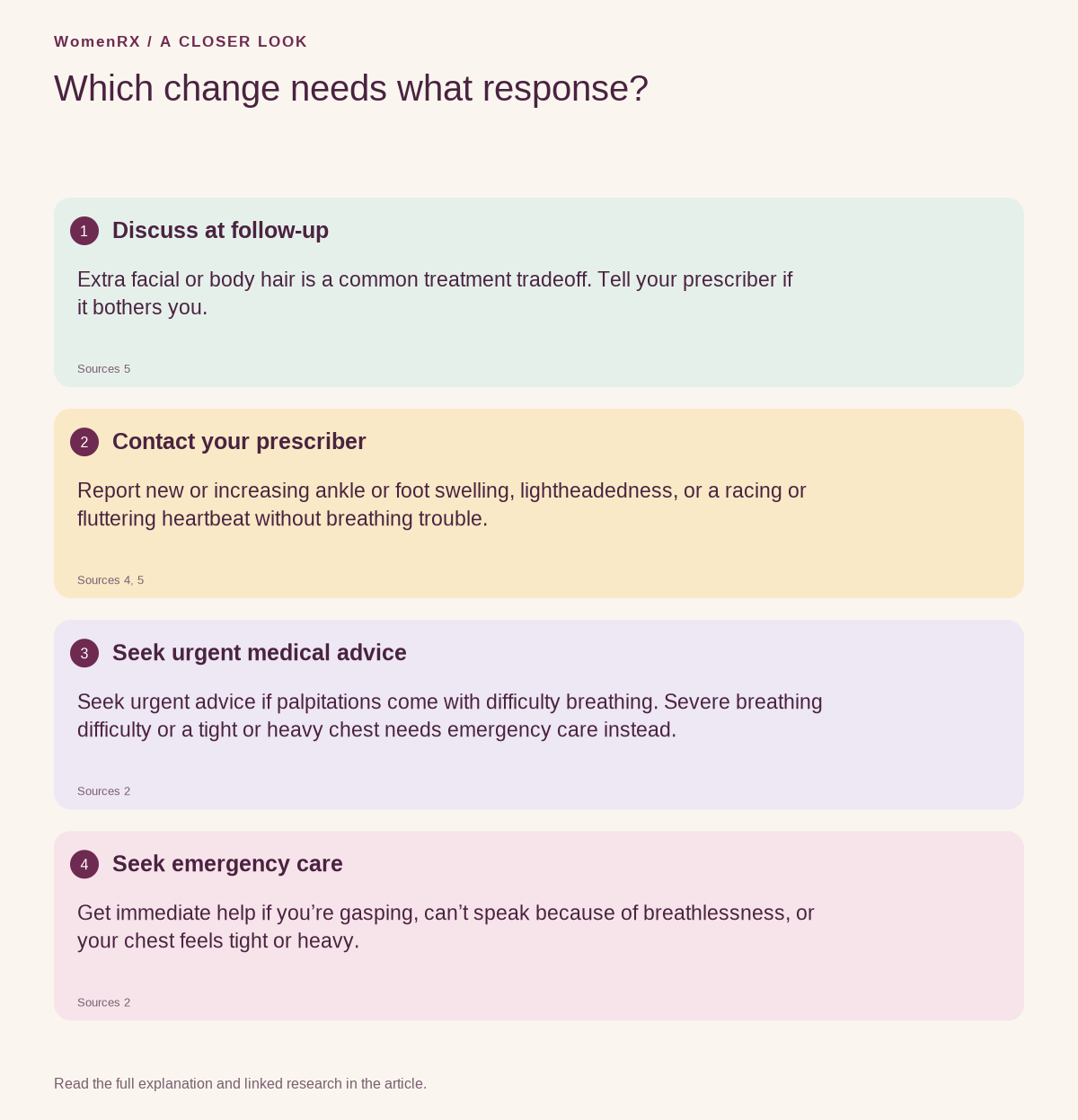
Which change needs what response?
Discuss at follow-up: Extra facial or body hair is a common treatment tradeoff. Tell your prescriber if it bothers you.5
Contact your prescriber: Report new or increasing ankle or foot swelling, lightheadedness, or a racing or fluttering heartbeat without breathing trouble.45
Seek urgent medical advice: Seek urgent advice if palpitations come with difficulty breathing. Severe breathing difficulty or a tight or heavy chest needs emergency care instead.2
Seek emergency care: Get immediate help if you’re gasping, can’t speak because of breathlessness, or your chest feels tight or heavy.2
Read the figure as text
Use the symptom, not a guess about its cause, to decide your next move. If you feel short of breath and have swollen ankles but are not severely breathless, see a clinician for assessment. 2 This is a sorting aid, not a diagnostic score.- Discuss at follow-up: Extra facial or body hair is a common treatment tradeoff. Tell your prescriber if it bothers you.5
- Contact your prescriber: Report new or increasing ankle or foot swelling, lightheadedness, or a racing or fluttering heartbeat without breathing trouble.45
- Seek urgent medical advice: Seek urgent advice if palpitations come with difficulty breathing. Severe breathing difficulty or a tight or heavy chest needs emergency care instead.2
- Seek emergency care: Get immediate help if you’re gasping, can’t speak because of breathlessness, or your chest feels tight or heavy.2
More questions, answered
Is more scalp shedding after starting oral minoxidil always a bad sign?
Not necessarily. Transient shedding is a reported effect of low-dose oral minoxidil, but a change in shedding doesn’t identify its cause by itself. If it’s concerning or persistent, tell your prescriber rather than assuming it must be part of the treatment working. 31
Sources you can check
- Hair Loss | Alopecia | Alopecia Areata | MedlinePlusAccessed 2026-09-25Return to first citation
- Shortness of breath - NHSAccessed 2026-09-25Return to first citation
- Oral Minoxidil for Alopecia Treatment: Risks, Benefits, and Recommendations.Ong MM, Li Y, Lipner SR. · American journal of clinical dermatology · 2026Return to first citation
- Gender Differences in Adverse Effects and Dosing Practices of Low-Dose Oral Minoxidil for Androgenetic Alopecia: A Retrospective Analysis of 310 Patients.Ong MM, Do H, Ho B, Lipner SR. · Skin appendage disorders · 2025Return to first citation
- Characterization and Management of Adverse Events of Low-Dose Oral Minoxidil Treatment for Alopecia: A Narrative Review.Jimenez-Cauhe J, Lo Sicco KI, Shapiro J, Hermosa-Gelbard A, Burgos-Blasco P, Melian-Olivera A, Ortega-Quijano D, Pindado-Ortega C, Buendia-Castaño D, Asz-Sigall D, Vaño-Galvan S. · Journal of clinical medicine · 2025Return to first citation