Health Care Before, During, and After Pregnancy
The most useful pregnancy care plan starts before conception when possible and includes a clear handoff into postpartum follow-up.
Think of pregnancy care as connected stages, not one checklist: review health conditions and medicines before pregnancy when you can, keep prenatal care focused on your changing needs, and make a follow-up plan for after birth. The timing and specialists involved depend on your health and pregnancy history; one schedule does not fit everyone. 1 4 2
The through line: what could change your care?
A health review before pregnancy can surface issues that may need attention before conception or a different plan once you’re pregnant. High blood pressure and diabetes are two examples MedlinePlus highlights. If you already take medicine, don’t stop or start it on your own: some medicines may pose risks, but leaving a condition untreated can also be harmful. The decision depends on the medicine and your health. 1 4
Your history matters, too. A previous pregnancy affected by a neural tube defect, for example, changes the folic-acid conversation; recommendations for people at higher risk differ from general recommendations. Bring prior pregnancy complications and current prescriptions, over-the-counter products, herbs, and supplements into the discussion. 3 4
Before pregnancy: prepare what can be prepared
If you’re planning a pregnancy, a preconception visit is a chance to review conditions such as diabetes or high blood pressure and make a plan for medicines and other health needs. If you have a condition that may require coordinated care, ask who will be involved and how the plan will continue once you’re pregnant. 1 4
Folic acid is one practical reason to think ahead: guidance summarized by the NIH Office of Dietary Supplements recommends 400-800 micrograms daily for people who could become pregnant, beginning at least a month before conception and continuing into early pregnancy. Recommendations differ for some people at higher risk, so a history of a neural tube defect or certain other risk factors calls for an individualized plan rather than simply using the general amount. 3
If you weren’t planning to become pregnant, you can still raise these questions when you learn you’re pregnant. The point is to review your situation, not to treat preparation as a test you’ve passed or failed.
During pregnancy: keep the plan responsive
Prenatal care follows the pregnancy, but what needs attention can depend on what came before it. A condition that existed before pregnancy, a prior complication, or a medicine that needs review may call for coordination beyond routine visits. MedlinePlus advises checking with a care provider before taking or stopping medicines, including herbs and supplements, because both treatment and untreated illness can carry risks. 4
Nutrition is another topic to review rather than assume a supplement settles. Pregnancy changes requirements for several nutrients, and prenatal products vary in their ingredients and amounts. For example, some products do not contain iodine or choline, and some gummy formulations contain no iron or calcium. If you take a prenatal supplement, its label and your eating pattern are useful parts of a nutrition conversation. 3
A care plan can also include who to contact if your health changes, what monitoring is needed, and whether you need a specialist. Those details should be based on your situation, not copied from another person’s pregnancy.
After birth: make the handoff explicit
Birth is a transition in care, not a signal that every health issue is resolved. Recovery can involve physical changes as well as emotional ones; MedlinePlus notes that postpartum sadness can sometimes be more serious, particularly if you feel extremely sad or cannot care for yourself or your baby. Raise these concerns rather than waiting for them to fit a particular appointment. 2
If you had a health condition before or during pregnancy, ask who will follow it after birth and when that follow-up should happen. For example, an expert-developed pathway for people with intermediate- to high-risk cardiovascular disease describes planned postpartum monitoring and assessment, illustrating why a single routine check may not be enough for some patients. That pathway is specific to cardiovascular risk, not a schedule for everyone. 5
Before leaving pregnancy care, try to clarify three things: which pregnancy-related or existing conditions still need follow-up, who is responsible for it, and how to reconnect if symptoms or treatment questions come up. The right plan may involve a primary care provider, a specialist, or the pregnancy care team, depending on your needs.
A useful way to carry the plan forward
At each transition, bring the same short summary: your health conditions, medicines and supplements, important pregnancy history, and the next follow-up that has been agreed on. Ask what changes in the plan now, what carries over, and who owns the next step. That keeps preconception, prenatal, and postpartum care connected without assuming every woman needs the same appointments or specialists.
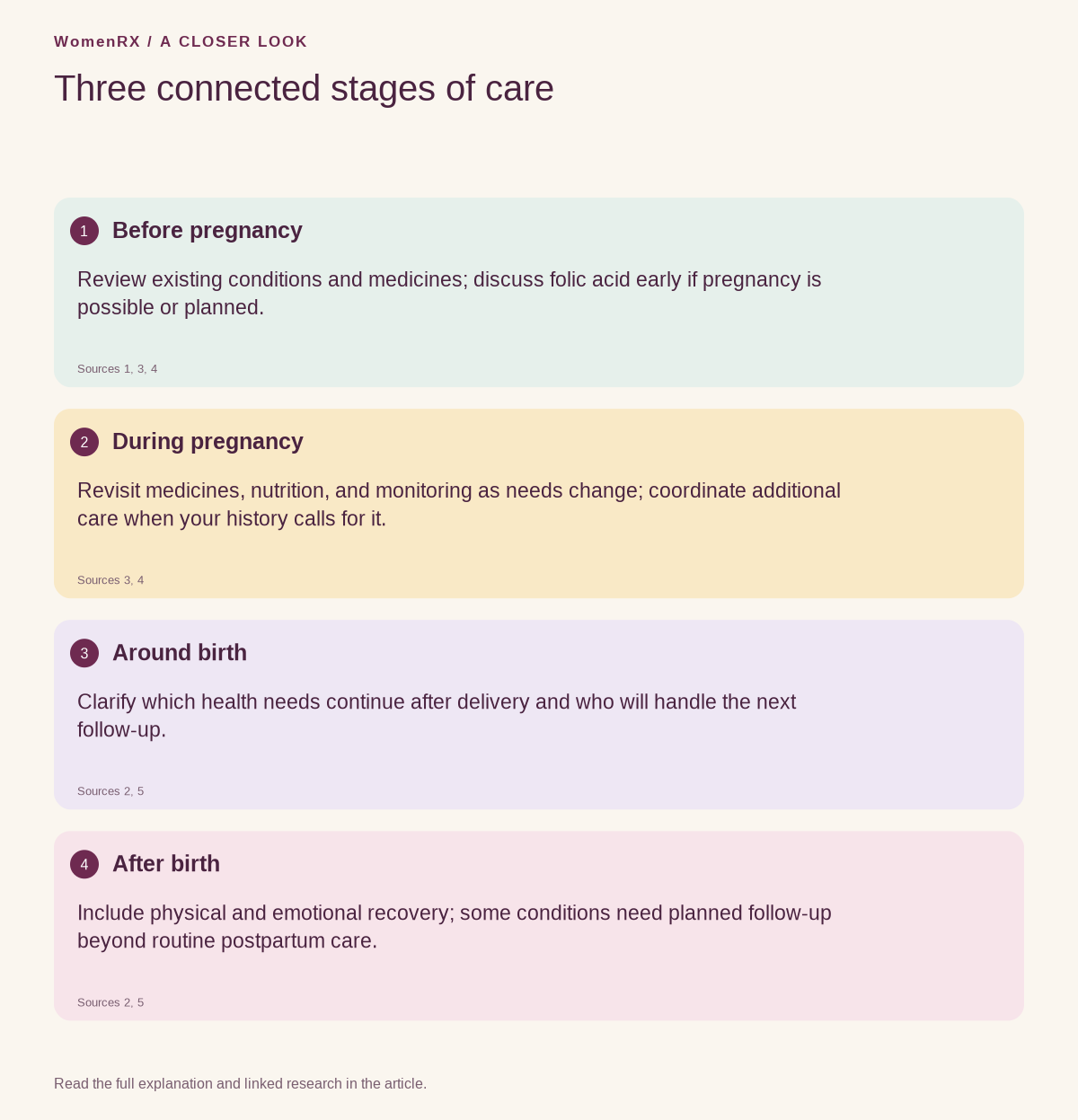
Three connected stages of care
Before pregnancy: Review existing conditions and medicines; discuss folic acid early if pregnancy is possible or planned.134
During pregnancy: Revisit medicines, nutrition, and monitoring as needs change; coordinate additional care when your history calls for it.34
Around birth: Clarify which health needs continue after delivery and who will handle the next follow-up.25
After birth: Include physical and emotional recovery; some conditions need planned follow-up beyond routine postpartum care.25
Read the figure as text
A general map of topics that may come up at each stage. Timing, appointments, and specialists should be tailored to your health and pregnancy history.- Before pregnancy: Review existing conditions and medicines; discuss folic acid early if pregnancy is possible or planned.134
- During pregnancy: Revisit medicines, nutrition, and monitoring as needs change; coordinate additional care when your history calls for it.34
- Around birth: Clarify which health needs continue after delivery and who will handle the next follow-up.25
- After birth: Include physical and emotional recovery; some conditions need planned follow-up beyond routine postpartum care.25
More questions, answered
Should I stop a medicine as soon as I find out I’m pregnant?
No. MedlinePlus advises talking with your care provider before stopping or starting a medicine. The decision weighs the medicine’s risks against the risks of leaving your health condition untreated. 4
Does a postpartum plan need to include more than one check-in?
It depends on your health and pregnancy history. Some people, including those with intermediate- to high-risk cardiovascular disease, may need planned monitoring and assessment after birth; that specialized pathway is not a universal schedule. 5
Sources you can check
- Preconception Care: MedlinePlusAccessed 2026-09-25Return to first citation
- Postpartum Care: MedlinePlusAccessed 2026-09-25Return to first citation
- Dietary Supplements and Life Stages: Pregnancy - Health Professional Fact SheetAccessed 2026-09-25Return to first citation
- Pregnancy and Medicines | MedlinePlusAccessed 2026-09-25Return to first citation
- A blueprint of an integrated cardio-obstetric care pathway for women with intermediate- to high-risk cardiovascular disease in pregnancy and postpartum.Vanharen Y, Mannaerts D, Kauling RM, Roos-Hesselink JW, Cornette J, Trongthiang N, Goossens E, Berendoncks AV. · European journal of obstetrics, gynecology, and reproductive biology · 2026Return to first citation