Planning a Pregnancy: Your Preconception Checklist
A few focused reviews before trying can help you spot what needs attention, without treating pregnancy preparation as a one-size-fits-all plan.
Before trying to conceive, review your health conditions, prescriptions and supplements, vaccine history, and reproductive history with a clinician. Start folic acid before pregnancy: guidance recommends 400-800 mcg daily for most people who could become pregnant, beginning at least a month before conception. Your medical history may call for a different plan, so don’t stop or change medicines on your own. 1 2 3
Preconception care is a chance to make a plan for your health before pregnancy, not a test you need to pass. Some steps apply broadly, while medication choices, condition management, and certain supplements depend on your history. It can be useful before trying to conceive, including when you’ve had a complicated pregnancy or are working with a fertility team. 1 4 5
Start with the steps that apply broadly
Take folic acid. For most people who could become pregnant, recommendations call for 400-800 micrograms daily from a supplement and/or fortified foods, starting at least one month before conception and continuing through early pregnancy. The timing matters because the neural tube develops and closes in the first 28 days after conception, often before someone knows they’re pregnant. Check whether your prenatal supplement lists folic acid: other forms of folate have not been tested in clinical trials for preventing neural tube defects. 2
A history that raises the risk of a neural tube defect, or use of a medicine that affects folate, can change the recommendation. Ask your clinician what amount and timing fit your situation rather than choosing a higher dose yourself. 2
Review vaccines. Bring your vaccine record if you have it, or say which vaccines you’re unsure about. Preconception guidance includes checking immunization status; which vaccines you need and when depends on your history and circumstances. 1 6
Talk through health habits and exposures. Be ready to discuss smoking, alcohol or other substance use, nutrition, physical activity, and any environmental or work exposures that concern you. The goal is to identify practical changes that make sense for you, not to expect perfect habits before seeking care. 1 6
Use your history to shape the plan
Go over every medicine and supplement. Bring a list or photos of the labels for prescriptions, over-the-counter medicines, vitamins, herbs, and other supplements. Some medicines and supplements may harm a developing fetus, but stopping a medicine you need can also be harmful. Don’t stop, start, or switch a treatment on your own; ask whether it should continue, change, or be managed another way before pregnancy. 3
This is especially worth planning early if you take medicine for a chronic condition, such as diabetes, high blood pressure, asthma, or seizures. The right choice depends on the medicine and the health problem it treats, so a blanket rule to stop medication isn’t safe. 1 3
Discuss health conditions and past pregnancies. Mention ongoing conditions, mental or physical health concerns, and any previous pregnancy complications or outcomes. If you’re receiving fertility treatment, include that plan in the conversation and coordinate questions with your fertility team. Preconception care aims to identify health issues that may affect pregnancy and make a plan before conception where possible. 1 4 5
Bring your reproductive history. Note what you know about your menstrual cycles, any prior pregnancies and their outcomes, and whether you’ve had fertility evaluation or treatment. These details give the clinician context for the conversation; they don’t determine by themselves whether you can become pregnant. A detailed personal and family history is a common focus of preconception guidance. 5 6
What to bring and ask
A short, prioritized list can make the visit more useful:
- Your medication and supplement list: What should I keep taking, change, or discuss with the prescriber before trying?
- Your health history: Do any of my conditions need a plan before pregnancy?
- Your vaccine record: Am I up to date, or should anything be addressed before trying?
- Your reproductive history: Do my cycle history, fertility treatment, or prior pregnancy complications change the plan?
- Your folic acid source: Does my supplement contain folic acid, and is the usual recommendation right for me?
- Your concerns about habits or exposures: Which changes would be most useful in my circumstances?
Not every person needs the same tests, medication changes, or supplements. The useful outcome is a plan that separates what you can do now, what needs an individualized decision, and what can wait. Preconception guidance covers many areas, but reviews of clinical guidelines have found that evidence quality varies; folic acid for reducing neural tube defect risk is among the areas with the strongest support. 4
What to review before trying
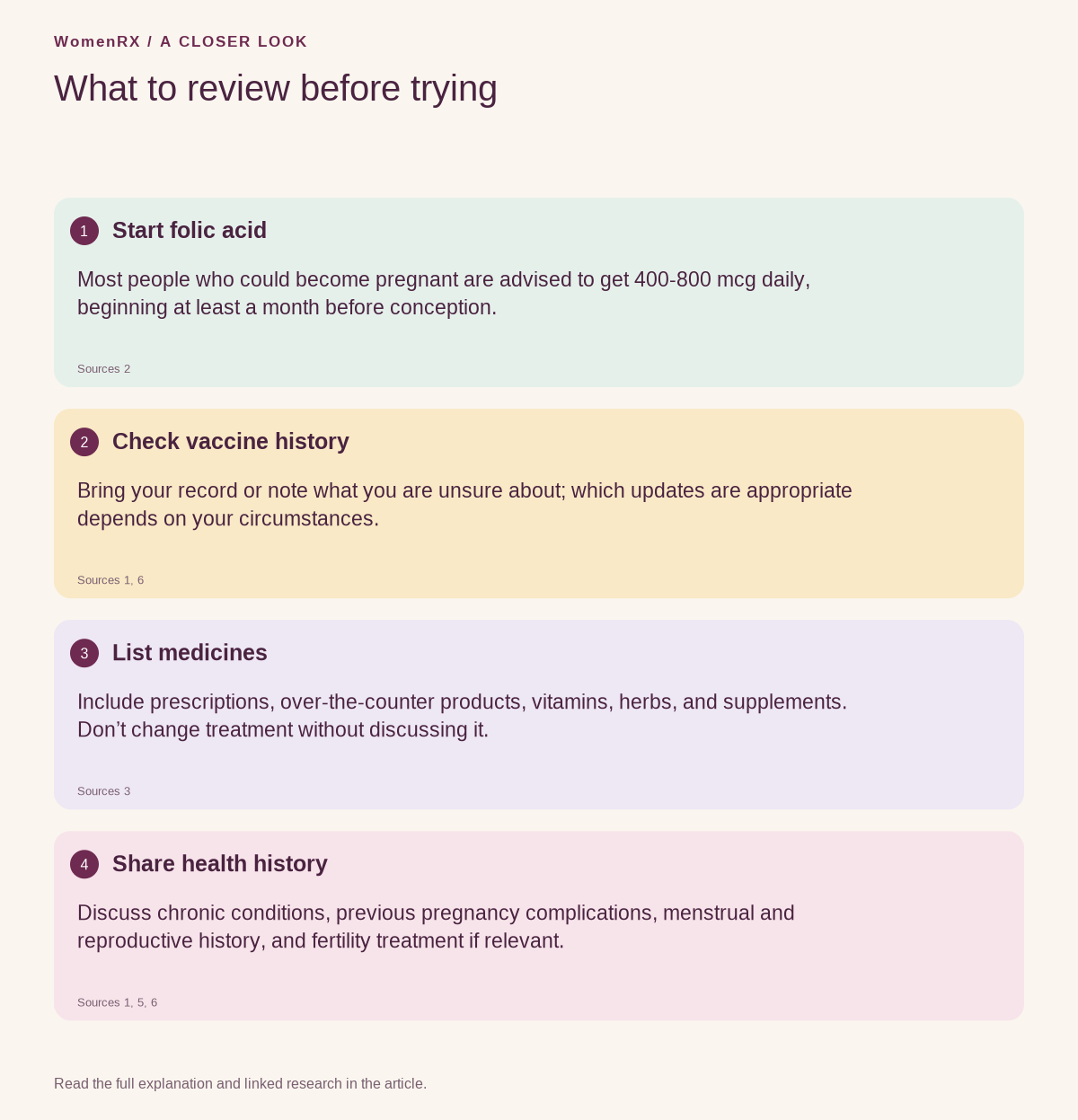
Start folic acid: Most people who could become pregnant are advised to get 400-800 mcg daily, beginning at least a month before conception.2
Check vaccine history: Bring your record or note what you are unsure about; which updates are appropriate depends on your circumstances.16
List medicines: Include prescriptions, over-the-counter products, vitamins, herbs, and supplements. Don’t change treatment without discussing it.3
Share health history: Discuss chronic conditions, previous pregnancy complications, menstrual and reproductive history, and fertility treatment if relevant.156
Read the figure as text
Use this list to separate steps that are broadly relevant from questions that need a plan based on your history.- Start folic acid: Most people who could become pregnant are advised to get 400-800 mcg daily, beginning at least a month before conception.2
- Check vaccine history: Bring your record or note what you are unsure about; which updates are appropriate depends on your circumstances.16
- List medicines: Include prescriptions, over-the-counter products, vitamins, herbs, and supplements. Don’t change treatment without discussing it.3
- Share health history: Discuss chronic conditions, previous pregnancy complications, menstrual and reproductive history, and fertility treatment if relevant.156
Sources you can check
- Preconception Care: MedlinePlusAccessed 2026-09-25Return to first citation
- Dietary Supplements and Life Stages: Pregnancy - Health Professional Fact SheetAccessed 2026-09-25Return to first citation
- Pregnancy and Medicines | MedlinePlusAccessed 2026-09-25Return to first citation
- A Systematic Review of Clinical Guidelines for Preconception Care.Dorney E, Boyle JA, Walker R, Hammarberg K, Musgrave L, Schoenaker D, Jack B, Black KI. · Seminars in reproductive medicine · 2022Return to first citation
- Priority topics for preconception care in general practice: a consensus study.Schoenaker D, Lovegrove E, Santer M, Matvienko-Sikar K, Carr H, Alwan N, Kubelabo L, Davies N, Godfrey K. · BJGP open · 2026Return to first citation
- Preconception Care: A Comparative Review of Major Guidelines.Giouleka S, Papagera V, Siargkas A, Michos G, Liberis A, Kalogiannidis I, Mamopoulos A, Tsakiridis I, Dagklis T. · Obstetrical & gynecological survey · 2025Return to first citation