What Can Menopause Care Cost? A Checklist for Planning Expenses
Make a practical budget by separating possible one-time costs from ongoing ones, then confirming which services and treatments apply in your health system.
Menopause-care costs vary, and no one needs every possible service. As dated US examples, on September 25, 2026, one telehealth provider listed self-pay visits at $250 for an initial 30-minute visit and $150 for a 15-minute return visit; one pharmacy listed a 30-capsule progesterone package for $9.45. Neither is a personal quote or a full care total, and package prices don’t establish monthly costs. 5 7
Build a budget around the care you may use
Menopause care isn’t one standard package. You might want help with hot flashes, sleep disruption, vaginal or urinary symptoms, or another concern. You might consider treatment, decide against it, or revisit the question later. Hormone therapy is one option for bothersome symptoms, and evidence-based nonhormone treatments are also available for hot flashes. These are choices, not a list of services everyone needs. 3 4
For budgeting, separate one-time or occasional assessment costs from costs that could recur. A visit, a test if recommended, a treatment, and later follow-up may have separate charges. These are categories to ask about, not a prediction that every item will be needed or billed separately.
A fill-in worksheet
Use the currency and payment terms relevant where you live. Write down an estimate only after checking with the service or payer involved. Mark an item “not planned” if it doesn’t apply.
| Possible expense | One-time or recurring? | What to ask | Estimate and date checked |
|---|---|---|---|
| First appointment | ___ | What type of visit is planned, and what would I pay? | ___ |
| Follow-up visit | ___ | Is follow-up expected for this option? If so, how often and what would it cost? | ___ |
| Test, if recommended | ___ | What question does it answer? Is there a separate charge? | ___ |
| Treatment, if chosen | ___ | What is the cost of this specific option, and could it recur? | ___ |
| Other support | ___ | Is this service available, and what fees or coverage rules apply? | ___ |
| Coverage or eligibility | ___ | Do I need a referral or approval? What costs or limits apply to me? | ___ |
Add only estimates you’ve confirmed. For a recurring cost, note how often it applies and the period the estimate covers. Ask whether a quoted amount includes the appointment, test, prescription, or follow-up, rather than assuming it does.
Keep testing as a question, not a default expense
A blood test isn’t automatically part of menopause care. Ask what a proposed test is meant to clarify and whether its result would change the next step. For example, NICE guidance in the UK describes identifying perimenopause in the context of recently started vasomotor symptoms alongside menstrual-cycle changes. It also advises against using an FSH blood test to identify menopause for people using combined estrogen-and-progestogen contraception or high-dose progestogen. Those recommendations address particular circumstances; they aren’t a rule that testing is never useful. 1
Before a test, ask the clinician what it is for, then ask the relevant clinic or payer for an estimate. If you use a public health service, ask whether the test is available through that service, whether you need a referral, and whether any charge applies.
Price the specific treatment, not a category
If you’re considering treatment, request an estimate for the particular option being discussed. Hormone therapy decisions are individualized and may be reevaluated over time. Nonhormone options for hot flashes include certain prescription medicines and approaches such as cognitive behavioral therapy; their costs and payment arrangements won’t necessarily be the same. 3 4
For a prescription, check with the pharmacy and the relevant payer using the exact medication and formulation. Ask whether the estimate applies to each fill and whether approval, coverage, or other requirements affect what you pay. For a non-prescription service or therapy, ask the provider about fees and whether any coverage applies. A current estimate from the place that provides or pays for the specific option is more useful than a general total.
Dated US price examples, not a care plan
These snapshots show why it helps to ask what a quoted price includes. On September 25, 2026, Midi listed self-pay prices of $250 for a 30-minute first visit and $150 for a 15-minute return visit. The provider says additional costs may apply; those visit prices don’t establish that prescriptions or lab work are included. Insurance costs depend on the plan. 7
On the same date, Cost Plus Drugs displayed a $9.45 drug price for 30 capsules of generic progesterone, 100 mg each. Standard shipping was listed separately at $5.25; taxes and the final checkout cost vary by location. This is one retailer’s price for that package, not an insurance quote or a monthly treatment cost. The package quantity alone doesn’t tell you how long a prescription would last. 5
The retailer also displayed a $53.30 drug price for one package of four Climara estradiol patches, each labeled 0.025 mg per 24 hours. Standard shipping was listed separately at $5.25, with taxes and final checkout costs varying by location. That listing said the product wasn’t eligible for insurance at that retailer. A four-patch package price doesn’t establish a monthly cost or say whether this treatment is right for you. 6
Treat these as dated examples, not prices to expect from another pharmacy, provider, or plan. Recheck current prices and ask which charges are separate. Medication cost depends on the specific prescription and its schedule, so don’t turn a package price into a monthly estimate without confirming how it would be used and refilled.
Check how your health system handles care
If you have an insurer or health plan, ask about the specific appointment, test, or treatment. Confirm the estimate with the clinic or pharmacy too, since the amount you owe may depend on where care is provided and your plan’s rules. If you receive care through a public health service, ask about eligibility, referral requirements, availability, and any charges for the same specific service or treatment. Don’t assume that coverage, access, or fees work the same way in every system.
A US study offers one example of why it’s worth checking your own situation: among women aged 45 to 64 who were eligible for menopausal hormone therapy, a reported history of use was more common among participants with private insurance than among those with Medicaid. The study was cross-sectional and used survey data collected from 2013 to 2020. It describes an association in that study population, not what a particular plan covers or what you will pay. 2
If you’re comparing options, request estimates for each one before making a decision, and write down who provided each estimate and when. That gives you a budget tied to the care you’re actually considering, rather than a bill built from every possible service.
Sort possible menopause-care expenses
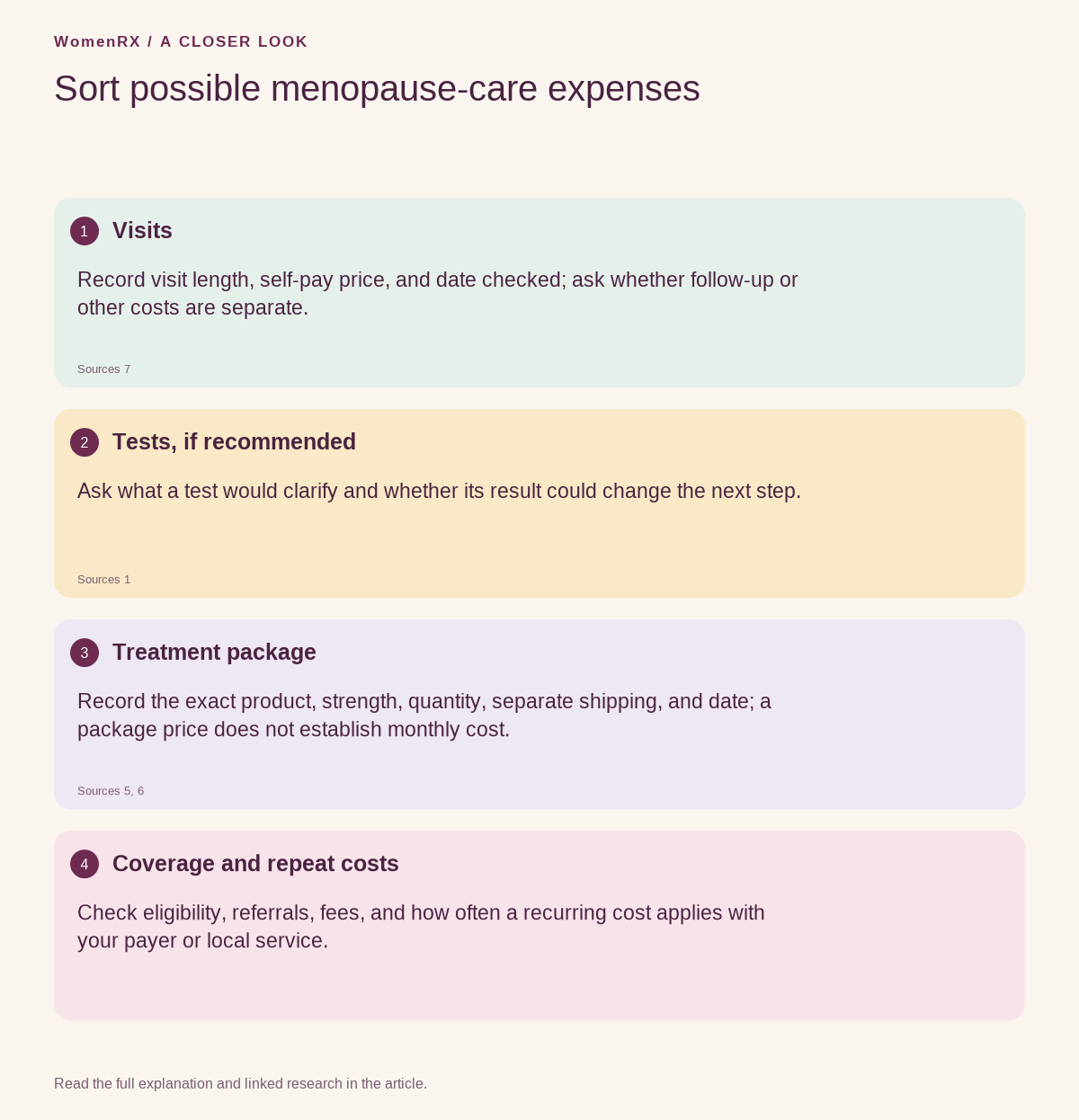
Visits: Record visit length, self-pay price, and date checked; ask whether follow-up or other costs are separate.7
Tests, if recommended: Ask what a test would clarify and whether its result could change the next step.1
Treatment package: Record the exact product, strength, quantity, separate shipping, and date; a package price does not establish monthly cost.56
Coverage and repeat costs: Check eligibility, referrals, fees, and how often a recurring cost applies with your payer or local service.
Read the figure as text
Use these categories to decide what to ask about and where to confirm an estimate. They are budgeting prompts, not required services.- Visits: Record visit length, self-pay price, and date checked; ask whether follow-up or other costs are separate.7
- Tests, if recommended: Ask what a test would clarify and whether its result could change the next step.1
- Treatment package: Record the exact product, strength, quantity, separate shipping, and date; a package price does not establish monthly cost.56
- Coverage and repeat costs: Check eligibility, referrals, fees, and how often a recurring cost applies with your payer or local service.
Sources you can check
- Recommendations | Menopause: identification and management | Guidance | NICEAccessed 2026-09-25Return to first citation
- Insurance Type and Menopausal Hormone Therapy Use Among US Women.Chesnokova A, Mumford SL, Schachter A, Hamm RF, Lorch S, Klebanoff M, Lindley S, Harness E, Williams M, Schapira MM. · JAMA network open · 2026Return to first citation
- The 2022 hormone therapy position statement of The North American Menopause Society.“The 2022 Hormone Therapy Position Statement of The North American Menopause Society” Advisory Panel. · Menopause (New York, N.Y.) · 2022Return to first citation
- The 2023 nonhormone therapy position statement of The North American Menopause Society.Menopause (New York, N.Y.) · 2023Return to first citation
- Progesterone 100mg Capsule | Cost Plus DrugsAccessed 2026-09-25Return to first citation
- Climara 0.025mg/24HR 4 Patches | Cost Plus DrugsAccessed 2026-09-25Return to first citation
- Midi menopause telehealth visit pricesAccessed 2026-09-25Return to first citation