Choline Needs Change During Pregnancy and Breastfeeding
The daily choline guidance rises from 425 mg for most adult women to 450 mg during pregnancy and 550 mg while breastfeeding.
For women 19 and older, the choline Adequate Intake is 425 mg a day, 450 mg during pregnancy, and 550 mg while breastfeeding. These are planning benchmarks, not tests of deficiency. Add up choline from food and any supplement, since many prenatal vitamins contain little or none. Research linking lower choline to neural tube defects does not establish that supplements prevent them. 124
The benchmark depends on your life stage
For women ages 19 and older, the Adequate Intake (AI) for choline is 425 mg a day. It is 450 mg during pregnancy and 550 mg while breastfeeding. For ages 14 to 18, the corresponding figures are 400 mg, 450 mg, and 550 mg. 1
An AI is used when there isn’t enough evidence to set a Recommended Dietary Allowance (RDA). It’s a useful intake benchmark, but it isn’t a diagnostic cutoff: eating less than the AI doesn’t, by itself, show that you’re deficient. 1 The pregnancy increase is modest; the breastfeeding benchmark is higher than either the pregnancy or general adult benchmark.
If you’re planning pregnancy but aren’t pregnant yet, the adult AI is the relevant general benchmark in this guidance. Once pregnant or breastfeeding, use the benchmark for that stage. Individual needs can vary, and these figures aren’t a reason to assume every woman needs a supplement. 1
Add food and supplement amounts together
Choline comes from a mix of foods. For example, one large hard-boiled egg contains about 147 mg, a cup of milk about 43 mg, and half a cup of roasted soybeans about 107 mg. Meat, fish, dairy, beans, cruciferous vegetables, nuts, seeds, and whole grains can all contribute. These numbers are examples, not fixed amounts for every brand, recipe, or serving. 1
To estimate your intake, note the choline in foods you commonly eat, then add the amount listed on any supplement label. As an illustration, two large eggs and a cup of milk add up to about 337 mg, before other foods or a supplement. Food labels aren’t required to list choline unless it’s been added, so a missing number on a package doesn’t necessarily mean the food contains none. 1
Check your prenatal label rather than assuming it covers choline. In a 2022 evaluation of 188 prenatal supplements sold in the United States, 40% contained choline; among those products, the median amount was 25 mg per serving. That amount may contribute, but it’s only part of the day’s total. 2
Pregnancy and neural tube development
Choline has roles in cell membranes, nervous system function, and early development, which helps explain why it matters during pregnancy. But a biological role is not the same as proof that taking extra choline prevents a birth defect. 2
A systematic review and meta-analysis of human studies found an association between lower maternal choline intake or blood concentrations and higher odds of neural tube defects. The evidence included five case-control studies in the meta-analysis, and the review’s prediction interval included no association. That means the finding raises a question about risk; it doesn’t establish that a choline supplement prevents neural tube defects. 4
Choline isn’t an evidence-based substitute for folic acid. MedlinePlus says getting enough folic acid before and during pregnancy can prevent birth defects of the brain or spine; the human-study review of choline does not establish that choline supplements prevent neural tube defects. 34
When extra may not be the answer
Many pregnant women in the United States consume less than the choline AI, and prenatal products often add little. That makes checking food patterns and the supplement label more useful than assuming the prenatal covers everything. People who avoid eggs or follow a vegan diet may want to pay particular attention to other choline-containing foods and the label. 2
Still, a low estimated intake isn’t proof of deficiency, and the cited human evidence does not establish that taking extra choline prevents neural tube defects. If you’re considering a separate supplement, first add up your usual food and prenatal amounts; don’t treat the AI as a dose to add on top. The upper intake level for adults age 19 and older is 3,500 mg a day from food and supplements combined. It’s a safety ceiling, not a target. 124
A practical next step is to check the choline amount on your prenatal label and compare it with your usual foods for the life stage you’re in. If the label doesn’t list choline, you can’t confirm from the label how much that product contributes; it doesn’t change how much choline your food contributes.
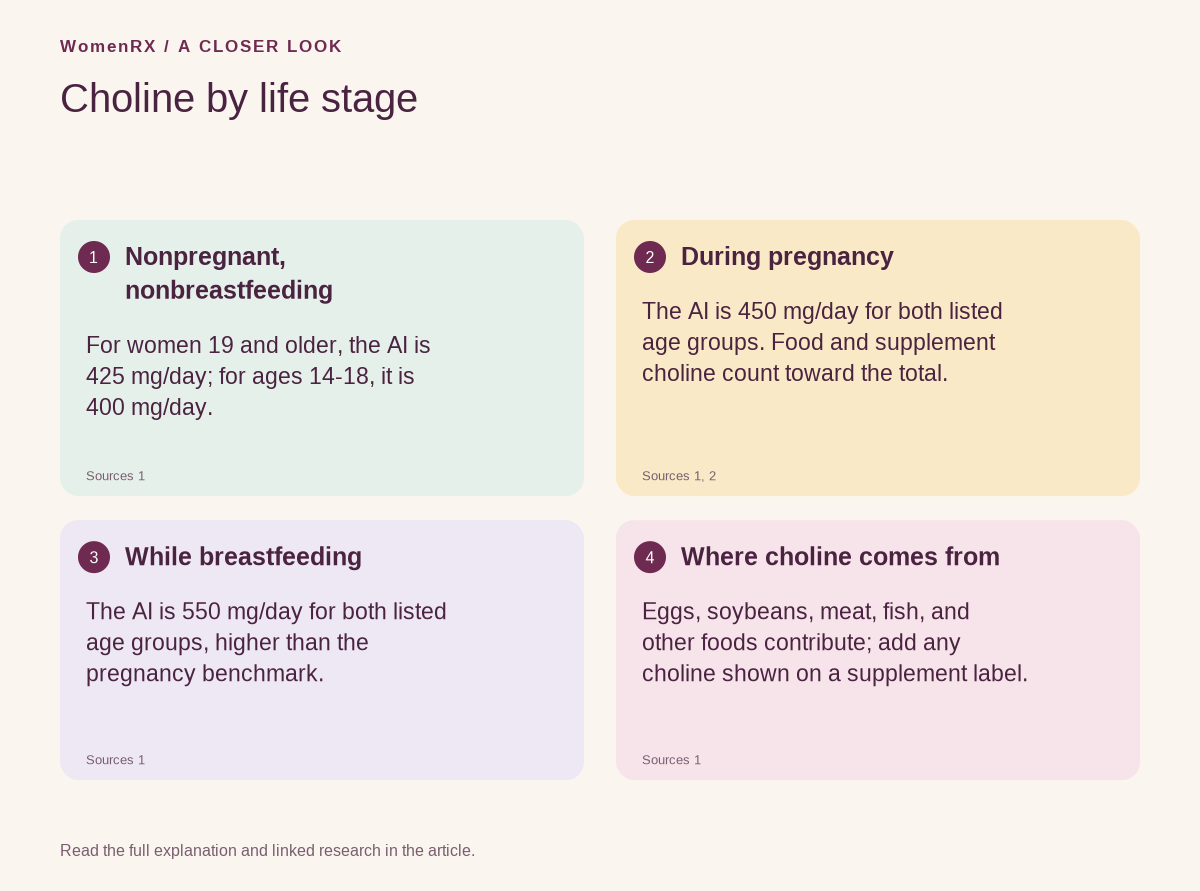
Choline by life stage
Nonpregnant, nonbreastfeeding: For women 19 and older, the AI is 425 mg/day; for ages 14-18, it is 400 mg/day.1
During pregnancy: The AI is 450 mg/day for both listed age groups. Food and supplement choline count toward the total.12
While breastfeeding: The AI is 550 mg/day for both listed age groups, higher than the pregnancy benchmark.1
Where choline comes from: Eggs, soybeans, meat, fish, and other foods contribute; add any choline shown on a supplement label.1
Read the figure as text
Compare the daily Adequate Intake benchmarks and see how food and supplements contribute to the same daily total.- Nonpregnant, nonbreastfeeding: For women 19 and older, the AI is 425 mg/day; for ages 14-18, it is 400 mg/day.1
- During pregnancy: The AI is 450 mg/day for both listed age groups. Food and supplement choline count toward the total.12
- While breastfeeding: The AI is 550 mg/day for both listed age groups, higher than the pregnancy benchmark.1
- Where choline comes from: Eggs, soybeans, meat, fish, and other foods contribute; add any choline shown on a supplement label.1
More questions, answered
Does eating below the AI mean I’m deficient?
No. The AI is a planning benchmark, not a diagnostic test. The evidence wasn’t sufficient to establish an RDA for choline, and an intake below the AI alone doesn’t establish deficiency. 1
Can choline replace folic acid when planning pregnancy?
No. MedlinePlus states that getting enough folic acid before and during pregnancy can prevent birth defects of the brain or spine. A review of human choline studies found an association between lower maternal choline and neural tube defects, but that evidence does not establish that choline supplements prevent them or replace folic acid. 34
Sources you can check
- Choline - Health Professional Fact SheetAccessed 2026-09-25Return to first citation
- Dietary Supplements and Life Stages: Pregnancy - Health Professional Fact SheetAccessed 2026-09-25Return to first citation
- Pregnancy and Medicines | MedlinePlusAccessed 2026-09-25Return to first citation
- Association between Maternal Choline, Fetal Brain Development, and Child Neurocognition: Systematic Review and Meta-Analysis of Human Studies.Obeid R, Derbyshire E, Schön C. · Advances in nutrition (Bethesda, Md.) · 2022Return to first citation