Choose Menopause Exercise by the Change You Want
The best activity depends on your goal: strength training targets muscle, aerobic movement builds fitness, and exercise shouldn’t be counted on to treat hot flashes.
There isn’t one best exercise for every woman during perimenopause or after menopause. For muscle strength and physical function, include resistance exercise; for cardiovascular fitness, choose aerobic activity you can keep doing. A trial in women aged 40-60 found improved muscle and function measures after a program combining training and nutrition, with no difference by menopausal status. Exercise is not recommended as a treatment for hot flashes. 1 3 4
Start with the outcome you want
Menopause doesn’t make one kind of exercise right for everyone. Think of activity as a set of tools: aerobic exercise supports cardiovascular fitness, resistance exercise challenges muscles, and balance and flexibility activities work on stability, coordination, and joint movement. Many routines combine more than one type. 1
That distinction matters when your goal is specific. If you want to build or maintain strength, a walk may be enjoyable and useful for fitness, but it doesn’t replace muscle-strengthening activity. If you want better cardiovascular fitness, strength work alone may not be the whole plan. You can mix activities without needing to find a single perfect workout.
For strength and physical function, make room for resistance work
A 2025 randomized trial offers a relevant midlife example. It enrolled healthy women aged 40-60; 52 of the 83 women who completed an initial period of reduced activity were postmenopausal. After that period, participants completed a 12-week program that included strength exercise and a nutrition intervention. Muscle mass, strength, and physical-function measures improved after the program, including above the participants’ pre-restriction baseline. The study found no interaction between menopausal status and the response to training. 4
There are useful limits to that result. The program combined exercise with nutrition, so it doesn’t show that resistance exercise alone produced every improvement. It also doesn’t establish the best exercise plan for every person, or prove that responses are identical across all stages of menopause. Still, it supports resistance training as a reasonable part of a plan focused on muscle and function, rather than assuming that age-related changes mean strength is out of reach. 4
For fitness and broader health, choose sustainable movement
Walking, running, and swimming are examples of aerobic activity. These activities raise breathing and heart rate and support cardiovascular fitness. Regular exercise also has broader health benefits, including supporting heart health, mood, bone and muscle health, and weight management. 1 2
If weight or body composition is your goal, don’t assume one exercise format has been shown to be best during menopause. A 2026 review reports evidence that combined diet-and-exercise interventions, particularly during the menopausal transition, can improve weight, body composition, and metabolic risk factors. That supports a combined approach, not a claim that a specific workout will cause a particular amount of weight loss. 5
A practical example: if you enjoy walking but want to work on strength too, keep walking as your aerobic activity and add a resistance-based option that suits your preferences. If balance or ease of movement is another goal, activities such as tai chi, standing balance practice, stretching, or yoga can address stability, coordination, or flexibility as general fitness components. These are general fitness purposes, not established menopause-specific effects. 1
For hot flashes, separate symptom treatment from general health
Exercise can support health without being a proven hot-flash remedy. The North American Menopause Society’s 2023 position statement did not recommend exercise or yoga as treatments for vasomotor symptoms, which include hot flashes and night sweats, based on its evidence review. That doesn’t mean you should stop moving if you enjoy it; it means choosing exercise for fitness, strength, or other goals is more evidence-aligned than relying on it to control hot flashes. 3
Build a mix around what matters to you
A straightforward way to choose is to match activities to goals, then combine them if you have more than one:
- Strength or muscle function: include resistance exercise. A midlife trial found improvements after a program combining strength training and nutrition, but didn’t isolate the effect of exercise alone. 4
- Cardiovascular fitness: choose an aerobic activity such as walking, running, or swimming. 1
- Balance or flexibility: consider activities that practice stability, coordination, or joint movement. These are general fitness purposes, not established menopause-specific effects. 1
- Hot flashes: don’t choose exercise on the promise that it will treat them. 3
- Weight or body composition: consider movement alongside dietary changes; the review supports combined interventions, not one best exercise type. 5
Enjoyment and consistency matter too. MedlinePlus recommends choosing activities you enjoy and notes that many people benefit from combining exercise types. Start with the goal that feels most useful to you, then add another kind of movement if it addresses a separate goal. 1
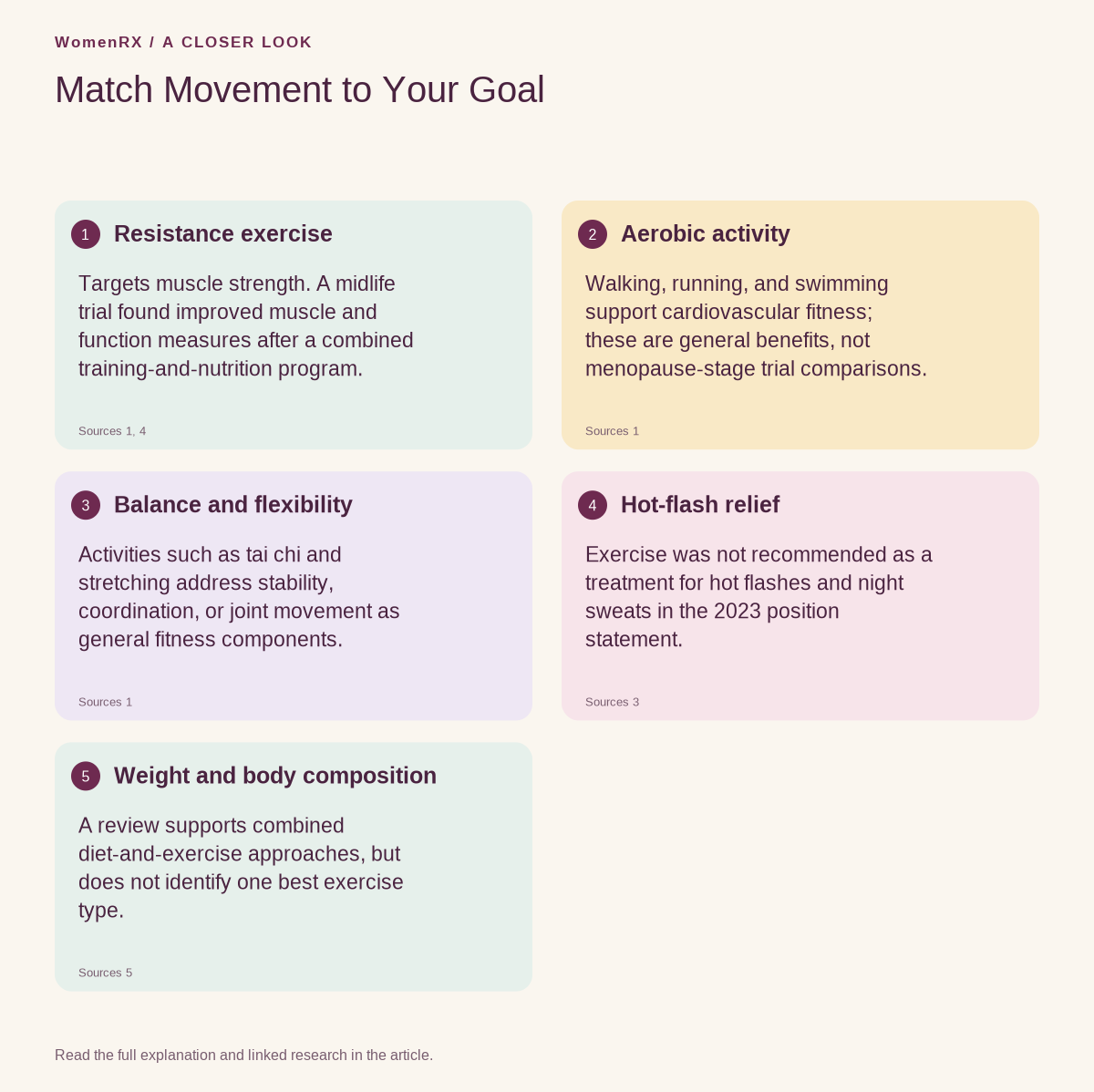
Match Movement to Your Goal
Resistance exercise: Targets muscle strength. A midlife trial found improved muscle and function measures after a combined training-and-nutrition program.14
Aerobic activity: Walking, running, and swimming support cardiovascular fitness; these are general benefits, not menopause-stage trial comparisons.1
Balance and flexibility: Activities such as tai chi and stretching address stability, coordination, or joint movement as general fitness components.1
Hot-flash relief: Exercise was not recommended as a treatment for hot flashes and night sweats in the 2023 position statement.3
Weight and body composition: A review supports combined diet-and-exercise approaches, but does not identify one best exercise type.5
Read the figure as text
Different activities support different outcomes. The evidence is strongest here for general fitness distinctions, one combined midlife training program, and the separate question of hot-flash treatment.- Resistance exercise: Targets muscle strength. A midlife trial found improved muscle and function measures after a combined training-and-nutrition program.14
- Aerobic activity: Walking, running, and swimming support cardiovascular fitness; these are general benefits, not menopause-stage trial comparisons.1
- Balance and flexibility: Activities such as tai chi and stretching address stability, coordination, or joint movement as general fitness components.1
- Hot-flash relief: Exercise was not recommended as a treatment for hot flashes and night sweats in the 2023 position statement.3
- Weight and body composition: A review supports combined diet-and-exercise approaches, but does not identify one best exercise type.5
More questions, answered
Can exercise help with hot flashes?
The North American Menopause Society did not recommend exercise or yoga as treatments for hot flashes and night sweats in its 2023 evidence review. You can still choose exercise for fitness, strength, or general health, but don’t rely on it as a hot-flash treatment. 3
Should I choose walking or strength training?
Choose based on what you want to work on. Walking is an aerobic activity that supports cardiovascular fitness; resistance training targets muscle strength. If both goals matter, a mix may fit better than choosing only one. 1
Sources you can check
- Exercise and Physical Fitness: MedlinePlusAccessed 2026-09-25Return to first citation
- Benefits of Exercise: MedlinePlusAccessed 2026-09-25Return to first citation
- The 2023 nonhormone therapy position statement of The North American Menopause Society.Menopause (New York, N.Y.) · 2023Return to first citation
- Postinactivity Exercise Training Improves Sarcopenia Traits in 40-60-Year-Old Women Regardless of Fortified Milk Supplementation.Trezise J, Lima RM, Poppitt SD, Fanning AC, Devine A, Blazevich AJ. · Journal of cachexia, sarcopenia and muscle · 2025Return to first citation
- Weight Management in Menopause: Diet, Physical Activity, Medication, and Surgery.Lu V, Tayachew B, Chevtsov A, Nicklas JM. · Obstetrics and gynecology clinics of North America · 2026Return to first citation