Exercise With PCOS: Choose What You Can Keep Doing
There isn’t one proven best workout for PCOS; the most useful choice depends on what you want from movement and what fits your life.
Research suggests exercise can improve some metabolic measures in women with PCOS, but it hasn’t established one exercise type or intensity as best for everyone. You could start with five minutes of an activity that feels manageable, then build gradually. That’s a practical starting example, not a PCOS-tested dose or an amount you must reach to benefit. 1 2 4
Start with the outcome you care about
Exercise can be part of PCOS care without being a test of discipline, a requirement for weight loss, or a condition for pursuing pregnancy. You might want to support metabolic health, build strength, improve stamina, lift your mood, or simply make daily movement easier. Those are different goals, and they don’t require the same workout.
In a systematic review of 22 randomized trials involving 1,044 women with PCOS, exercise was associated with improvements in fasting insulin, insulin resistance, and several hormone and cholesterol measures. The results varied with the studies’ exercise programs and participants, so they don’t point to a single routine that will work for every woman. 2
That distinction matters: a change in a lab measure is not a promise that periods will become regular, fertility will improve, or body weight will change. Exercise can still be worthwhile for health, function, or enjoyment even when those aren’t your goals.
Match the activity to the goal
For stamina and aerobic fitness: Walking, cycling, swimming, dancing, or another activity that gets you moving continuously can be a practical starting point. A recent review found that high-intensity interval training improved measured aerobic capacity, while moderate-intensity continuous training improved insulin resistance. Both were associated with lower fasting insulin and LDL cholesterol in that analysis. The evidence ranged from low to moderate, and neither approach improved every measure studied. 5
For strength and variety: Resistance exercise can include weights, resistance bands, or body-weight movements. A network meta-analysis found combined aerobic and resistance exercise ranked highly for fasting insulin, but the overall certainty across outcomes was low or very low. That ranking is a possible clue, not proof that combining workouts is the right choice for you. 4
For mind-body movement: Tai Chi may appeal if you’re interested in a practice that combines movement and mindful attention. In one small trial of female college students with PCOS, a group doing Tai Chi alongside dietary changes had more favorable changes in menstrual cycle length and testosterone than a group making the dietary changes alone. The comparison estimates the benefit of adding Tai Chi to that diet program; it doesn’t show what Tai Chi would do on its own or whether it works better than another activity. A broader analysis ranked mind-body exercise highly for some glucose and insulin-resistance outcomes, but rated the evidence very uncertain. 3 4
You don’t have to pick just one category. A routine might include walking on some days and a short strength session on another, or a class you enjoy alongside everyday movement. Those are examples, not PCOS-specific prescriptions.
Intensity is a preference and a constraint, too
Harder isn’t automatically better. In the review comparing exercise intensities, moderate continuous training improved insulin resistance, while high-intensity intervals improved aerobic capacity. The different results suggest that intensity may matter for some outcomes, but the evidence doesn’t justify telling every woman to do intervals or to avoid them. 5
Consider what makes an activity feel doable: your current fitness, joint comfort, fatigue, symptoms, schedule, available space, and whether you prefer exercising alone or with others. If an activity leaves you dreading the next session, try a different pace, format, or type. Consistency is more realistic when movement fits your actual week.
Choose an amount you can build from
If you’re unsure where to begin, use five minutes as a small starting point: take a short walk, move to a video, or try another activity you can do comfortably. General exercise guidance says to start slowly and notes that even five minutes of activity has health benefits. That’s a practical starting example, not a PCOS-tested dose. 1
The PCOS studies discussed here don’t identify a single PCOS-specific starting dose. General exercise guidance recommends working toward the amount of activity advised for your age, while emphasizing that some activity is better than none. You can build gradually and choose an amount that fits your circumstances. 1 2 5
For example, you might begin with five minutes on days that suit your schedule, then add time or another session when it feels manageable. If your schedule changes, keep a flexible fallback: a walk around the block, a few movements at home, or active errands. If symptoms, pain, disability, or access make one option hard, that’s a reason to adapt the plan, not a reason to assume exercise is off limits. Choose a form of movement that works with your body and circumstances. 1
Keep the evidence in perspective
Some reviews report benefits for metabolic or hormone measures, while comparisons among exercise types remain uncertain. A network meta-analysis ranked different activities for particular outcomes, but judged the evidence low or very low overall. Rankings can suggest what researchers should study next; they don’t reliably identify a winner for an individual. 2 4
Reproductive outcomes are especially easy to overpromise. The reviewed evidence doesn’t establish one exercise style as better than another for menstrual or other measured reproductive outcomes. 4 You don’t need to earn care or prove commitment through exercise. Pick movement for the benefits that matter to you, and let your plan change when your needs do.
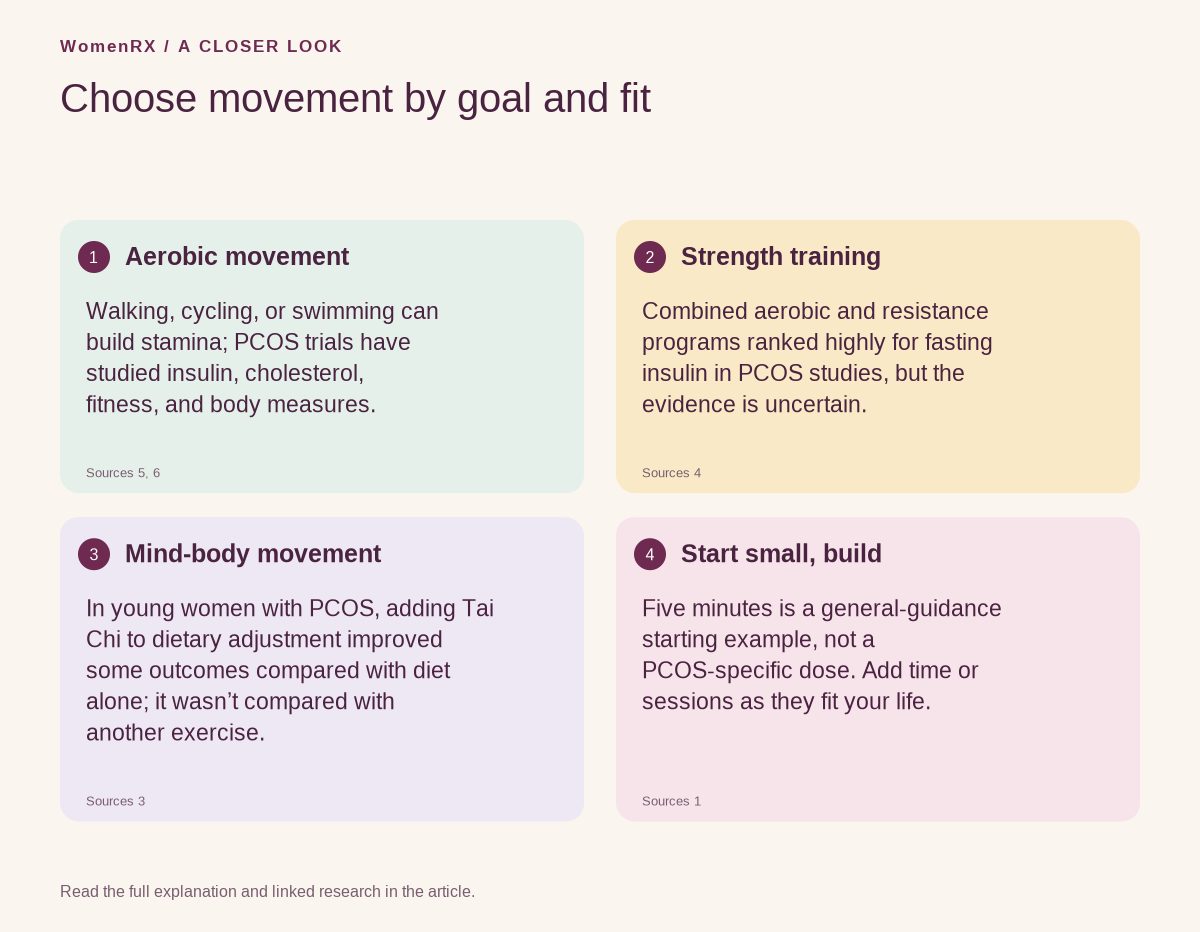
Choose movement by goal and fit
Aerobic movement: Walking, cycling, or swimming can build stamina; PCOS trials have studied insulin, cholesterol, fitness, and body measures.56
Strength training: Combined aerobic and resistance programs ranked highly for fasting insulin in PCOS studies, but the evidence is uncertain.4
Mind-body movement: In young women with PCOS, adding Tai Chi to dietary adjustment improved some outcomes compared with diet alone; it wasn’t compared with another exercise.3
Start small, build: Five minutes is a general-guidance starting example, not a PCOS-specific dose. Add time or sessions as they fit your life.1
Read the figure as text
These options connect activity styles and a flexible starting approach with outcomes studied in PCOS, while keeping the evidence and practical tradeoffs in view.- Aerobic movement: Walking, cycling, or swimming can build stamina; PCOS trials have studied insulin, cholesterol, fitness, and body measures.56
- Strength training: Combined aerobic and resistance programs ranked highly for fasting insulin in PCOS studies, but the evidence is uncertain.4
- Mind-body movement: In young women with PCOS, adding Tai Chi to dietary adjustment improved some outcomes compared with diet alone; it wasn’t compared with another exercise.3
- Start small, build: Five minutes is a general-guidance starting example, not a PCOS-specific dose. Add time or sessions as they fit your life.1
More questions, answered
How much exercise should I aim for with PCOS?
The PCOS studies discussed here don’t identify a single PCOS-specific starting dose. You could start with five minutes of a manageable activity and build gradually. General exercise guidance recommends working toward the amount advised for your age, but also says some activity is better than none. 1 2 5
Do I need to lose weight for exercise to help with PCOS?
No. Exercise studies in PCOS measure outcomes beyond body weight, including fasting insulin and insulin resistance. A recent review found some metabolic benefits, while changes in BMI were not significant for every exercise measure it assessed. Movement can be valuable without weight loss being the goal. 2 5
Is high-intensity interval training the best exercise for PCOS?
It hasn’t been shown to be best for everyone. One analysis found benefits for aerobic capacity, insulin, and LDL cholesterol with high-intensity intervals, while moderate continuous training improved insulin resistance. The certainty of evidence was low to moderate, so choose based on your goals and what you can sustain. 5
Sources you can check
- Benefits of Exercise: MedlinePlusAccessed 2026-09-25Return to first citation
- The Effect of Exercise on Reproductive and Metabolic Outcomes in Women With Polycystic Ovary Syndrome: A Systematic Review and Meta-Analysis.Zou K, Ping Y, Wei Q, Zhao X, Wang Y, Wu D, Chen L, Wang S, Feng X. · The journal of obstetrics and gynaecology research · 2026Return to first citation
- Effects of Tai Chi combined with dietary intervention on health-promoting lifestyle and metabolic and reproductive outcomes in female college students with polycystic ovary syndrome: a randomized controlled trial.Ren J, Chen H, Zhang L, Cui C, Wang L, He Q, Feng Y, Liang L. · Frontiers in endocrinology · 2026Return to first citation
- Ranking exercise interventions by their effectiveness in the management of polycystic ovary syndrome: a systematic review and network meta-analysis.Hu S, Shen Q, Li Z, He T, Luo Y, Tu P, Yan C, Lei J. · Reproductive biology and endocrinology : RB&E · 2026Return to first citation
- Comparative cardiometabolic effects of high, moderate, and low intensity exercise in polycystic ovary syndrome: a systematic review and network meta-analysis of randomized controlled trials.Sámano Sánchez M, Floridia Rietmann LM, Magallanes Bajana A, Rodriguez CFC, Moreno Díaz TA, Sultana S, Castillo Vera D, Sierra Cogollos C, De la Luz Franco M, Arredondo González MA... · BMC women's health · 2026Return to first citation
- Effectiveness of Aerobic Exercise on Metabolic Profiles in Women with Polycystic Ovary Syndrome: A Systematic Review, Meta-Analysis, and GRADE Assessment of RCTs.Gautam R, Maan P, Sivakumar S, Arora A, Jena SK, Arora T. · Diabetes, metabolic syndrome and obesity : targets and therapy · 2026Return to first citation