How to Choose Exercise That Supports Healthy Aging
Aerobic activity, strength work, and balance practice do different jobs, so a useful routine makes room for more than one.
There’s no single best workout for aging well. Aerobic activity supports heart and metabolic health; strength work helps preserve muscle and puts useful stress on bones; and balance practice helps older adults reduce falls. A mix matters more than choosing a winner. Start with activities you can do, then add the type that serves a goal your current routine misses. 134
Think about what you want to keep doing
Maybe your goal is to walk comfortably for errands, carry groceries, or feel steadier on stairs. Those are different tasks, and exercise types help with them in different ways. Walking regularly can build aerobic activity into your day, but it doesn’t replace working your muscles against resistance. Strength work has its own benefits, but it doesn’t make balance practice unnecessary as falls become a concern. U.S. guidance for older adults calls for a weekly mix of aerobic, muscle-strengthening, and balance activities. 34
Aerobic activity is the part that gets you breathing harder, whether that’s a brisk walk, a bike ride, or another activity that fits your abilities. Regular exercise supports heart health and blood-glucose control. If you’ve been inactive, you can start with short periods and build gradually rather than waiting until you can manage a long workout. 14
Strength work asks muscles to push or pull against resistance. Weights, resistance bands, and body-weight movements can all do that. It helps maintain muscle and strength for everyday tasks, such as getting out of a chair, and places stress on bones that can help keep them strong. 13
Balance practice challenges your steadiness. Tai chi, step-ups, and controlled weight shifts are examples. Its practical aim is different from getting your heart rate up: better balance can help prevent falls, especially in older age. A fall is also one way a fragile bone becomes a broken bone, which is why balance and strength both belong in a bone-health conversation. 3
Where the evidence is specific to women
Bone health is a good reason not to treat every form of activity as interchangeable. In a systematic review and meta-analysis of 40 studies involving 2,230 postmenopausal women ages 50 to 60, aerobic, resistance, and combined exercise were associated with small improvements in bone mineral density at measured sites, including the spine and hip. Bone mineral density is not the same outcome as avoiding a fracture, and the review does not establish one ideal routine for every woman. 6
A separate network meta-analysis of 55 randomized trials in older postmenopausal women found that multicomponent training improved femoral-neck bone mineral density compared with control interventions. Those programs can include resistance, endurance, balance, and flexibility work. The result supports considering a mix, not copying a particular program or assuming that its bone-density finding proves fewer fractures. 7
If you already have low bone density or osteoporosis, the question isn’t simply whether exercise is good for bones. It’s which movements suit your bones and physical abilities. The National Institute of Arthritis and Musculoskeletal and Skin Diseases recommends getting help choosing an exercise program before starting one in that situation. 3
Women at other life stages may need different adjustments. U.S. guidance includes moderate-intensity activity during pregnancy and after delivery, while recognizing that how to exercise may need to change for the individual. The postmenopausal bone studies above shouldn’t be treated as evidence for exercise choices during pregnancy or postpartum recovery. 367
Does the activity have to be intense to count?
No. The general adult target is 150 to 300 minutes of moderate-intensity aerobic activity a week, or 75 to 150 minutes of vigorous activity, plus muscle-strengthening activity on at least two days. Those are targets, not an entry requirement: smaller amounts are useful, and older adults who can’t meet the aerobic target because of their health are encouraged to be as active as their health allows. 34
More intense exercise can be an option, but it isn’t the established winner for every woman. In a five-year randomized trial of 1,567 relatively healthy Norwegian adults ages 70 to 75, high-intensity interval training showed some advantages on measures related to muscle strength, walking speed, and sarcopenia compared with a group following physical-activity guidelines; moderate continuous training did not show those effects. About half the participants were women, but the reported results were for the groups overall, not a women-only result. That trial also compared specific programs and outcomes, not which workout makes women live longest. 2
Exercise and longer life are linked in observational research, but that doesn’t identify a single best activity. For example, a prospective study of adults who reported no leisure-time exercise found that longer bouts of moderate-to-vigorous activity in daily life were associated with lower mortality than bouts under one minute. Women made up 56.2% of the study group, but a women-specific result wasn’t reported in its abstract. Because this was observational, it cannot show that changing bout length caused people to live longer. 5
Build around the piece you’re missing
A simple way to choose your next activity is to look at what you already do. If you walk often but rarely challenge your muscles, strength work adds something distinct. If you lift but spend little time moving continuously, add aerobic activity you enjoy. If you’re concerned about steadiness, make balance practice part of the mix rather than expecting walking or lifting alone to cover it. These are examples of how to use the different roles of exercise, not a prescribed schedule. 134
The best mix is one that addresses your goals and fits your abilities well enough to keep doing. You can begin with what’s manageable and build from there. 34
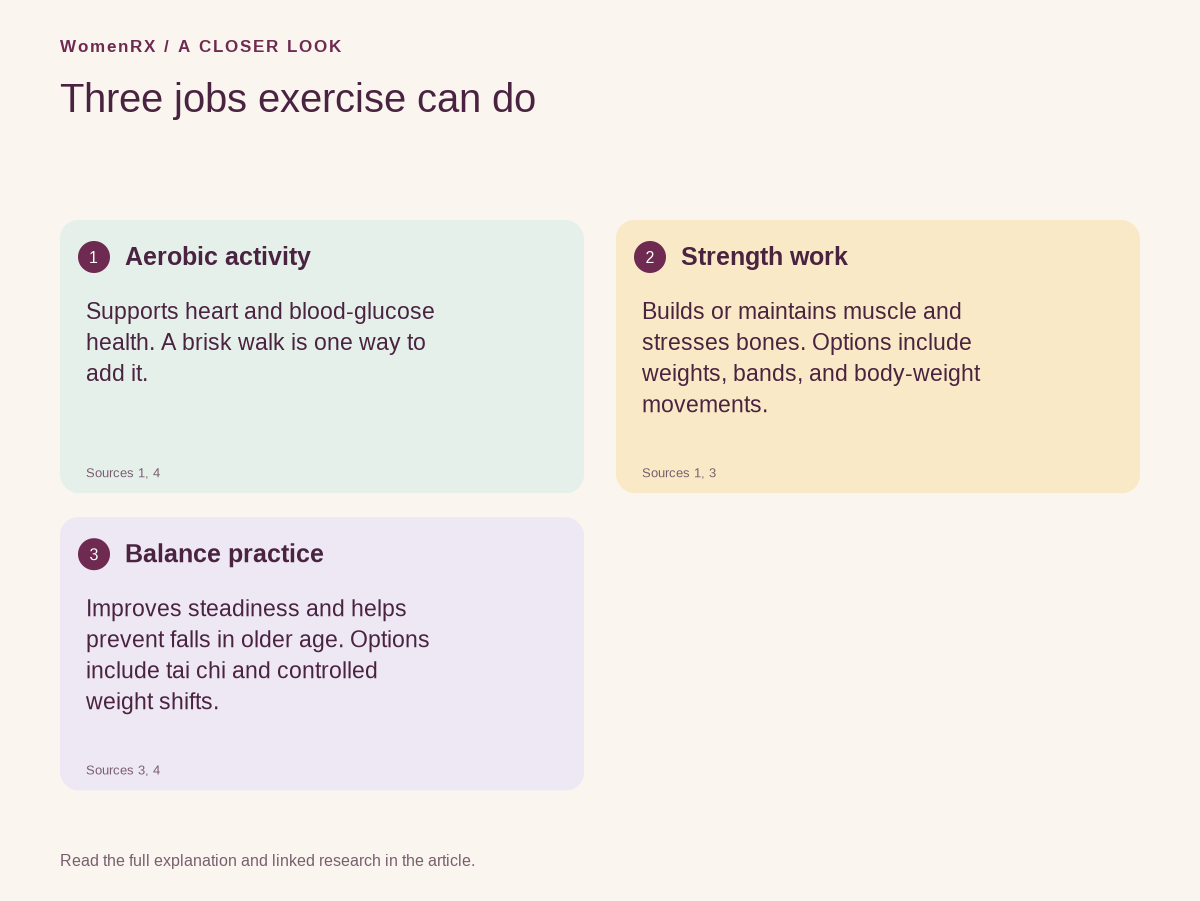
Three jobs exercise can do
Aerobic activity: Supports heart and blood-glucose health. A brisk walk is one way to add it.14
Strength work: Builds or maintains muscle and stresses bones. Options include weights, bands, and body-weight movements.13
Balance practice: Improves steadiness and helps prevent falls in older age. Options include tai chi and controlled weight shifts.34
Read the figure as text
Choose an activity by the benefit your current routine may be missing. The three types can complement one another.- Aerobic activity: Supports heart and blood-glucose health. A brisk walk is one way to add it.14
- Strength work: Builds or maintains muscle and stresses bones. Options include weights, bands, and body-weight movements.13
- Balance practice: Improves steadiness and helps prevent falls in older age. Options include tai chi and controlled weight shifts.34
Sources you can check
- Benefits of Exercise: MedlinePlusAccessed 2026-09-25Return to first citation
- Effects of 5 Years of Aerobic Exercise on Sarcopenia in Older Adults-Secondary Outcomes of the Generation 100 Study.Stene GB, Lequerica MJ, Stensvold D, Balstad TR, Lydersen S, Wisløff U, Helbostad JL. · Journal of cachexia, sarcopenia and muscle · 2026Return to first citation
- Exercise for Your Bone Health | NIAMSAccessed 2026-09-25Return to first citation
- How Much Exercise Do I Need?: MedlinePlusAccessed 2026-09-25Return to first citation
- Brief bouts of device-measured intermittent lifestyle physical activity and its association with major adverse cardiovascular events and mortality in people who do not exercise: a prospective cohort study.Ahmadi MN, Hamer M, Gill JMR, Murphy M, Sanders JP, Doherty A, Stamatakis E. · The Lancet. Public health · 2023Return to first citation
- Impact of exercise modalities on bone health: a meta-analysis of aerobic, resistance, and combined training on bone mineral density in postmenopausal women.Hejazi K, Rahimi GRM, Hofmeister M. · Archives of osteoporosis · 2025Return to first citation
- Effects of different exercise interventions on bone mineral density in elderly postmenopausal women: a network meta-analysis.Ma M, Su W, Liu D. · Frontiers in physiology · 2025Return to first citation