Sleep and Healthy Aging in Women: Midlife and Postmenopausal Evidence
Long-term studies of women at midlife and after menopause link some sleep patterns with later health, but they can’t show that changing your sleep will prevent illness or extend your life.
In long-term studies of women at midlife and after menopause, both shorter and longer sleep have sometimes been associated with poorer health later on. That’s a pattern, not proof that sleep duration caused the outcome or that a particular number of hours guarantees longevity. Sleep quality and possible disorders matter too. Continued trouble sleeping may warrant care; daytime dozing is a clue to consider when assessing your sleep. 1 2 3
What midlife and postmenopausal sleep studies can tell you
A long-term study can show that people who report certain sleep patterns later experience different health outcomes from people who report other patterns. It cannot, on its own, establish that sleep caused the difference. Underlying health factors may be related to both sleep patterns and later outcomes, making it hard to tell what explains an association. 2 4
That distinction matters when you see headlines about sleep and longevity. In a review of the Women’s Health Initiative, a long-running study of more than 161,000 postmenopausal women, both shorter and longer reported sleep were associated with several later outcomes, including mortality and cognitive decline. The review also found that many associations weakened after researchers adjusted for other factors. These findings concern women who were already postmenopausal; they don’t describe sleep during pregnancy or establish what changes during the menopause transition. 2
One study of women in the Nurses’ Health Study looked at healthy aging, defined as being free of major chronic disease and of cognitive, physical, and mental health limitations. Among women who had no major chronic diseases at the start and survived to age 70 or older, 11% met that definition. Seven hours of reported sleep at midlife was associated with the highest odds of healthy aging in this particular analysis. That does not make seven hours a longevity guarantee: the study measured reported sleep, included a selected group of survivors, and found associations rather than cause and effect. 3
The practical takeaway isn’t to treat one night, or one sleep-duration category, as a prediction of your future. Look at the wider pattern and how you feel and function during the day.
Duration, quality, and disorders are different clues
Duration is the amount of time you sleep. Some studies find associations at both shorter and longer durations, but the cutoffs and results vary. The Women’s Health Initiative review reported that study definitions differed, which makes simple comparisons difficult. 2
Quality includes whether sleep feels restorative and whether it is repeatedly interrupted. Hours alone don’t capture that. MedlinePlus notes that people whose sleep is frequently interrupted may miss some sleep stages; trouble getting up and daytime dozing can be clues that sleep may not be sufficient or restful. 1
A sleep disorder is not the same thing as a sleep-duration category or a rough self-report. Insomnia and sleep apnea are examples of conditions that can contribute to ongoing sleep problems, and continued trouble sleeping may warrant assessment. Snoring is an association worth noticing, not a diagnosis: in one study, regular snoring in midlife was linked with lower odds of healthy aging later, but the study could not show that snoring caused that difference. 1 3
These distinctions help make the research more useful. A report about long sleep and mortality doesn’t tell you whether an individual’s longer sleep reflects a disorder, another health issue, or something else. Nor does it show that deliberately sleeping less would improve health.
If your sleep changes during pregnancy or menopause
A change that happens during pregnancy or the menopause transition raises a different question from a headline about longevity: what’s happening to your sleep now? The postmenopausal Women’s Health Initiative findings cannot tell you which sleep changes to expect during pregnancy or the transition. Nor can they tell you that a new problem is simply part of either life stage. 2
What you can distinguish is an occasional disrupted night from continued trouble sleeping. If interruptions keep happening, or you’re dozing during the day, pay attention to that pattern rather than explaining it away as pregnancy, menopause, or aging. Continued sleep trouble may warrant assessment for a sleep disorder such as insomnia or sleep apnea. 1
What’s worth acting on now
You don’t need to calculate your future risk from a sleep chart. Pay attention to continued trouble sleeping, repeated interruption, or dozing during the day, especially if it affects daily functioning. MedlinePlus recommends seeking care for continued sleep trouble because conditions such as insomnia or sleep apnea may be involved. 1
A useful first question is not just “How many hours did I get?” but “Am I regularly waking unrefreshed or struggling to stay alert?” The answer can help distinguish a number on a study from a sleep problem that deserves attention. Researchers can keep studying how sleep and health influence one another; for you, persistent symptoms are a more actionable signal than a promise of longevity tied to a specific duration.
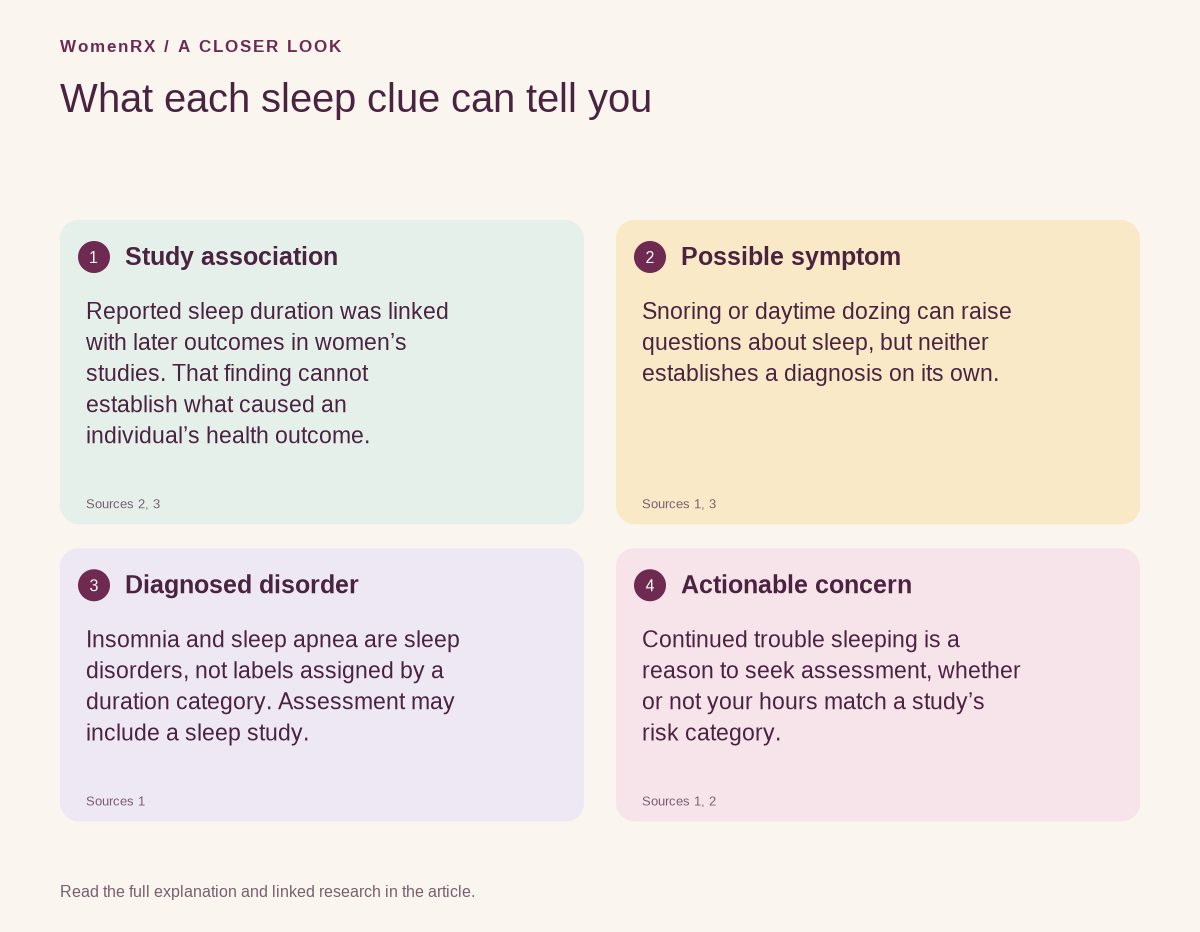
What each sleep clue can tell you
Study association: Reported sleep duration was linked with later outcomes in women’s studies. That finding cannot establish what caused an individual’s health outcome.23
Possible symptom: Snoring or daytime dozing can raise questions about sleep, but neither establishes a diagnosis on its own.13
Diagnosed disorder: Insomnia and sleep apnea are sleep disorders, not labels assigned by a duration category. Assessment may include a sleep study.1
Actionable concern: Continued trouble sleeping is a reason to seek assessment, whether or not your hours match a study’s risk category.12
Read the figure as text
A research finding, a symptom, and a diagnosed condition answer different questions.- Study association: Reported sleep duration was linked with later outcomes in women’s studies. That finding cannot establish what caused an individual’s health outcome.23
- Possible symptom: Snoring or daytime dozing can raise questions about sleep, but neither establishes a diagnosis on its own.13
- Diagnosed disorder: Insomnia and sleep apnea are sleep disorders, not labels assigned by a duration category. Assessment may include a sleep study.1
- Actionable concern: Continued trouble sleeping is a reason to seek assessment, whether or not your hours match a study’s risk category.12
More questions, answered
Does sleeping more mean you’ll live longer?
No. Some observational studies associate longer sleep with poorer later health, but they cannot show that sleeping longer caused the outcome. Longer sleep may also occur alongside other health factors. A study association is not a reason to cut back on sleep. 2 4
Is needing less sleep a normal part of getting older?
MedlinePlus says there is no evidence that adults need less sleep simply because they age, although older adults often sleep less or spend less time in deep sleep. A persistent sleep problem shouldn’t be dismissed as inevitable aging. 1
Sources you can check
- Healthy Sleep | MedlinePlusAccessed 2026-09-25Return to first citation
- Contributions of the Women's Health Initiative to understanding associations between sleep duration, insomnia symptoms, and sleep-disordered breathing across a range of health outcomes in postmenopausal women.Beverly Hery CM, Hale L, Naughton MJ. · Sleep health · 2020Return to first citation
- Sleep Duration and Snoring at Midlife in Relation to Healthy Aging in Women 70 Years of Age or Older.Shi H, Huang T, Ma Y, Eliassen AH, Sun Q, Wang M. · Nature and science of sleep · 2021Return to first citation
- Impaired sleep and allostatic load: cross-sectional results from the Danish Copenhagen Aging and Midlife Biobank.Clark AJ, Dich N, Lange T, Jennum P, Hansen AM, Lund R, Rod NH. · Sleep medicine · 2014Return to first citation