Inflammation and Aging: What a Blood Test Can Tell You
Chronic low-grade inflammation is studied as one part of aging, but no inflammatory test gives you a validated personal aging score.
“Inflammaging” describes a research concept: persistent, low-grade inflammation associated with aging. It isn’t the same as a diagnosis, and a result such as CRP or IL-6 can’t, by itself, tell you how quickly you’re aging. This research concerns chronic patterns; it doesn’t explain what a single result means in a short-term situation. Menopause may affect aging-related pathways, but no biological-aging test has a validated threshold for routine menopause care. 1 2
Inflammaging is a research idea, not a diagnosis
Inflammation is part of how the body responds to change and harm. In aging research, “inflammaging” refers to a persistent, low-grade inflammatory state observed alongside age-related immune changes. Researchers study whether this pattern contributes to conditions that become more common with age. That makes inflammation a possible part of a larger process, not a complete explanation for aging or an outcome you can read from one lab result. 1
That research concept should not turn an individual lab result into an “inflammaging” score. 1 2
Menopause may be part of the picture, not the whole story
Menopause is a reproductive transition that may influence biological aging through several possible pathways, including estrogen loss, changes in body composition, and chronic inflammation. Those are proposed connections, not proof that a change in one inflammatory marker was caused by menopause. 2
Age, health conditions, and other influences may also matter. Research on aging biomarkers has not established one measure as a universal readout of biological age: clocks use different combinations of molecular or clinical information and can reflect different outcomes. Their results aren’t interchangeable, and questions remain about confounding, interpretation, and clinical use. 3
That distinction matters if you’re in perimenopause or postmenopause and receive an inflammatory test result. The result may be useful for the clinical question your clinician was investigating, but it doesn’t by itself explain a symptom, identify menopause as the cause, or tell you how fast you’re aging.
What a marker can show, and what it can’t
CRP and IL-6 are examples of markers discussed in research on chronic, low-grade inflammation and aging. Routine inflammatory biomarkers capture only part of the molecular variation involved in inflammation; they aren’t a complete readout of aging. And an association between a marker and aging-related health outcomes does not prove that the marker caused them. 1 4
The aging research discussed here concerns chronic, low-grade patterns. It doesn’t explain what a single result means during a short-term situation; that is a different question from whether chronic inflammation is associated with aging. 1 4
Researchers are also testing more complex measures. In a large UK Biobank analysis, researchers developed a proteomic inflammation score using data from 40,471 participants in England and evaluated it in a separate cohort of 5,250 people. The score was associated with mortality and age-related health measures. That is a population-level research finding, not evidence that this score, or a routine test, can tell an individual woman her personal aging rate. The abstract does not report a menopause-specific result. 4
For postmenopausal women, a 2026 review likewise says that available biological-aging biomarkers vary by tissue and intended outcome, and that no biological-aging test has a validated threshold to guide routine menopause care. 2
Make the result answer a real question
If a test result has raised concern, useful questions are specific:
- What question was this test ordered to answer?
- Is this result being used to evaluate a health condition, or is it being presented as an aging measure?
- How does it fit with my health history and other findings?
- Would the result change a decision about my care?
- Is there a reason to interpret it differently given my menopausal stage or other health circumstances?
These questions help separate a clinically relevant result from a number that sounds like a measure of overall aging. Current research on biological-aging clocks still faces challenges with specificity, confounding, and clinical applicability. 3
The practical takeaway is simple: inflammation is one area researchers are studying in relation to aging, but a marker is not a personal verdict. Ask what the result was meant to clarify and how it affects the next decision, rather than treating it as a standalone measure of your biological age.
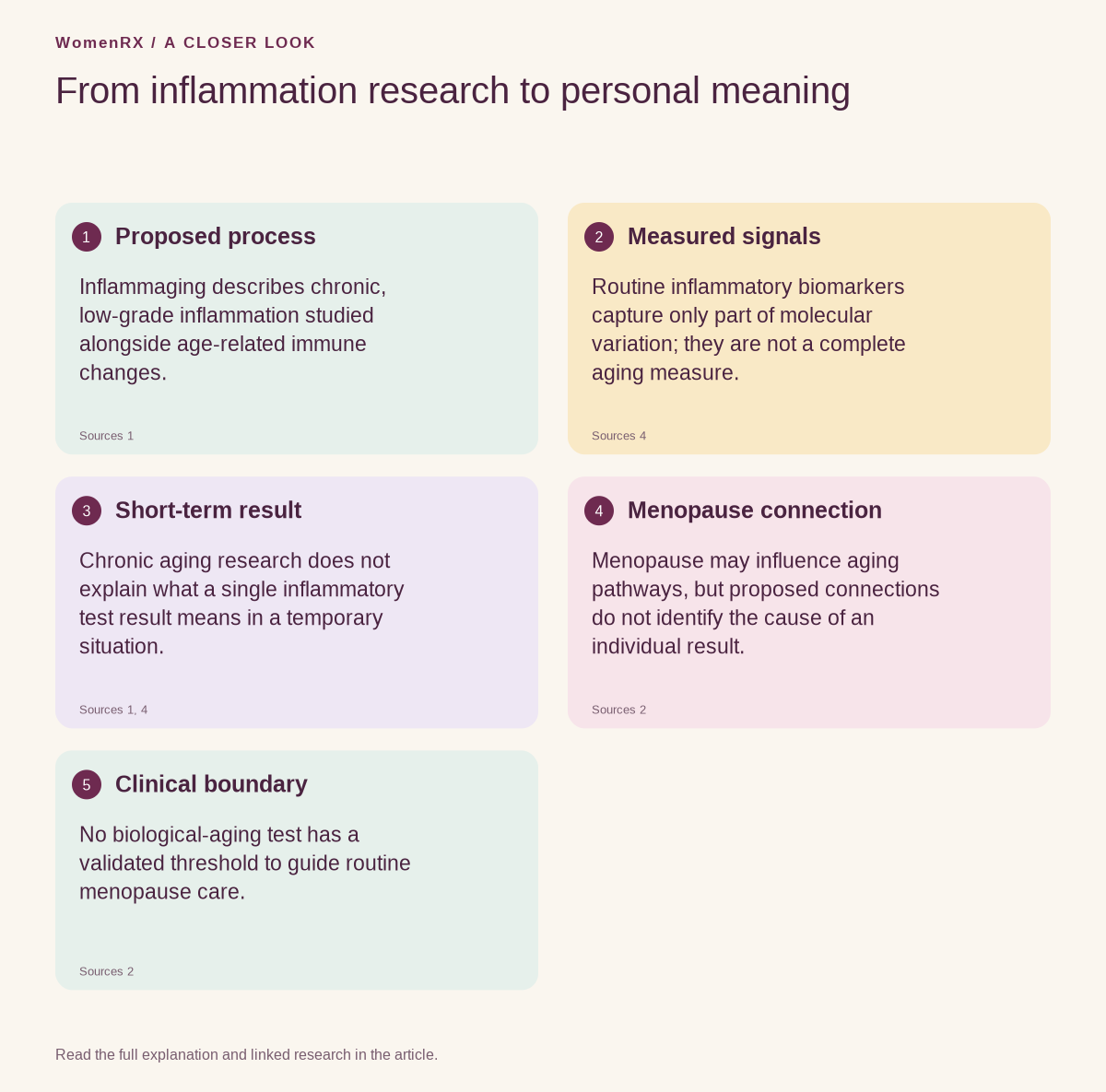
From inflammation research to personal meaning
Proposed process: Inflammaging describes chronic, low-grade inflammation studied alongside age-related immune changes.1
Measured signals: Routine inflammatory biomarkers capture only part of molecular variation; they are not a complete aging measure.4
Short-term result: Chronic aging research does not explain what a single inflammatory test result means in a temporary situation.14
Menopause connection: Menopause may influence aging pathways, but proposed connections do not identify the cause of an individual result.2
Clinical boundary: No biological-aging test has a validated threshold to guide routine menopause care.2
Read the figure as text
These are different levels of evidence: a proposed aging process, measures researchers use, and what is currently established for individual menopause care.- Proposed process: Inflammaging describes chronic, low-grade inflammation studied alongside age-related immune changes.1
- Measured signals: Routine inflammatory biomarkers capture only part of molecular variation; they are not a complete aging measure.4
- Short-term result: Chronic aging research does not explain what a single inflammatory test result means in a temporary situation.14
- Menopause connection: Menopause may influence aging pathways, but proposed connections do not identify the cause of an individual result.2
- Clinical boundary: No biological-aging test has a validated threshold to guide routine menopause care.2
More questions, answered
Can an inflammation test show whether menopause is aging me faster?
No validated biological-aging test currently has a threshold for routine menopause care. Menopause may influence biological-aging pathways, but a marker alone cannot establish that menopause caused a change or measure your personal aging rate. 2
Sources you can check
- Inflammaging: the driving force in osteoporosis?Lencel P, Magne D. · Medical hypotheses · 2011Return to first citation
- Biomarkers for Biological Aging in Postmenopausal Women.Dreisbach C. · Journal of obstetric, gynecologic, and neonatal nursing : JOGNN · 2026Return to first citation
- Biological aging clocks as biomarkers of human aging: Biological basis, methodological design, and epidemiological implications.Fermín-Martínez CA, García-González SB, Castañeda EGL, Ramírez-Rivera DL, Carrillo-Herrera KB, Cabrera-Quintana LA, López-Teros MT, Antonio-Villa NE, Gomes-Goncalves N, García-Peña... · Revista de investigacion clinica; organo del Hospital de Enfermedades de la Nutricion · 2026Return to first citation
- Proteomic signatures of systemic inflammation in aging, multimorbidity, and mortality.Jiang Z, Ling D, Chen Z, Zhou H, Cui Z, Ma X, Zheng S, Wang H, Wang Q. · Experimental gerontology · 2026Return to first citation