When Does an Estradiol Blood Test Tell You Something Useful?
The meaning of an estradiol result depends on your cycle, your symptoms, and why the test was ordered.
Estradiol, also called E2, changes substantially during a menstrual cycle and is generally lower after menopause. A result is most useful when it answers a specific question, such as why periods have stopped or how ovaries are responding during fertility treatment. It cannot be interpreted apart from cycle timing, other findings, or symptoms. If pregnancy is possible and your period is late, a pregnancy test comes first. 45
An estradiol result can look reassuring or alarming depending on the range printed beside it. But that range isn’t the whole story. The useful question is: What was this test meant to find out? An E2 level drawn during a natural cycle, during fertility treatment, or after menopause is answering a different question in each setting. 4
During a cycle, the day changes the meaning
Estradiol is produced primarily by the ovaries during the reproductive years. Its blood level is relatively low early in a menstrual cycle, rises before ovulation, falls, then rises again during the second half of the cycle. A level that makes sense early in the cycle may mean something different just before ovulation. That’s why a single result without the cycle day, or without knowing whether cycles are regular, is hard to interpret. 45
For example, imagine two results with the same E2 number: one was collected early in a predictable cycle; the other was collected while someone’s periods have been absent for months. The number alone doesn’t explain the second situation. A clinician may need the period history, a pregnancy test, and other hormone results to work out why periods stopped. 5
When periods stop unexpectedly, E2 works with other clues
If you’ve missed periods and pregnancy is possible, pregnancy is the first possibility to check. Estradiol isn’t a substitute for a pregnancy test. After pregnancy has been ruled out, an evaluation for absent periods may include estradiol alongside follicle-stimulating hormone (FSH) and luteinizing hormone (LH). The pattern can help distinguish reduced ovarian function from causes involving signals from the brain to the ovaries. A normal E2 and normal gonadotropin results, however, may not clearly distinguish among other reasons periods have stopped. 5
Age matters here. Primary ovarian insufficiency, or POI, means the ovaries aren’t working normally before age 40. It can first show up as irregular or missed periods or difficulty getting pregnant. Unlike menopause after periods have stopped permanently, POI can involve occasional periods, and pregnancy is still possible. An unexpectedly low E2 result is therefore a reason to consider the wider picture, not a diagnosis to make from one number. 145
Fertility care uses E2 for a different question
During ovarian stimulation for IVF or ICSI, estradiol may be measured alongside ultrasound to assess how the ovaries are responding. This is treatment monitoring, not a general test of whether you can conceive naturally. A review comparing ultrasound alone with ultrasound plus estradiol found the evidence too uncertain to establish whether adding the blood test changes pregnancy or ovarian hyperstimulation outcomes. None of its six trials reported live birth, so its findings shouldn’t be read as proof that E2 monitoring is either essential or useless for every treatment cycle. 3
E2 also isn’t interchangeable with every other fertility test. In a systematic review of studies predicting ovarian response to controlled stimulation, anti-Müllerian hormone (AMH) and antral follicle count performed better than E2 or FSH for predicting a low or high response. That finding concerns response to stimulation, not whether an individual woman will become pregnant. 2
Around menopause, start with the question behind the test
Estradiol levels are generally much lower after menopause than during the reproductive years, and E2 measurement can contribute to an assessment of menopausal status. But a blood result and a symptom story provide different information. Hot flashes and vaginal dryness, for example, are symptoms associated with falling estrogen; an isolated E2 number does not measure how much either symptom affects your life. 46
That distinction is especially useful if you’re considering or already using menopausal hormone therapy. Estradiol is commonly used in that treatment, and specialized blood testing may be used in some treatment-monitoring situations. But the existence of a test does not make an E2 target the answer to every treatment question. If symptoms aren’t improving, the symptom pattern and treatment details still matter. 46
If you have an E2 result in hand, look at it with three pieces of context: why it was ordered, whether you were cycling or receiving hormone treatment, and what other findings were considered. Those details can turn an isolated number into an answer, or show why a different question needs answering first. 45
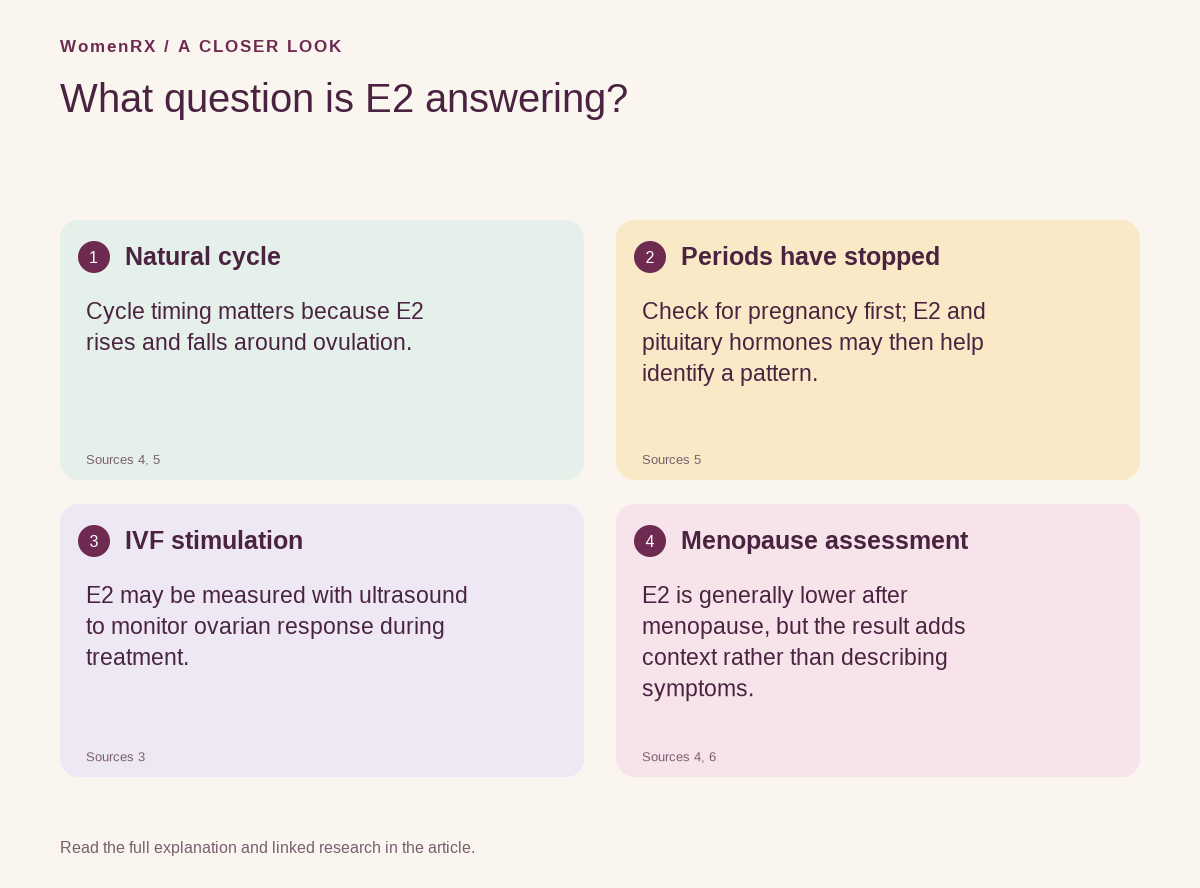
What question is E2 answering?
Natural cycle: Cycle timing matters because E2 rises and falls around ovulation.45
Periods have stopped: Check for pregnancy first; E2 and pituitary hormones may then help identify a pattern.5
IVF stimulation: E2 may be measured with ultrasound to monitor ovarian response during treatment.3
Menopause assessment: E2 is generally lower after menopause, but the result adds context rather than describing symptoms.46
Read the figure as text
The same blood test has different uses depending on what is happening at the time.- Natural cycle: Cycle timing matters because E2 rises and falls around ovulation.45
- Periods have stopped: Check for pregnancy first; E2 and pituitary hormones may then help identify a pattern.5
- IVF stimulation: E2 may be measured with ultrasound to monitor ovarian response during treatment.3
- Menopause assessment: E2 is generally lower after menopause, but the result adds context rather than describing symptoms.46
More questions, answered
Can estradiol tell me whether a missed period means pregnancy?
No. When pregnancy is possible, pregnancy testing is the first step in evaluating a missed period. Estradiol may be considered with other hormone tests if periods remain absent after pregnancy has been ruled out. 5
Sources you can check
- Primary Ovarian Insufficiency | POI | MedlinePlusAccessed 2026-09-25Return to first citation
- The best ovarian reserve marker to predict ovarian response following controlled ovarian hyperstimulation: a systematic review and meta-analysis.Salemi F, Jambarsang S, Kheirkhah A, Salehi-Abargouei A, Ahmadnia Z, Hosseini HA, Lotfi M, Amer S. · Systematic reviews · 2024Return to first citation
- Monitoring of stimulated cycles in assisted reproduction (IVF and ICSI).Kwan I, Bhattacharya S, Woolner A. · The Cochrane database of systematic reviews · 2021Return to first citation
- EEST - Overview: Estradiol, SerumAccessed 2026-09-25Return to first citation
- Current evaluation of amenorrhea: a committee opinion (2024) | American Society for Reproductive Medicine | ASRMAccessed 2026-09-25Return to first citation
- About oestrogen tablets, patches, gel and spray - NHSAccessed 2026-09-25Return to first citation