Healthy Aging: Measures That Matter More Than Longevity Claims
A useful aging plan focuses on function and well-matched prevention, not promises about adding years to your life.
For a practical picture of healthy aging, look beyond a single number: consider whether you can move, manage everyday tasks, think clearly, and maintain social and emotional well-being. Regular activity, not smoking, appropriate screenings, and steps to reduce falls are grounded starting points. These actions support health and function, but they’re not a proven universal formula for extending lifespan. 1235
Start with what you want to preserve
“Healthy aging” can sound like a promise about living longer. A more useful question is whether you can keep doing the things that matter to you: getting around, managing daily life, thinking, and staying connected. The World Health Organization framework describes intrinsic capacity across locomotion, vitality, sensory function, cognition, and psychological health. It’s a way to organize aspects of function, not a personal pass-or-fail score. 5
That shift helps separate measurable outcomes from longevity marketing. A study may find a change in strength or daily function without showing that people live longer. And a biological marker or proposed mechanism is not, by itself, proof of improved function or lifespan.
Which measures can make the picture clearer?
Everyday function is concrete. For example, you might consider whether walking, climbing stairs, carrying groceries, or handling your usual daily tasks has become harder. A Mexican cohort study of adults aged 50 and older measured a broad healthy-aging score separately from limitations in basic or instrumental activities of daily living. That distinction is useful: a broad picture of health and a specific difficulty with daily tasks are related, but they are not interchangeable. 4
Strength and physical capacity are also measurable outcomes, not stand-ins for lifespan. In a systematic review and meta-analysis of 17 randomized trials involving 968 women aged 60 and older, functional exercise improved measures of functionality, strength, and power. The review supports those physical outcomes in this group; it does not show that the programs extended participants’ lives. 3
No single measure captures every dimension of healthy aging. A useful discussion can start with changes you notice in movement or daily activities, then consider other domains that matter to you, such as hearing, vision, mood, or memory. These observations can help make the conversation specific without turning them into a diagnosis. 45
Put prevention ahead of a universal “longevity stack”
A practical plan starts with prevention suited to your age, sex, family history, and individual risk factors. Screening is intended to look for disease before symptoms appear, but which tests are appropriate depends on those personal factors. The useful question isn’t “Which tests does everyone need?” but “Which screenings are due for me, and what are their benefits and harms?” 2
For daily habits, MedlinePlus identifies regular physical activity, not smoking, nutritious eating, taking part in enjoyable activities, regular checkups and needed screenings, and fall-prevention steps among the parts of a healthy-aging lifestyle. It also notes that activity can be built up gradually if you haven’t been active. These are broad health measures, not a proven formula for a specific lifespan. 1
You can make that guidance more practical by choosing one function you want to maintain and one prevention question to clarify. For example, if staying steady on your feet matters, ask whether your activity and home environment could better support fall prevention. If your concern is future disease, check which screenings fit your age and personal risk rather than adding unproven tests or supplements. MedlinePlus specifically points to regular eye checkups, physical activity, and home safety as steps that can lower fall risk among older adults. 12
Where women’s evidence is specific, and where it isn’t
There is direct intervention evidence for women over 60: the exercise review included women only and found improvements in several physical-capacity measures. That’s a meaningful women-specific finding, but it answers a focused question about function, strength, and power, not about lifespan. 3
The general healthy-aging and screening guidance applies broadly and does not establish a special longevity routine for women. It also doesn’t establish that menopause calls for a particular supplement, biomarker target, or lifespan-extending regimen. 12
Bone density and fractures are concrete outcomes to look for when you hear a menopause-related aging claim. Research on estrogen signaling discusses bone and vascular health, but the rat-artery experiments in one menopause-focused review cannot tell you when an individual woman’s bone density will change or whether a phytoestrogen prevents fractures or extends life. That review does not establish a menopause-specific clinical plan. 6
A good filter for longevity claims is simple: What outcome was measured? In whom? Was it a change in function or disease risk, or only a biological signal? Did the research actually measure lifespan? Those questions keep a concrete goal, such as preserving strength or daily independence, from being blurred into a promise to live longer.
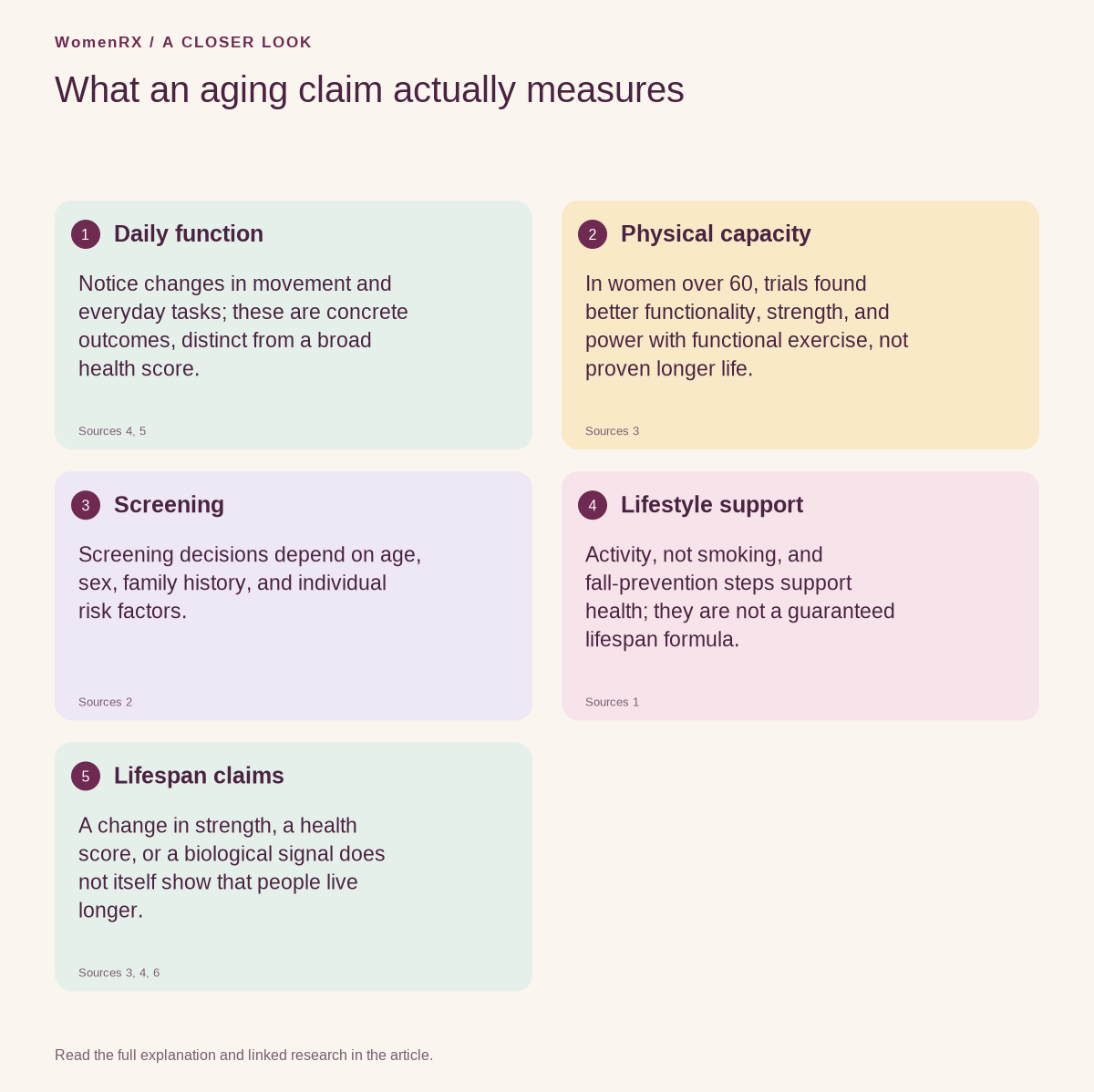
What an aging claim actually measures
Daily function: Notice changes in movement and everyday tasks; these are concrete outcomes, distinct from a broad health score.45
Physical capacity: In women over 60, trials found better functionality, strength, and power with functional exercise, not proven longer life.3
Screening: Screening decisions depend on age, sex, family history, and individual risk factors.2
Lifestyle support: Activity, not smoking, and fall-prevention steps support health; they are not a guaranteed lifespan formula.1
Lifespan claims: A change in strength, a health score, or a biological signal does not itself show that people live longer.346
Read the figure as text
Separate outcomes that can guide a practical conversation from claims that go beyond the evidence.- Daily function: Notice changes in movement and everyday tasks; these are concrete outcomes, distinct from a broad health score.45
- Physical capacity: In women over 60, trials found better functionality, strength, and power with functional exercise, not proven longer life.3
- Screening: Screening decisions depend on age, sex, family history, and individual risk factors.2
- Lifestyle support: Activity, not smoking, and fall-prevention steps support health; they are not a guaranteed lifespan formula.1
- Lifespan claims: A change in strength, a health score, or a biological signal does not itself show that people live longer.346
More questions, answered
Does improving strength mean you’ll live longer?
Not by itself. The trials in women over 60 found improvements in functionality, strength, and power, but those outcomes do not demonstrate longer lifespan. 3
Should everyone get the same health screenings as they age?
No. Which screenings are appropriate depends on age, sex, family history, and individual risk factors. 2
Sources you can check
- Healthy Aging: MedlinePlusAccessed 2026-09-25Return to first citation
- Health Screening: MedlinePlusAccessed 2026-09-25Return to first citation
- The effects of functional exercise on healthy aging in women over 60 years of age: A systematic review and meta-analysis.Rodríguez-Otero H, Hernandez-Lucas P, Lopez-Barreiro J, Leirós-Rodríguez R. · Archives of gerontology and geriatrics · 2026Return to first citation
- Impact of the SARS-CoV-2 pandemic on healthy aging and functionality in older Mexican adults: insights from the MHAS cohort.Arroyo-Quiroz C, Alavez S. · Aging clinical and experimental research · 2026Return to first citation
- A Multidimensional Digital Health Platform to Support Intrinsic Capacity and Healthy Aging: Pilot Feasibility Study.Kolakowski M, Lupica A, Bader SB, Ayadi J, Gilardi L, Consoli A, Mocanu IG, Cramariuc O, Ferrazzini L, Reithner E, Velciu M, Borgogni B, Rivaira S, Antognoli L, Leonzi S, Felici E,... · JMIR aging · 2026Return to first citation
- Estrogen Receptor-Phytoestrogen Interactions in Health and Aging: A Review on Estrogen Receptor Vascular Actions with Proof-of-Concept Data.Smith B, Myers K, Nigro K, Bao S, Yu X, Han G. · Nutrients · 2026Return to first citation