CJC-1295 Claims for Women: What the Research Shows
CJC-1295 raises growth hormone levels in short human trials, but that result doesn’t establish a health benefit for women.
Short randomized trials in healthy adults found that CJC-1295 increased growth hormone and IGF-I levels. They did not establish improvements in health outcomes for women, and the published abstract reports no women-specific results.2 Reviews describe performance-related use as investigational.13 In the US, FDA has identified safety concerns with compounded CJC-1295; its appearance on an FDA compounding page is not an approval.45
What the human trials measured
CJC-1295 is designed to stimulate the growth hormone pathway. In two randomized, placebo-controlled trials lasting 28 and 49 days, researchers studied healthy adults and measured CJC-1295 levels, growth hormone, IGF-I and short-term safety. Growth hormone and IGF-I rose after CJC-1295. That shows the compound had a measurable effect on this pathway in the people studied. It does not show that they gained muscle, recovered faster, felt better or aged more healthfully.2
That distinction matters when a claim starts with “raises growth hormone” and ends with “benefits women.” The second statement needs its own evidence: a study measuring the proposed benefit in a relevant population. Reviews of performance and musculoskeletal uses continue to describe CJC-1295 as investigational, rather than an established treatment for those goals.13
What can we say specifically about women?
The trial abstract describes participants as healthy adults aged 21 to 61, but does not report how many were women or provide results separated by sex. It also does not say whether pregnant or breastfeeding people were included or excluded. Those details cannot be filled in by assuming the adults studied represent women at every life stage.2
There are several separate questions here. Did any women have the same measured hormone response? Did that response improve an outcome women care about? Would the findings apply during pregnancy, breastfeeding, perimenopause or postmenopause? The reported trial results do not answer those questions. In particular, a short-term hormone study cannot establish pregnancy or breastfeeding safety, nor can it turn a proposed menopause or body-composition benefit into a demonstrated one.2
Why a short trial cannot settle safety
The investigators reported no serious adverse reactions in their short trials. That is a useful observation about those studies, not a guarantee for longer use or for products sold outside a trial.2 FDA separately says it has identified serious adverse events associated with CJC-1295, including increased heart rate and a reaction involving widening of blood vessels throughout the body. FDA also flags potential immune reactions and difficulties characterizing impurities in compounded peptide products, while noting that clinical data are limited.4
These findings need not be forced into a single verdict. A short controlled study can report no serious reactions, while a regulator can identify concerning events and product-quality risks from a wider safety assessment. Neither source establishes how often a particular event occurs in women or whether CJC-1295 caused every reported event.24
What its US product status means for a buyer
CJC-1295 should not be treated as established care for physique, athletic performance or injury recovery. Reviews describe those uses as investigational and do not establish a proven clinical benefit.13 FDA’s discussion of CJC-1295 concerns compounded drugs made from the bulk substance and identifies potential significant safety risks. A substance being named on that page does not mean FDA has approved a CJC-1295 drug, endorsed a compounded preparation or checked what is in a product offered for sale.45
That last distinction is practical. “CJC-1295” on a website or vial is a product claim, not evidence that its contents match the material studied in a trial. If you’re weighing an offer, separate three questions: What outcome is promised? Was that outcome measured in people like you? And what evidence establishes the identity and quality of the specific product? The hormone trials help with the first part of the science, but they do not answer the other two.24
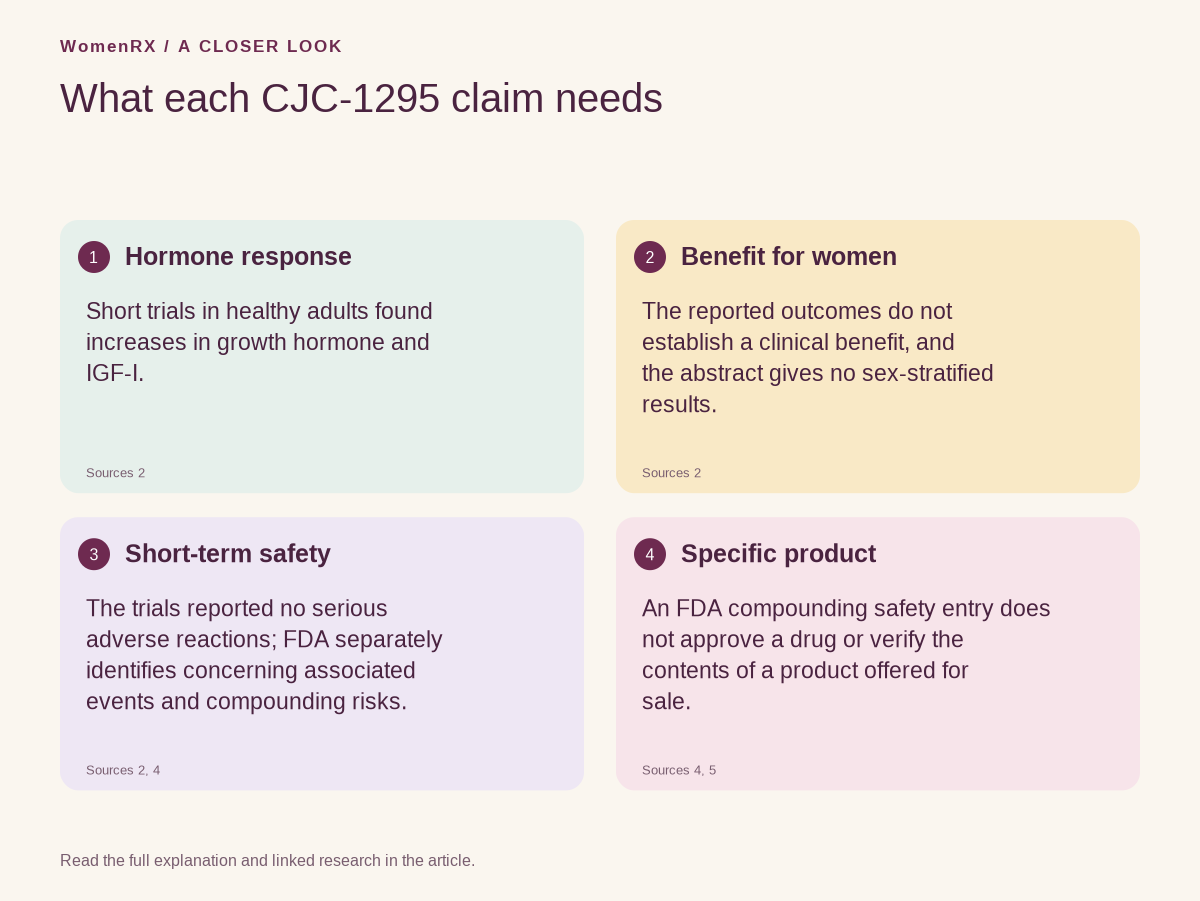
What each CJC-1295 claim needs
Hormone response: Short trials in healthy adults found increases in growth hormone and IGF-I.2
Benefit for women: The reported outcomes do not establish a clinical benefit, and the abstract gives no sex-stratified results.2
Short-term safety: The trials reported no serious adverse reactions; FDA separately identifies concerning associated events and compounding risks.24
Specific product: An FDA compounding safety entry does not approve a drug or verify the contents of a product offered for sale.45
Read the figure as text
The measured hormone effect answers a different question from a promised health benefit or a product-quality claim.- Hormone response: Short trials in healthy adults found increases in growth hormone and IGF-I.2
- Benefit for women: The reported outcomes do not establish a clinical benefit, and the abstract gives no sex-stratified results.2
- Short-term safety: The trials reported no serious adverse reactions; FDA separately identifies concerning associated events and compounding risks.24
- Specific product: An FDA compounding safety entry does not approve a drug or verify the contents of a product offered for sale.45
More questions, answered
Does raising IGF-I mean CJC-1295 builds muscle?
No. The randomized trials reported IGF-I and growth hormone changes as their main outcomes, not demonstrated muscle gains. Reviews still characterize performance-related benefits as uncertain or investigational.213
Sources you can check
- The emerging landscape of performance-enhancing peptides modulating GH-IGF1 axis: bridging the gap between clinical evidence and patient self-administration.Dominikowski A, Rękoś Z, Olejarz M, Szczepanek-Parulska E, Domin R, RuchaŁa M. · Frontiers in endocrinology · 2026Return to first citation
- Prolonged stimulation of growth hormone (GH) and insulin-like growth factor I secretion by CJC-1295, a long-acting analog of GH-releasing hormone, in healthy adults.Teichman SL, Neale A, Lawrence B, Gagnon C, Castaigne JP, Frohman LA. · The Journal of clinical endocrinology and metabolism · 2006Return to first citation
- Injectable Peptides in Sports Medicine: A Structured Narrative Review of Evidence, Safety, and Antidoping Implications.Villegas Meza AD, Nocek M, Mitchell BC, Lizarraga M, DeFoor MT, Ruzbarsky JJ, Huard J, Philippon MJ. · JBJS reviews · 2026Return to first citation
- Certain Bulk Drug Substances for Use in Compounding that May Present Significant Safety Risks | FDAAccessed 2026-09-26Return to first citation
- Bulk Drug Substances Used in Compounding Under Section 503A of the FD&C Act | FDAAccessed 2026-09-26Return to first citation